Photo walks revive interest in Indian heritage and culture
Seeing heritage through a lens eye

Photowalks are emerging across the country as an informal way of engaging with local history
With growing availability of mobile phones equipped with most modern cameras, photography is now well within the grasp of practically everyone. Alongside rising number of budding photographers is the growing popularity of photo walks where troupes of wannabe Raghu Rai of India explore their surroundings.
Photowalks are emerging across the country as an informal way of engaging with local history
On a bright sunny evening in November, a group of 30 persons gathered at the Deer Park, a green oasis in the heart of Hauz Khas, in South Delhi, known for its long walking trails, lake and duck park.
Though they had all gathered at a given time and place, none of the participants knew each other, yet they had all gathered for the same purpose, to imbibe some of the most beautiful but little known bits of heritage left standing in the national capital.
The group was soon divided into smaller teams which engaged in interactive activities to mingle and get to know one another. Then, they began exploring the area around them, moving from the crowded streets to quieter parts of Hauz Khas, where a number of artists sat by the roadside displaying their art.
Soon enough, each of the 30 persons began clicking photographs of the artists and their art, while talking to the artists about their own stories and the stories that their artworks tried to tell.
Also Read: World Photography Day 2020: Picturing the pandemic
After exploring the by-lanes of the area, which has emerged as a chic art district of Delhi, the amateur photographers decided to extend their experience together by heading for an impromptu meal at a restaurant sharing their own perceptions of the evening and understanding of the deeper history embedded within art and the neighbourhoods that cradle it.
Over the past few years, the concept of photo walks, like the one experienced by the group in Hauz Khas, has caught on not just in Delhi, but across the country.
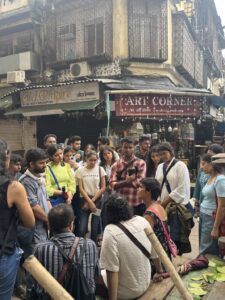
Photowalks have emerged in different cities across the country
A photo walk is a collective experience in which participants walk through neighbourhoods, markets or heritage areas with cameras or smartphones, photographing details that capture their attention. Photo walks have gained popularity across major cities as an engaging and informal way of engaging with local history, architecture and community life.
Photo walks help individuals discover elements of culture that are often overlooked in the humdrum of daily routines. As cities expand and redevelop, these walks have become a method of reconnecting people with their surroundings. They encourage participants to slow down, explore and interact with built environments and social settings, fostering awareness of both tangible and intangible heritage.
Though it may have caught the fancy of the people now, photo walks are not new as their origin dates back to the 19th century when the British initially used the skill for documentation.
Gradually, photographers started gathering at a spot to document their surroundings in an informal manner, which also built the future of the activity in the country.
In 2010s, photo walks were held across unexplored parts of cities across India to help people engage in the history of capturing India’s rich and diverse culture. These photo walks were usually held in narrow streets or heritage corners, reconnecting the people, young or old, with their roots through photography.

On a photo walk, anything can make for a good photo
Among the organisers of photo walks in India is Karan Singh Gahlot, a multi-disciplinary artist and founder of Mannghadant, a visual arts community that focusses on creating platforms for artists to refine their skills and engage with peers through activities such as photo walks, documentary-making and sketching sessions.
“The idea of starting a photo walk came to my mind two years ago. I hail from Jaipur and as a child I often used to go out with my parents to heritage sites. While there is so much known in every city, there is also a lot left unexplored. The main aim behind this was to bring together a community sharing the same passion and love for history and culture,” Gahlot tells Media India Group.
“Culture and heritage of a city are things which are viewed with a new and different dimension by every person. Photo walks help carve in a photo in the moment and a moment of nostalgia in the future. While photo studios are now dying, these photo walks are a new way of keeping alive culture and keep alive the passion of photography,” Gahlot adds.
Kashvi Kapoor, a student at the Delhi University and the Delhi representative for Manngadhant, believes that photo walks have a booming future ahead.
“Photo walks have been curated for exploring the city through a different lens and to understand what the city actually holds. I believe cities are picking up on this and it definitely has the potential to grow more,” Kapoor tells Media India Group.
Rupanshu Juneja, street and sports photographer who was a part of the photo walk says that the experience reminded him that photography was not just about images but also experiences and connection.
“The photo walk at Hauz Khas was a refreshing creative break. It helped me understand the area from a different and completely new lens, and also allowed me to meet strangers who felt like a community,” Juneja tells Media India Group.
Also Read: Nature Photography Day 2017
As urban environments continue to evolve, photo walks are being recognised as more than documentation exercises. They serve as opportunities for individuals to rediscover personal and collective histories, broaden cultural awareness and strengthen connections to place and identity.
Through the images captured, participants link the past, represented by heritage structures, traditions and stories, to the present act of exploration. These photographs become resources for learning and reflection, demonstrating that heritage extends far beyond monuments and is embedded in the everyday movements, textures and interactions that define urban life.