Galdan Namchot: Ladakh’s landmark winter festival
A tradition that sustains continuity

Galdan Namchot links families to monasteries, connects generations living in the same household, and ties villages to a shared calendar
In mid-December, the Union Territory of Ladakh marks Galdan Namchot signalling the beginning of its winter festive season. It is a day when homes and monasteries light lamps, share meals and follow quiet rituals that bring the community together.
Galdan Namchot links families to monasteries, connects generations living in the same household, and ties villages to a shared calendar
Galdan Namchot, that marks the birth and enlightenment of Je Tsongkhapa, signals the start of Ladakh’s winter festive cycle. The festival brings homes, monasteries and entire neighbourhoods into a shared routine of lighting lamps, offering prayers and gathering for simple winter meals. In a season defined by long nights and slow movement, it becomes a source of connection and continuity.
On December 14, Ladakh will enter a period of winter celebration. Galdan Namchot, a festival observed across Buddhist communities in the region. It commemorates the birth and enlightenment of Je Tsongkhapa, the scholar-saint whose teachings shaped the Gelug school. While the religious meaning is central, in Ladakh the festival carries a community function that has grown over generations. It opens a season of gatherings, visits, meals and rituals that continue until Losar, the Ladakhi New Year.
In the weeks leading up to Galdan Namchot, preparations begin quietly, picking up pace as the date approaches. Shops in capital Leh and in villages start stocking butter for lamps, ceremonial scarves, local produce and traditional food ingredients. There is an increase in household movement as lamps are checked, prayer rooms cleaned and supplies stored. Winter in Ladakh is long. Days shorten, temperatures fall and routine slows down. A festival at this time is not incidental it is a way of maintaining rhythm in a period defined by stillness.
Unlike urban festivals elsewhere in India, Galdan Namchot is not driven by spectacle. Its significance lies in participation. Every home, every monastery and most public buildings become part of the observance. The lighting of butter lamps is the most visible act, but the festival is also built on smaller decisions making food together, inviting neighbours, exchanging khatak (ceremonial scarves) and preparing offerings for prayer.
Around dusk, lamps begin to appear across Ladakh. First in monasteries, then in homes. The act is simple: a small flame lit in butter or oil. Yet, simplicity does not mean casualness. For many, it is a gesture of gratitude, remembrance and clarity. The festival honours Je Tsongkhapa not through elaborate performance, but through repetition of what he symbolises learning, reflection, ethical conduct.
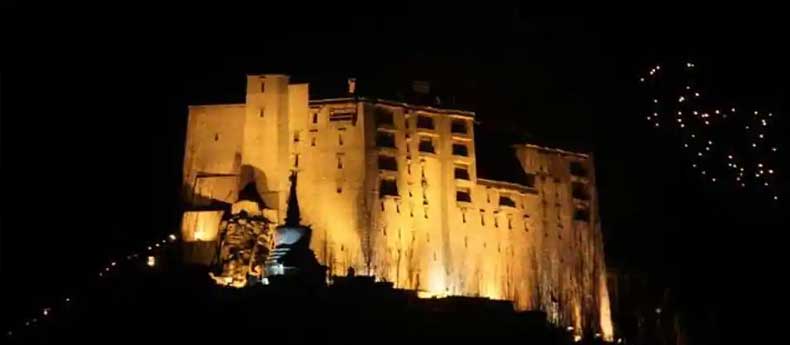
The lighting of butter lamps is the most visible act, but the festival is also built on smaller decisions making food together, inviting neighbours and exchanging khatak
Inside monasteries, monks chant prayers, recite teachings and reflect on Tsongkhapa’s life. The prayers are not meant to entertain. They are meant to anchor the community’s memory. Young monks observe seniors and learn how to conduct rituals, how to prepare lamps, and how to lead prayer in the years that will follow. In Ladakh, where oral transmission and lived practice matter as much as written history, festivals become classrooms.
On the day of Galdan Namchot, most Ladakhi households prepare foods that are specific to winter. Thukpa, momos, butter tea and traditional breads form a common menu. Families gather early because evenings are short in December. Meals are shared, not served in a formal pattern. Children help in kitchens or carry lamps to the rooftop. Elders sit in central rooms where stoves burn steadily through the night.
What stands out during Galdan Namchot is not the variety of food but the way it is eaten slowly, in groups, without hurry. In a landscape where movement reduces in winter, human presence becomes more valuable. People visit relatives, exchange greetings, catch up on news and discuss agricultural concerns, water availability, or school admissions. Festivals like this often double as informal community meetings.
Galdan Namchot falls on the 25th day of the 10th month in the Tibetan lunar calendar. The date shifts in the Gregorian calendar in 2025, it aligns with December 14. The alignment is watched carefully each year. Monasteries, cultural organisations and village councils announce the date in advance so that travel, procurement and household planning can be managed. This matters in a region where accessibility in winter is affected by weather, road conditions and early snowfall.
The connection between the festival and the winter season is not symbolic alone. For generations, people used festival cycles to measure time. Even today, many Ladakhi families recall events by linking them to festivals rather than specific dates. Galdan Namchot is identified as the point where winter has settled but the community has not withdrawn into isolation. It is winter’s beginning, not its peak.
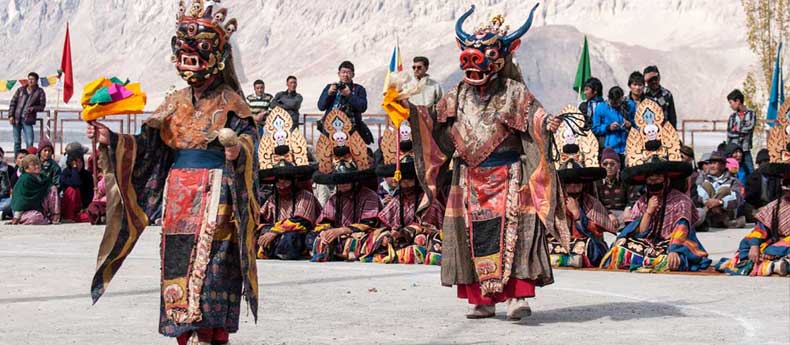
Galdan Namchot marks the birth and enlightenment of Je Tsongkhapa, signals the start of Ladakh’s winter festive cycle.
Visitors in Ladakh during Galdan Namchot often notice the quiet organisation. There are no loudspeakers, no fireworks and no public stages. Instead, the shift happens through gradual illumination. A lane brightens, then a rooftop, then a monastery at a distance. By evening, traveller walking through Leh find corners lit by rows of small flames. One does not need to enter a monastery to witness the festival; the community brings it into the open.
In recent years, Ladakh has faced environmental and political challenges. Water availability fluctuates. Winters are sometimes harsher, sometimes unpredictable. Young people move out for education and jobs. The festival, in this context, does more than honour a spiritual teacher it reinforces continuity. It reminds residents that their identity is not seasonal.
Galdan Namchot links families to monasteries, connects generations living in the same household, and ties villages to a shared calendar. It is a point where the individual becomes part of the collective. Even those who have moved to cities return home if possible, because the festival carries the weight of belonging.
By late night on December 14, Ladakh will not be jubilant in the conventional sense. The celebration is reserved, steady and structured. Lamps continue to burn. Prayer rooms remain open. Households wind down slowly, aware that the festival marks not an end but a beginning. The weeks leading to Losar will bring more gatherings, dances, and rituals.
Galdan Namchot does not demand a spectacle. Its strength lies in repetition across time. The flame that burned this year burned last year, and will burn next year. It is continuity without noise.