
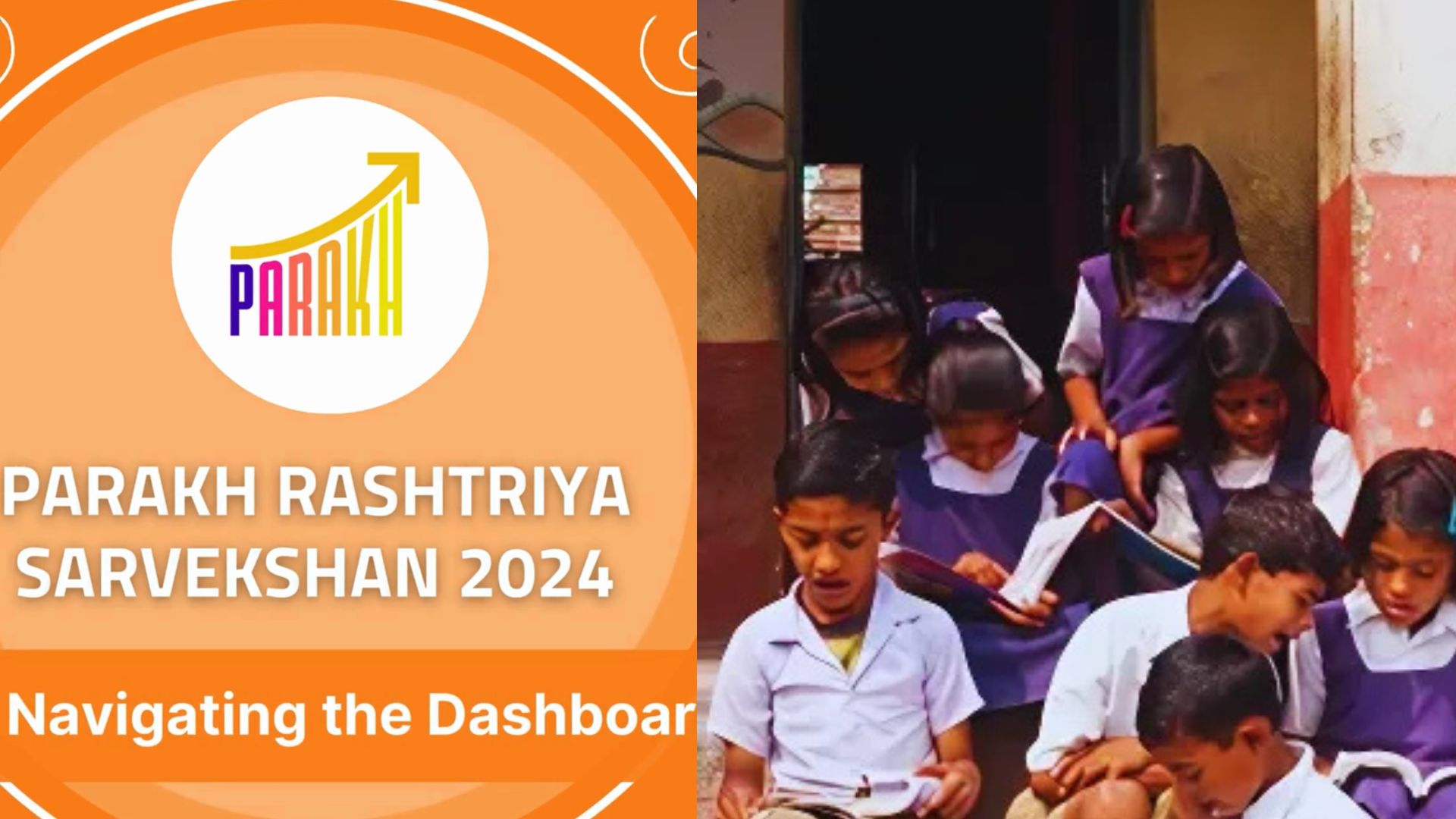
Evaluating over 2.1 million students across 781 districts and over 74,000 schools, this nationwide assessment revealed how far India’s schoolchildren lag in basic learning outcomes
On July 1, 2025, India received a stark reality check from its classrooms. The country’s top educational body, National Council for Educational Research and Training (NCERT), released results of its survey, Performance Assessment, Review, and Analysis of Knowledge for Holistic Development (PARAKH), the biggest such exercise in the nation. Evaluating over 2.1 million students across 781 districts and over 74,000 schools, this nationwide assessment revealed how far India’s schoolchildren lag in basic learning outcomes.
Students in Grades III, VI and IX were tested in language and mathematics, while subjects like environmental studies, science, and social science were added for older grades. Alongside, over 270,000 teachers and school leaders also contributed their perspectives.
The numbers tell a worrying story. Only 28 pc of students could apply percentage concepts in math, just 54 pc could summarise key ideas from a passage, and less than two-thirds could understand short stories. While minor gains since 2021 were observed, such as Grade III language scores rising to 64 pc, they still lag behind pre-pandemic benchmarks.
A system stretched thin
India’s sprawling education ecosystem serves over 248 million school students. With a median age of 29 and 12 million youth entering the workforce annually, at a time when most developed economies around the world are facing acutely ageing and shrinking populations, India should ideally be poised for a demographic dividend. But if the young citizens continue to emerge from schools without basic literacy and numeracy, the dividend could turn into a disaster.
This concern is echoed in the Annual Status of Education Report 2024 (ASER) report. Just 23.4 pc of Grade III government school students can read a Grade II-level text, a modest rise from 16.3 pc in 2022, but still reflecting that nearly four in five cannot. Only 33.7 pc can solve basic subtraction. In higher grades, half of Grade V students struggle with basic vocabulary like ‘humans’ or ‘plants’. These figures point to a persistent foundational crisis.
Worryingly, this learning deficit exists alongside a steep 8 pc drop in enrolment in elementary schools between 2021 and 2023, according to Ministry of Education data. Large states like Uttar Pradesh, Rajasthan, and Maharashtra accounted for the bulk of this decline, indicating not just a learning crisis, but a growing crisis of access to education as well.
According to news reports, 23 states and union territories have recorded a drop in government school enrollments, with Uttar Pradesh seeing the sharpest fall. This erosion in public school participation, which often is the only viable schooling option for children from low-income families threatens to further marginalise students from underprivileged backgrounds.
Policy vision vs classroom reality
According to Upasha Kumari, Education and Public Policy specialist in New Delhi and the lead author of forthcoming book titled Creativity and Critical Pedagogy in Education, she notes that the problem is rooted not just in pandemic-era disruptions, but in years of chronic neglect. “The extended school closures during the pandemic really brought India’s digital divide into sharp focus. Students without reliable access to devices or the internet were left far behind, many never caught up,” Kumari tells Media India Group.
She explains that while the National Education Policy (NEP) 2020 lays out a progressive vision, it is largely aspirational without corresponding pedagogical investments.
“Teacher training is not evolving fast enough to meet the needs of foundational literacy and numeracy. The NEP 2020 sounds promising, but without strong, ongoing pedagogical support, it just does not go far enough,” adds Kumari.
Mounting burden on teachers and schools
Indeed, India’s teachers are expected to deliver results without adequate tools. Schools remain under-resourced, overcrowded and at odds with the Right to Education (RTE) Act mandates. “Many schools do not have even basic materials. Then there are structural issues, poverty, poor nutrition, overcrowded classrooms, and children being taught in unfamiliar languages. All of this makes learning difficult, especially in early years,” adds Kumari.
The numbers reflect these challenges. According to Unified District Information System for Education Plus (UDISE+ data) of 2021–22, Delhi has the worst pupil-teacher ratio in the country at the upper primary level 33:1, well above the RTE-prescribed 30:1. At the primary level, only Bihar fares worse.
And beyond ratios, India has nearly 120,000 schools that operate with just one teacher, according to news reports. This staggering figure reflects a systemic teacher shortage that leaves millions of children without consistent instruction or individual attention, conditions that virtually guarantee poor learning outcomes.
In private schools, teacher numbers have declined steadily over the past three years, even as student enrollments in government schools have surged post-pandemic. These shifts further burden public institutions, already stretched to the limit.
When the cracks first appeared
While Covid-19 made the gaps more visible, foundational learning problems have long existed.
“This challenge predates the pandemic. ASER data show Grade III reading proficiency stagnated at 24 pc between 2012 and 2014. There were modest gains by 2018, but Covid-19 reversed those. By 2022, proficiency had fallen back to around 20 pc,” adds Kumari.
This trajectory is part of a larger trend where students start to fall behind just after Class II. The decline in both reading and math comprehension begins early and worsens with age, making remediation increasingly difficult. Without strong foundational learning, higher-level competencies become near-impossible.
Fixing the foundation
According to Kumari, India’s current focus on large-scale assessments may be putting the cart before the horse.
“If you prioritise testing before building the basics, classrooms turn into exam centres, not learning spaces,” warns Kumari. She recommends an instructional-first approach, with multilingual, activity-based pedagogy supported by proper classroom materials, remedial modules, and trained educators.
“Teachers need to be equipped with diagnostic and engaging strategies, not just syllabi. Only once strong teaching routines are in place should we think of summative assessments. Until then, use low-stakes tools like exit tickets, peer feedback, and observation to track progress meaningfully,” adds Kumari.
Additionally, community and parental engagement must be central.
“When families understand the learning strategies being used, they can reinforce them at home. This is crucial for long-term impact,” adds Kumari.
Role of technology
Ed-tech, often hailed as a silver bullet, has a role to play, but only as a support system, not a substitute. Adaptive learning modules, digital lesson plans, and automated feedback systems can help teachers customise instruction. But the core of learning, especially in early years, remains human interaction.
Kumari also advocates for better capacity-building of school leaders and district administrators. “They need to know how to use classroom data, not just to track scores, but to guide training, allocate resources, and redesign curriculum as needed. Only then can we create a self-sustaining loop of improvement,” she says.
A race against time
India has the potential to reap rich dividends from its youth, but only if the foundation is strong. Current indicators show that millions of children are being pushed through an education system that leaves them unprepared for both higher education and real-world problem-solving. As both PARAKH and ASER make clear, the cracks in India’s education system are not new, but they are becoming deeper. Without urgent, systemic intervention that focusses on learning rather than testing, India risks failing the very generation it is counting on to drive its future.
A country that aspires to be a global powerhouse cannot afford to let its children falter at the first step. Foundational learning is not just an education issue, it is a national imperative.
However, Kumari believes that NEP 2020 inspires a renewed commitment to foundational learning.
“NEP 2020 inspires a renewed commitment to foundational learning. I believe that when educators and all stakeholders collaborate with purpose, even the deepest cracks can be mended. I remain hopeful that we are capable of building lasting change together,” adds Kumari.
