
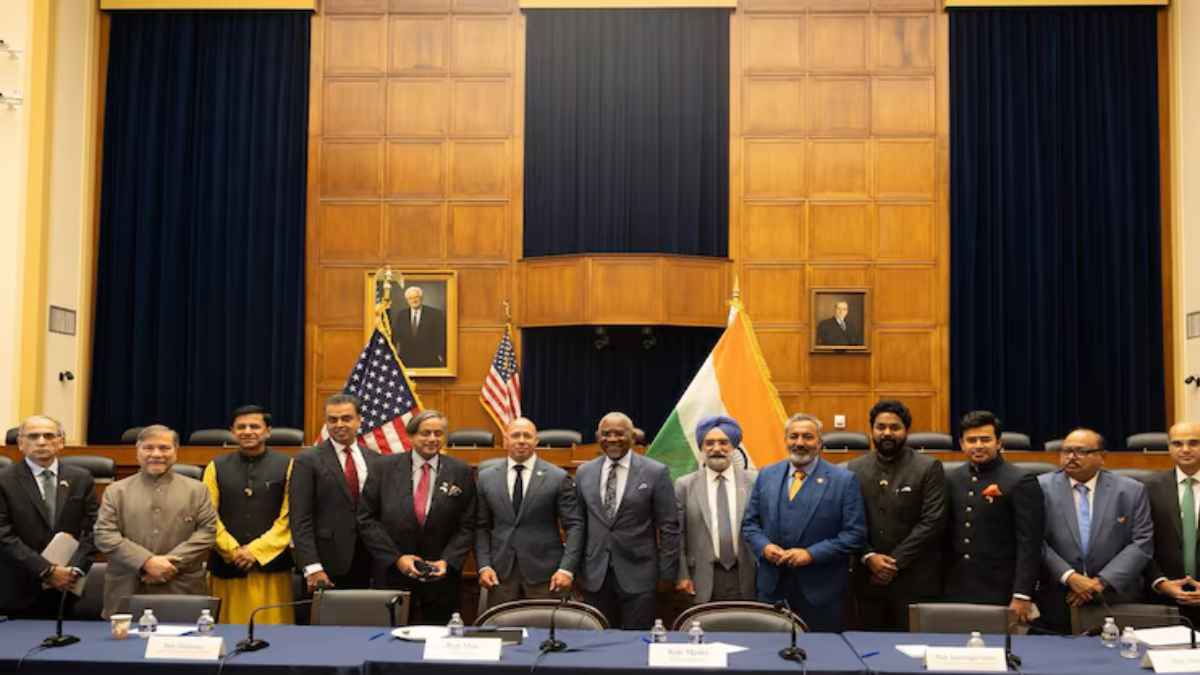
Shashi Tharoor meeting US Congressmen and Senators at Capitol Hill (Photo: Twitter/HouseForeign)
Congress MP Shashi Tharoor’s recent remarks that the Indian diaspora in the United States “is not playing its role in helping India” have ignited a heated debate across political, diplomatic, and diaspora circles. The comment, made during a leadership forum in New York on October 10, sparked strong rebuttals from community leaders abroad, highlighting the complex expectations surrounding the world’s most influential migrant community.
The controversy centres on whether the success of Indian-Americans should lead to sustained and visible political advocacy for India’s global interests, or whether their contribution is more nuanced, encompassing soft power, remittances, and cultural diplomacy.
Speaking at the Indian-American Leadership Forum, Tharoor argued that while the Indian diaspora has achieved extraordinary economic and academic milestones, it has largely failed to mobilise effectively on issues crucial to India’s global standing. He cited anecdotal examples of US lawmakers receiving “no calls from Indian-Americans” when anti-India positions were debated in Congress during the US President Donald Trump administration.
According to Tharoor, “for all our success stories in Silicon Valley, academia, and finance, we are missing a coordinated national voice that defends India’s interests when challenged in global forums.”
His statement implied that the diaspora’s influence, while individually exceptional, has not translated into organized strategic advocacy for India.
This comment touched a nerve in the US, home to nearly 4.7 million Indian-origin people, according to 2023 US Census data.
The Indian diaspora has a median household income of USD 147,000, nearly double the U.S. average. It forms one of the most educated and economically prosperous immigrant groups in America, heavily represented in sectors like technology, healthcare, and entrepreneurship.
Among those who responded sharply was Vibhuti Jha, a Journalist based in New York, who called Tharoor’s remark “devastating and unfair” to millions of Indian-Americans.
“The statement by Shashi Tharoor that five congressmen received no calls from Indian-Americans lobbying against anti-India Trump policies is misleading since those five are less than one percent of the US Congress. It plays into a divisive political toolkit aimed at dividing Indians globally,” Jha tells Media India Group.
He added that Indian-Americans have continuously supported initiatives promoting India’s image, including Prime Minister Narendra Modi’s diaspora events that drew record crowds, over 50,000 attendees at the Howdy Modi event in Houston (2019) and 60,000 at Namaste Trump in Ahmedabad (2020).
“The claim that Indian-Americans do not engage with senators or congressmen is a big lie. Our community contributes significantly through remittances, advocacy, investments, and philanthropy. But our quieter efforts, through policy research groups or community lobbies, are often invisible in Indian media,” Jha adds.
According to Reserve Bank of India data, total inward remittances touched USD 125 billion in 2023, making India the top recipient globally, with over 20 pc attributed to the US-based diaspora.
“Tharoor’s point suggests the diaspora’s success has not fully translated into strategic support for India’s global interests. While many Indian-Americans excel individually, coordinated efforts to shape foreign policy or global narratives about India remain limited. Still, his view may underappreciate softer, long-term contributions,” Swaratmika Dubey, Geopolitical analyst based in New Delhi, tells Media India Group.
She added that the diaspora has historically played pivotal roles when mobilised around national causes.
“The diaspora helped build bipartisan backing for the US, India civil nuclear deal in the early 2000s, boosted FDI flow, and enhanced India’s global image through cultural advocacy. These efforts aren’t declining—they are just less visible today because many Indian-Americans focus on deeper integration within US civic life,” Dubey adds.
According to India’s Department for Promotion of Industry and Internal Trade (DPIIT), cumulative FDI inflows from the U.S. stand at over USD 50 billion, a significant share of which channels through diaspora-led enterprises and venture funds.
Indian-Americans have also been instrumental in founding over 100 unicorns in the US, employing tens of thousands and creating cross-border supply chains that benefit Indian businesses.
“The divergence arises from different expectations: Tharoor likely seeks structured, policy-driven support, while diaspora leaders emphasize cultural outreach, remittances, and community-level aid. It is also shaped by differing roles, politicians look for national returns; diaspora leaders navigate dual responsibilities and more diffuse forms of influence,” says Dubey.
She further noted that as Indian-Americans become politically active, holding elected office in record numbers, their priorities sometimes reflect US domestic realities more than homeland politics.
“This reflects a broader tension where India expects political loyalty or lobbying from its diaspora, while Indian-Americans are carving out independent identities aligned with US civic life. As they gain influence, their policy choices would not always align neatly with India’s, leading to friction in perceived obligations,” says the analyst.
Experts point out that multiple community organisations, from the US-India Political Action Committee (USINPAC) to advocacy groups like the Indiaspora network, routinely engage with American legislators on issues affecting India. However, these efforts rarely attract domestic attention in India.
“Despite success, Indian-Americans are not viewed as a political force because we haven’t exercised that power in unison. But we do collaborate with political organisations to raise India’s issues here. Our silence is often misread as apathy, it is actually strategic restraint,” Jha adds.
“The Indian political class often accuses the diaspora of selfishness or abandonment. That is inaccurate and creates deep frustration. We need recognition of diverse contributions and a more collaborative, less divisive rhetoric,” he says.
The Tharoor debate shines a light on a larger evolution, the gradual shift from emotional homeland loyalty to balanced, civic-driven engagement. Today’s second-generation Indian-Americans contribute to India’s growth not just through politics, but through technology exchange, philanthropy, and education initiatives involving institutions like IIT Alumni Associations and the Pratham Foundation.
“India’s global rise will inevitably be supported by its diaspora, even if the contribution comes less through noisy lobbying and more through sustained, quiet influence,” Dubey added.
