
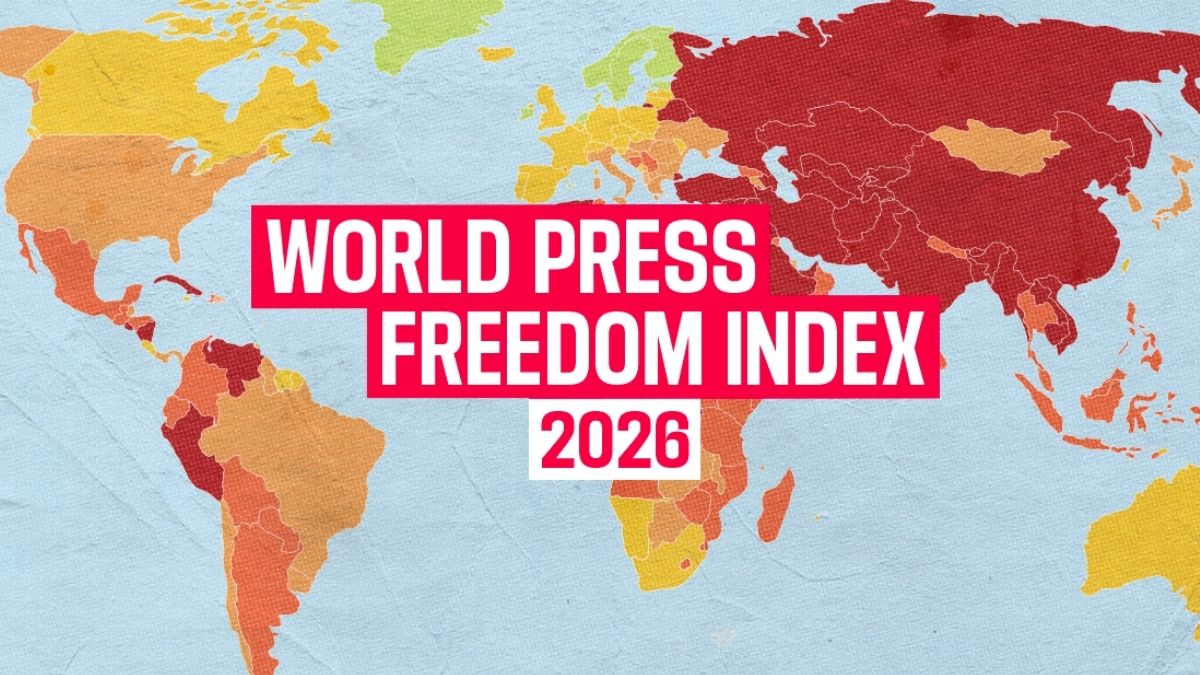
Across the Asia-Pacific, 21 of the 32 countries and territories assessed are classified as having a “difficult” or “very serious”
In India, press freedom remains under pressure, with the country ranked 157th in the 2026 World Press Freedom Index released by a Paris-based press freedom organisation, Reporters Without Borders (RSF), a marginal improvement from its 159th position in 2025 but still within the lower tier globally. The report attributes this to the increasing use of legal provisions including criminal defamation and national security laws against journalists, indicating sustained judicial pressure on independent media.
In a press statement, RSF says that the trend reflects a broader regional pattern. Across the Asia-Pacific, 21 of the 32 countries and territories assessed are classified as having a “difficult” or “very serious” press freedom situation.
Also Read: RSF flags India’s Data Protection law over information access concerns
RSF highlights how governments are relying on legal tools such as terrorism charges, cybersecurity laws, and strategic litigation to regulate and restrict journalism.
The statement adds that at the bottom of the Index, North Korea ranked 179th remains closed to independent journalism, while China ranked 178th continues to detain journalists under national security laws, with 121 media professionals currently imprisoned.
Similar legal approaches are evident in Vietnam ranked 174th and Myanmar ranked 166th, where cybersecurity laws are used to control online content and prosecute journalists. In Afghanistan ranked 175th, restrictions imposed since 2021 continue to limit media operations and shape public narratives.
RSF says that in Pakistan which ranked 153rd, the press operates under ongoing restrictions amid political tensions. In the Philippines which ranked 114th, terrorism-related charges have been used against journalists, with the case of Frenchie Mae Cumpio cited as a prominent example of prolonged detention.
Also Read: Online harassment of women journalists intensifies in India: RSF
Other Southeast Asian countries, including Indonesia at 129th, Singapore at 123rd, Malaysia at 95th and Thailand at 92, continue to see the use of strategic lawsuits against public participation (SLAPPs), often initiated by political or corporate actors.
According to RSF in more established democracies, legal provisions also remain a concern. Japan at 62 continues to enforce a state secrecy law affecting reporting, while South Korea at 47 has introduced measures targeting misinformation that have drawn criticism. No country in the Asia-Pacific region features in the global top 20. New Zealand at 22 remains the highest-ranked, followed by Taiwan at 28, Timor-Leste at 30 and Australia at 33.
