
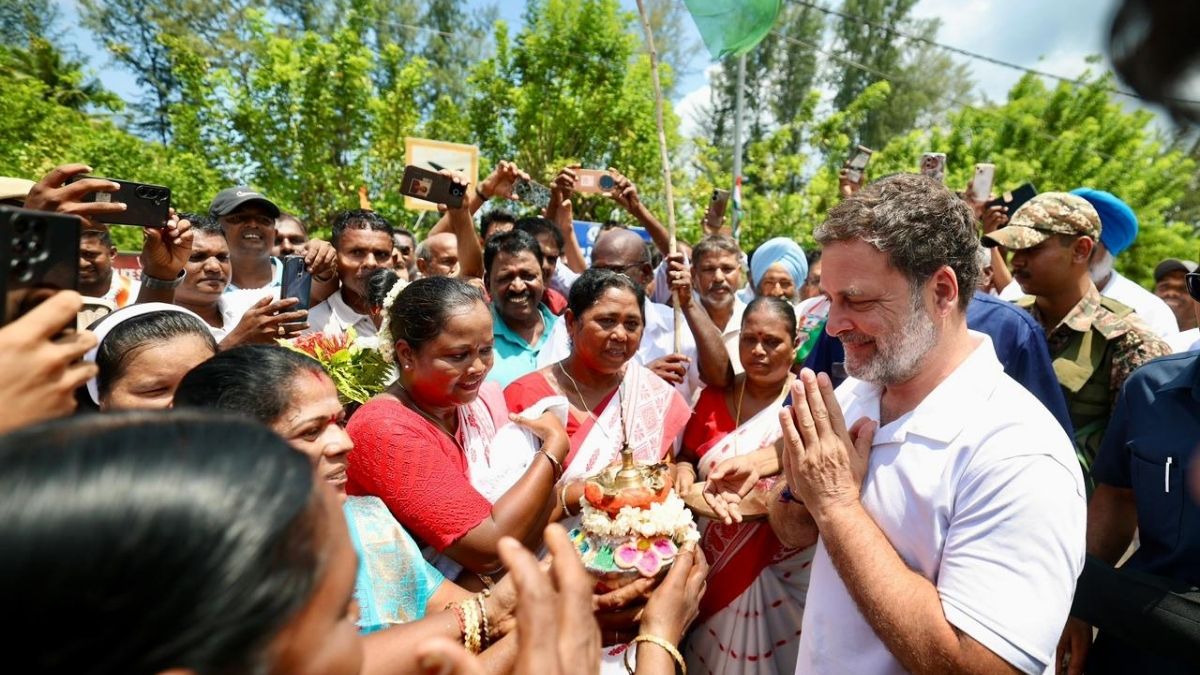
Rahul Gandhi interacts with Indigenous Nicobarese residents during his visit to Great Nicobar Island (Photo: Indian National Congress)
Attempts by Indian authorities to obstruct Rahul Gandhi, Leader of the Opposition in Lok Sabha, from visiting Great Nicobar Island failed as Gandhi managed to reach the ecologically-sensitive area to highlight concerns over a major project that the government claims will make the archipelago a major defence, tourism and shipping hub, but which critics say will ruin the islands and threaten the existence of the local tribes, including the Shompen, which remains in isolation in the rainforests here.
The rights groups and environmental activists argue it could lead to large-scale deforestation, disruption of fragile ecosystems and displacement or severe harm to indigenous communities. Concerns have particularly focussed on the Shompen, a vulnerable and mostly uncontacted tribe whose survival depends on the island’s forest environment.
In a press statement, Survival International, a global indigenous rights organisation, says that the project poses severe risks to the region’s indigenous communities and environment, including the Shompen.
According to the statement, attempts to prevent Gandhi’s visit were part of an effort to limit political scrutiny at a time when opposition to the project is growing among indigenous rights groups and environmental campaigners.
“As well as devastating the local environment and the Nicobarese indigenous communities, the Great Nicobar project would destroy the Shompen. Rahul Gandhi’s visit highlights mounting opposition to this ill-conceived project, which must be cancelled before an entire people are wiped out,” says Sophie Grig, Director of Asia and Pacific campaigns, Survival International.
“Thirty-nine genocide experts from around the world have agreed that the Mega Project planned for Great Nicobar is a death sentence for the Shompen, tantamount to the international crime of genocide,” adds Grig.
Also Read: Richard Gere to launch Survival International report on uncontacted tribes
Gandhi, too, said that the government had made every effort possible to stop his visit, including stopping air services to the island.
“There were attempts to stop me, permission was not being given. A Notam (Notice to Airmen, an aviation advisory restricting airspace use) was put in place, different excuses were made, but I came and now I am happy to be among you,” Gandhi said in his social media feed.
According to Gandhi, development must empower people, not erase them. “I will make every effort and the Congress Party will make every effort, to help you and to protect your land and your future,” Gandhi promised the locals during his visit.
“I travelled through Great Nicobar today. These are the most extraordinary forests I have ever seen in my life. Trees older than memory. Forests that took generations to grow. The people on this island are equally beautiful – both the adivasi communities and the settlers – but they are being robbed of what is rightfully theirs. The government calls what it is doing here a Project. What I have seen is not a project. It is millions of trees marked for the axe. It is 160 sqkm of rainforest condemned to die. It is communities that have been ignored while their homes have been snatched away. This is not development. This is destruction dressed in development’s language. So, I will say it plainly, and I will keep saying it: what is being done in Great Nicobar is one of the biggest scams and gravest crimes against this country’s natural and tribal heritage in our lifetime. It must be stopped. And it can be stopped – if Indians choose to see what I have seen,” added Gandhi in his post.
According to Survival International, attempts to restrict access to the island, including reported administrative hurdles and airspace-related restrictions, have raised further questions among activists and rights groups about transparency surrounding the project.
Survival International adds that it holds extensive documentation on the impact of the project, including expert analysis, field material, photographs and video evidence, and continues to monitor threats to the Shompen and other Indigenous communities.
