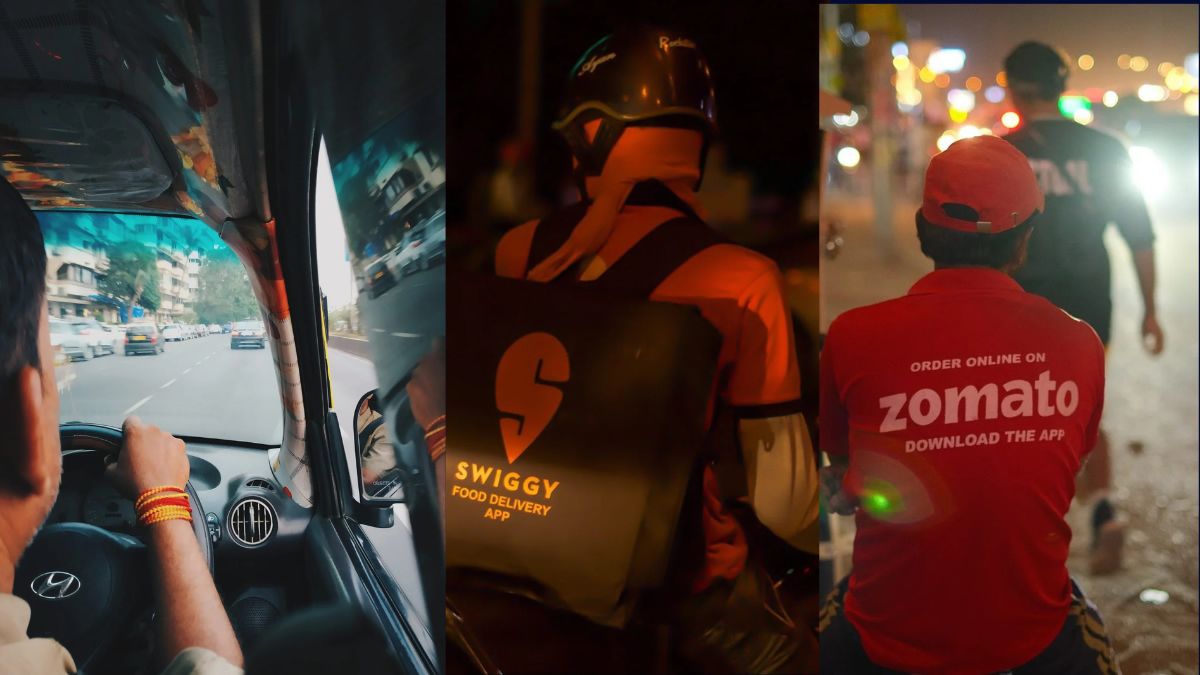
Telangana Government seeks to establish a social security framework for workers in an industry where employment arrangements, earnings and access to labour protections remain uncertain (Photo: TGPWU)
Unions representing gig economy workers with several aggregators and delivery platforms have welcomed a new social security initiative in Telangana for gig and platform workers that offers INR 500,000 in life insurance and INR 1 million in health insurance, alongside a transaction-linked contribution of 1 pc from aggregators on deliveries, bringing the financial responsibilities of platform companies into focus.
The initiative by the Telangana Government seeks to establish a social security framework for workers in an industry where employment arrangements, earnings and access to labour protections remain uncertain.
However, there is little clarity on how the state will collect and manage contributions, identify eligible workers, enforce payments by aggregators and ensure that benefits reach those who need them. It also puts the spotlight on whether delivery platforms, which depend on large networks of independent workers, will have to assume a greater share of the costs associated with their workforce.
Also Read:Karnataka’s ordinance promises rights, recognition for gig workers
For workers, the proposed insurance coverage could provide protection against medical expenses and loss of life. However, trade unions says that insurance alone cannot address the wider problems of unpredictable earnings, long working hours, arbitrary account deactivation and the absence of employment security.
Shaik Salauddin
Shaik Salauddin, Founder and President of the Telangana Gig and Platform Workers Union (TGPWU), which represents gig and platform workers and has campaigned for their labour and social security rights, describes the announcement as a significant development.
“This scheme is a historic milestone in the struggle for gig and platform workers’ rights. For the first time, workers are gaining a legal framework that recognises their identity, dignity, social security and welfare. The provision of INR 500,000 life insurance and INR 1 million health coverage through Rajiv Aarogyasri, along with worker registration, a dedicated Welfare Board and protection against arbitrary account blocking, can provide much-needed security to millions of workers and their families,” Salauddin tells Media India Group.
However, Salauddin says that the initiative must extend beyond insurance if it is to improve workers financial security. He says minimum remuneration, fair payouts, pension benefits, maternity benefits, accident compensation and safeguards against arbitrary deactivation must also become part of the framework.
Also Read: Fragile protections for workers weakened further by New Labour Codes
“We need to ensure that social security is treated as a legal responsibility of aggregators rather than a voluntary contribution or corporate charity. Workers should have access to a digital dashboard showing their registration status, contributions and benefits. Companies must submit mandatory quarterly returns and undergo independent financial audits so that there is transparency about the money collected and deposited. The Welfare Board must actively monitor compliance, with meaningful representation from trade unions and elected worker representatives,” he adds.
Funding and accountability
Nitesh Kumar Das, Organising Secretary of the Gig Workers Association (GigWA), which works on organising platform workers and advocating their labour rights, considers the contribution a starting point for establishing a dedicated welfare fund.
“The proposed 1 pc transaction-linked contribution is a good starting point because it creates a dedicated and predictable source of funding for gig workers welfare. But it is important that the law clearly states that this contribution must come from aggregators and should not be passed on to workers by reducing their earnings. Workers should not end up paying for their own social security through lower delivery payouts or reduced incentives,” Das tells Media India Group.
Nitesh Kumar Das
Das also questions whether 1 pc will be sufficient if the welfare framework eventually includes benefits beyond health and life insurance.
“If we are talking about comprehensive social security, including health insurance, pensions, maternity benefits, disability support and emergency assistance, the funding requirements will be much higher. The contribution should therefore be reviewed periodically based on workers needs and the financial sustainability of the fund. Large digital platforms, particularly those with significant revenues and market dominance, should bear a greater share of this responsibility because they generate substantial value from the labour of gig workers,” he says.
The question of enforcement is equally important. Without access to reliable transaction data and independent monitoring, the state could face difficulties in establishing whether aggregators are making the required contributions. A transparent system would also need to clarify how workers are registered, how their eligibility is established and how benefits are distributed when they work across multiple platforms.
Also Read: No instant gratification for Q-com workers
Salauddin says the Welfare Board must have the authority and resources to monitor compliance, recover unpaid contributions and penalise companies that fail to meet their obligations. He also calls for independent audits, transparent fund management and an accessible grievance redressal system.
A question of decent work
For platform workers, financial insecurity is not limited to medical emergencies or accidents. Their earnings often depend on the number of orders completed, distances travelled, incentives offered and changing payment structures.
Das says these arrangements leave workers without predictable monthly incomes and can encourage longer working hours and unsafe practices.
“Insurance is important, but it is only one part of the solution. What workers really need is decent work, which starts with fair and transparent payments and some form of minimum earnings guarantee. A worker should not have to spend an entire day on the road without knowing how much he will earn. As one Blinkit worker recently told me, ‘Bhaiya, iske liye mujhe mil raha hai INR 10, iske liye mil raha hai INR 30’ (Brother, I am getting INR 10 for this and INR 30 for that).This reflects how payments can vary from one task to another, leaving workers with little certainty about their income,” he says.
He adds that platforms must also be accountable for the incentive systems and algorithms that influence workers daily activities.
“These incentives are not necessarily extra income. Workers often have to extend their working hours and push themselves harder to earn enough. There must be safeguards against excessive working hours, protection against arbitrary account deactivation and transparency about how algorithms determine work allocation, ratings and payments. Workers also need access to drinking water, toilets and rest facilities, along with compensation for work-related injuries and occupational health risks,” Das says.
The issue of registration and access to benefits presents another challenge. Many workers operate across several delivery and mobility platforms, switching between apps depending on the availability of orders and earnings. A welfare system tied to a single aggregator could therefore exclude workers who do not have a permanent association with one company.
Das says that that the government should establish a universal registration mechanism with a portable identification system, allowing workers to access benefits regardless of the platform they work for or the state in which they operate.
“Many workers are aware that welfare schemes exist, but awareness does not necessarily translate into registration or access. This shows that simply sending notifications through applications is not enough. Registration and enrolment must be simplified through both online and offline channels, and workers must be informed about their entitlements in a way they can understand,” he says.
Need to replicate Telangana model nationally
Telangana’s initiative could provide a reference for other states considering dedicated welfare mechanisms for platform workers. However, replication would require a clear legal framework, reliable worker databases, financial accountability and coordination between state governments and aggregators operating across multiple jurisdictions.
Also Read: Industrial workers in India to get cashless payments
Das believes the model has the potential to be adopted nationally, provided states establish minimum standards while retaining flexibility to introduce stronger protections according to local requirements.
“Telangana’s initiative demonstrates that governments can move beyond recognising gig workers in policy documents and begin putting social security provisions into practice. We need a comprehensive national framework that establishes minimum protections across all states while allowing individual states to introduce stronger welfare measures. Platforms must contribute to social security funds, share relevant work-related data, ensure occupational safety and establish effective grievance redressal mechanisms. They must also respect workers’ right to organise and participate in collective dialogue,” he says.
Salauddin agrees that Telangana’s initiative should become the starting point for a wider national framework. He says worker representation and enforcement mechanisms must be built into welfare institutions rather than left to the discretion of companies or governments.
“Our vision is that no gig worker in India should be left without social security, dignity, fair remuneration or protection. Worker unions and elected representatives must have meaningful participation in Welfare Boards, while independent audits, transparent financial management and strict penalties must ensure that companies fulfil their obligations. Telangana’s initiative must become a starting point for a nationwide movement towards decent work and social justice,” he says.