
The Agniveer recruitment scheme has sparked intense public debate and criticism regarding its four-year tenure and limited permanent retention

Chirag Tawade
In June 2022, when the call for recruitment of the first batch of a new type of soldiers for the Indian defence forces was announced, 18-year-old Chirag Tawade, a resident of Mira-Bhayandar, an extended suburb of Mumbai, excitedly turned up hoping to join the coveted ranks of Indian Army, even if only for four years as per the rules for recruitment under a new scheme, Agnipath, whose stated objective was to reduce the average age of personnel in the Indian defence forces and also to reduce the weight of salaries and pensions, that account for nearly 60 pc of the country’s defence budget.
Under the scheme, which opened the doors of the armed forces to young men and women aged between 17.5 and 21 years for a short four-year period, each recruit, known as Agniveer, would begin with a monthly salary of around INR 30,000, which rises to INR 40,000 in the fourth year. Almost 30 pc of the salary is set aside for a savings corpus they receive after completing service. In addition, their accommodation and meals were also provided by the Army.
In a country where jobs are rare and government jobs, even for a short-period, even rarer, many youngsters applied to get in. Tawade was ecstatic when he was selected and joined the force in November 2022. However, four years later, as the first batch of Agniveers prepares to exit the Army, Tawade will not be one of them. And how he was discharged and what happened him next is not a story that the Agniveer recruitment brochures would tell.
Also Read: Forces face moral dilemma over Artificial Intelligence in defence
Just about a year into his service, Tawade suffered a serious shoulder injury during a rigorous physical conditioning exercise. The military medical board evaluated him and concluded the structural damage was permanent he could not safely meet the load-bearing and combat drill requirements that the job needed. He was placed in a permanent Low Medical Category and then medically discharged in August 2023.
But instead of receiving the promised benefits, all that he received at the time of leaving the force was his discharge certificate. Let alone the benefits, he was not even given any clarity on what he could expect next.
“To be honest, a lot of what was promised still feels uncertain on the ground. There are announcements about reservations in government jobs, support from various organisations it sounds good on paper. But many of us are still waiting to see how any of that actually translates into a stable job. The policies are there but the implementation is where it falls apart,” Tawade tells Biz@India.
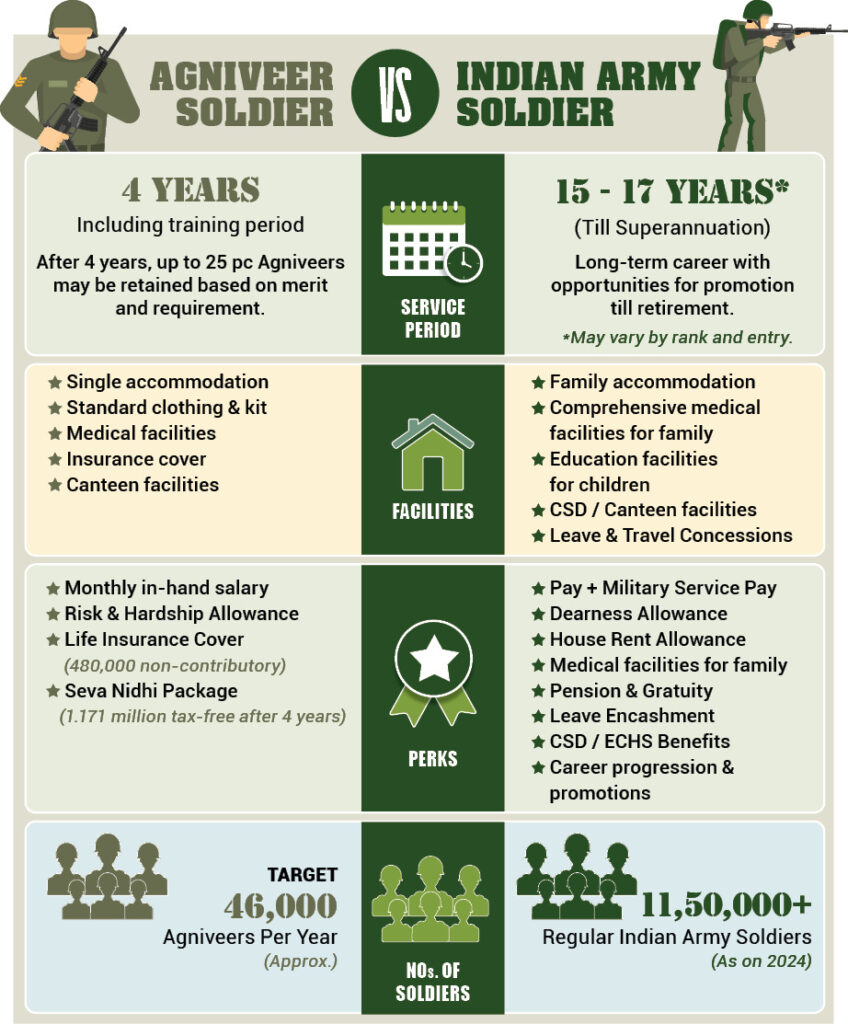
Agniveer soldier vs Indian army soldier (Infographics: Hitesh Mehta | Media India Group )
Tawade is not bitter in the way someone who had to quit under such circumstances could be. He says that he got injured doing what the Army asked him to do. His body gave out under the physical demands of the job and when the medical board closed his file, the system essentially closed his file too.
“My biggest worry right now is job security and I am still figuring out what comes next. I gave everything to this job, my body pays for it, and then I am still standing there with a discharge certificate and nothing else in my hand. For people with families depending on them, that uncertainty hits hard. You need a predictable income. You cannot run a household on a certificate,” says Tawade.
And as Tawade’s former colleagues exit the Army later this year, they may find themselves in the same sea of uncertainty as Tawade. For many young people in India where military service has long been seen as a source of pride, stability and social mobility, the scheme arrived with both hope and uncertainty.
At the end of the four-year term, only 25 pc of the Agniveers are selected for the regular long-term service, while the remaining 75 pc return to civilian life with a tax-free package of around INR 1.17 million and a service certificate and a set of skills that the civilian market is still figuring out how to value.
The government called it a transformational reform. Critics called it a contract labour scheme donning a respectable uniform. About 170,000 Agniveers have been recruited since the scheme was launched across the Army, Navy, and Air Force.
Also Read: Indo-German submarine deal another step in India’s quest for self-reliance
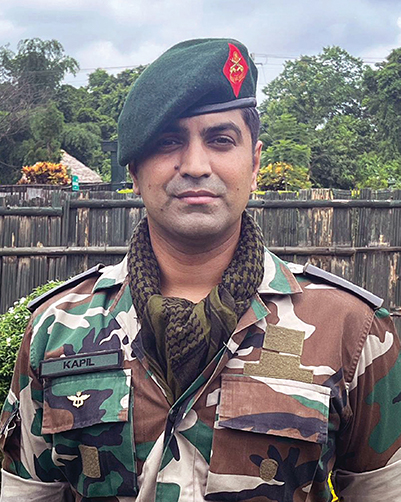
Kapil Singh Shekhawat
The tension inside a unit runs deeper than any policy document says Lt. Colonel Kapil Singh Shekhawat (Retd), a Special Forces veteran who served in counter-insurgency operations in Jammu & Kashmir and field units across challenging terrains.
“Now imagine two soldiers in the same bunk. One knows he belongs here for life. The other knows he has a four-year contract. Both are brave. Both are trained. But their relationship with tomorrow is fundamentally different. It is the difference between a unit that holds its position under fire and one that does not. It cannot be manufactured in a training syllabus. It is built in shared hardships, shared failures, shared victories over years,” Shekhawat, who later served as Joint Director, Procurement, at Integrated Headquarters, Ministry of Defence, tells Biz@India.
According to government, Agniveers are not being abandoned, pointing out that some state governments moved faster than others. Uttar Pradesh, Haryana, Madhya Pradesh, and Uttarakhand have said that Agniveers would get priority in state police recruitment, with reserved seats set aside for them.
On the education side, the Ministry of Education said Agniveers who finish four years will get a Class 12 equivalency certificate through the National Institute of Open Schooling (NIOS). The Defence Ministry also tied up with some universities to run bridge courses, so that those who want a degree have a way in without starting from scratch.
These are not nothing. But they are also not a guaranteed landing. A reserved category in a police recruitment process still means appearing for that process, competing, and clearing it. A bridge course still means years of study with no income. For a 22-year-old from a village in Rajasthan or Bihar who has a family watching and waiting, these are options, not answers, chances, not certitude.
Shekhawat is equally direct about the rehabilitation gap. “Four years sounds like a substantial tenure. But break it down in parts, so six months of basic training, another three to six months of specialist and unit integration training, then operational commitments, leave cycles, courses, exercises. By the time a young soldier has truly found his feet and started contributing at full potential, he is already looking at a depleting window,” says Shekhawat.
Shekhawat adds that every Agniveer who demonstrates merit should have a structured, transparent pathway either to continue in the Armed Forces or to receive priority, institutionally-guaranteed absorption into Central Armed Police Forces (CAPF), state police, or disaster response organisations. Not as a favour. As a national obligation.
Also Read: Global conflicts bring challenges & opportunities for Indian defence industry
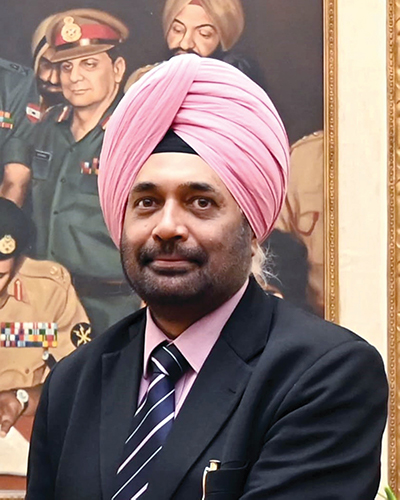
J S Sodhi
On paper, the ecosystem for reintegration exists. In practice, the gaps are significant. Lieutenant Colonel J S Sodhi (Retd), editor of Global Strategic & Defence News, a defence news website, has been one of the more consistent voices raising structural concerns about the scheme. His worry is not just about individual Agniveers, but more about their impact on India’s combat readiness.
“For a soldier to obtain full combat efficiency, he requires at least 8 to 10 years of continuous service. Fighting a conventional war is a very different ballgame than counterinsurgency operations. With 75 pc of Agniveers being phased out after four years, it will create a combat potential void. India is facing a two-front war threat from China and Pakistan that is on the horizon, expected any time after 2030,” Sodhi tells Biz@India.
Sodhi points to comments made last year by General Anil Chauhan, the recently retired Chief of Defence Staff, who flagged the growing proximity of China, Pakistan, and Bangladesh as creating serious security dynamics for India. He also cites General Manoj Pandey, the former Army Chief, who stated at a seminar in Pune that 60 pc would be the optimal retention rate for the scheme, which is significantly higher than the current 25 pc.
“If two employees in the same office are working under different rules different pay, different job security and different futures, there will be heartburn. Now apply that to soldiers living and working together in a unit. The operational consequences are real,” says Sodhi.
The government has not officially responded to calls for revising the retention percentage, though the Defence Ministry has reportedly been apprised of the concerns.
Beyond strategy and combat readiness, there is a quieter, more personal story unfolding in towns and villages across the, Punjab, Rajasthan, Uttarakhand, and the Northeast regions that have historically been the backbone of army recruitment.
Most Agniveers come from rural backgrounds. They joined because the army offered status, income, and a future. When they return without permanent service regardless of their own performance, their communities may not understand the fine print of a government scheme.
“When a soldier goes back to his village after four years without being retained, he will be seen as someone who was not fit enough to be kept. Whether that is true or not does not matter. That is the perception, and it will affect him psychologically,” says Sodhi.
Also Read: RRP Defence secures INR 298 million BEL order for germanium lenses
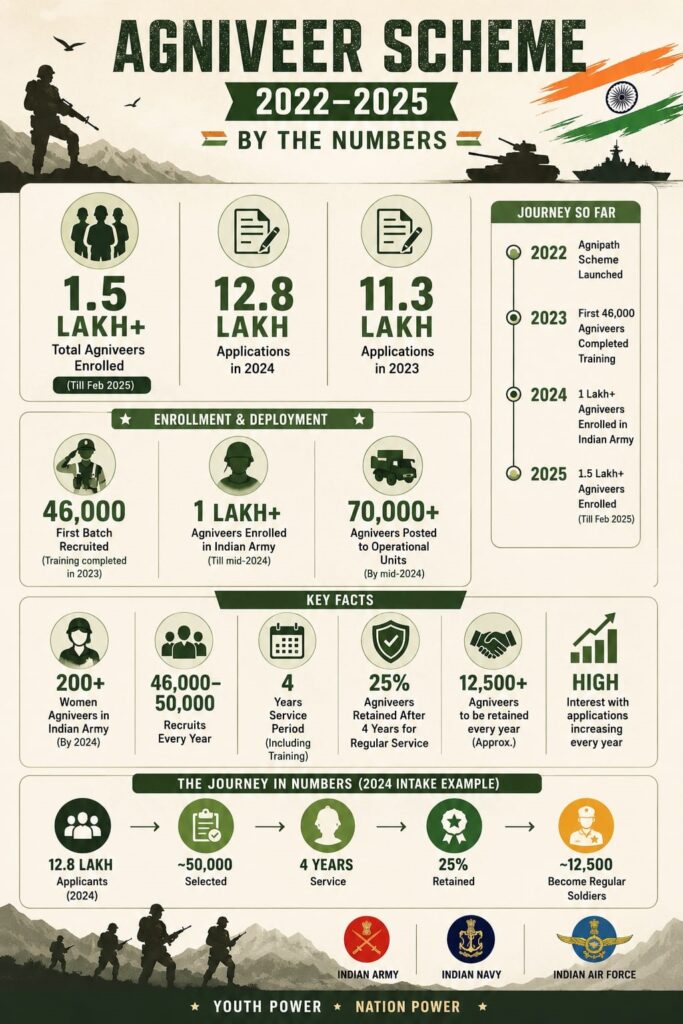
Agniveer scheme 2022-2025 ( Infographics: Hitesh Mehta | Media India Group )
The matrimonial consequences are equally real. In communities where a permanent government job is still the gold standard for marriage prospects, an Agniveer who was not retained will face difficult questions that have nothing to do with his actual service or capability.
Shekhawat, who has seen this pattern repeat across postings and generations of military families agrees. “A military family and millions of families in Rajasthan, Haryana, Punjab, and Uttar Pradesh have generations of military service understands what the uniform means. It means a career, a community, a pension, a lifelong identity. The question every parent in a cantonment town is now asking is: ‘Phir kya hoga?’ What comes after?.” That question, he says, is not cynicism. It is legitimate.
Tawade says that they were not given clear pathways. “Nobody told us here is exactly where you go, here is how your service translates into something real. The assurances were vague. And when you are injured, discharged early, and left to figure it out yourself, vague does not help,” says Tawade.
The structural problems with Agnipath’s current design are not a secret. The 25 pc retention rate is widely considered too low by the military’s own senior leadership. The promise of government reabsorption has not been fulfilled at the scale required. The private sector pipeline is informal and uneven.
General Pandey’s suggestion of 60 pc retention, if implemented, would fundamentally change the scheme’s economics and its social impact. It would also address the combat readiness concerns that Sodhi and others have raised.
For Shekhawat, the fundamental question has a simple logic behind it. “If an Agniveer is good enough to guard India’s borders for four years, why is he not considered good enough to continue serving? That is not a rhetorical question. That is a policy gap that deserves an honest answer,” says Shekhawat.
Meanwhile, 40,000 young men are few weeks away to complete their tenure. What India does with them now and how honestly it confronts the gaps in what was promised will define not just the future of Agnipath, but what a generation of young Indians who wanted to serve their country actually gets in return.