
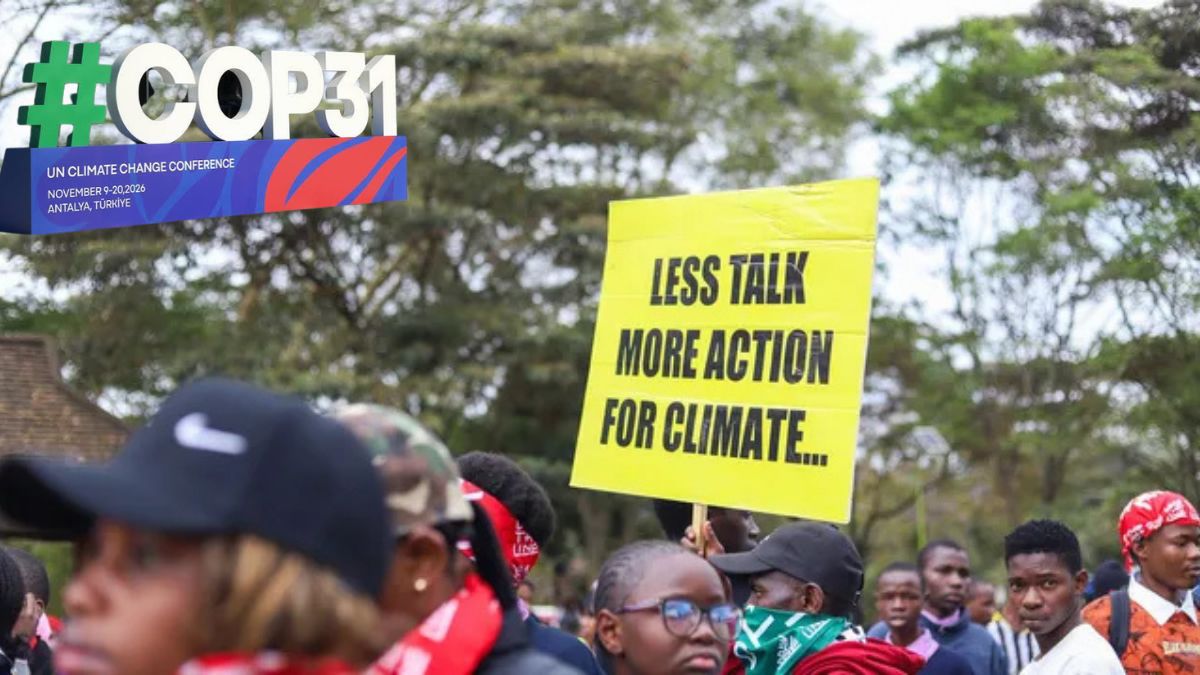
COP31 cover decision proposals open battle over fossil fuel transition and finance (Photo: 350 org)
In a document titled Summary of Reflections, drawing on initial interventions by participating countries at the 31st United Nations Climate Change Conference (COP31), the Presidencies, Australia and Türkiye, have outlined proposals that could shape the summit’s political outcome, with governments expected to respond to the compilation before the first draft of the Cover Decision is tabled early next week for negotiations by ministers.
In a press statement, the COP31 Presidencies says that the compilation places several contentious climate issues on the negotiating table, with governments expected to respond to the proposals before the first draft of the Cover Decision is presented early next week for negotiations by ministers.
One of the key proposals is a 35 by 35 electrification goal, which seeks to advance electrification by 2035. The proposal refers to the use of clean energy sources but does not explicitly link the target to accelerating renewable energy deployment or phasing out fossil fuels, leaving room for other energy sources, including nuclear power.
The document also welcomes the COP30 Presidency’s roadmaps on transitioning away from fossil fuels (TAFF) and halting and reversing deforestation and forest degradation. It reflects calls from several countries to establish a clear pathway for advancing these roadmaps towards the second Global Stocktake, which will assess collective progress under the Paris Agreement.
Also Read: Over 700 organisations demand Just Transition mechanism at COP31
The way forward for these roadmaps, both within and outside the Cover Decision, is expected to be a major point of discussion during COP31 negotiations.
Another issue highlighted in the compilation is the potential overshoot of the 1.5°C global warming threshold, alongside recognition of the International Court of Justice Advisory Opinion on Climate Change.
On climate finance, the proposals reaffirm existing financial commitments while identifying the need for stronger mechanisms to track adaptation funding. These include establishing a baseline and milestones to monitor progress towards tripling adaptation finance by 2035, addressing gaps in accountability and implementation.

Fanny Petitbon
“The first outline for a COP31 Cover Decision puts some of the summit’s central political fights on the table. Amid the biggest fossil fuel crisis in history, settling for the lowest common denominator would be a failure of leadership. Cutting fossil fuel dependence and scaling up climate finance, including by making big polluters foot part of the bill, are two make-or-break issues for a successful COP outcome. Baselines and milestones for tripling adaptation finance may sound like accounting details, but they are crucial for rebuilding trust and for showing frontline communities that developed nations will not leave them to fend for themselves. Belém drew the map to move off oil, gas and coal. Antalya must now set countries on the road, with the next Global Stocktake as the destination,” says Fanny Petitbon, Policy Expert at 350.org.
“That will take the full diplomatic weight, creativity and courage of both presidencies. The convenient option would be to drop each contested proposal at the first objection. Türkiye and Australia must resist that temptation. Driving the transition away from fossil fuels forward is their responsibility and the true test of their leadership,” adds Petitbon.
