

UNESCO designated Dholavira a World Heritage Site in 2021 (Photo: Incredible India)
They say reality is stranger than fiction, and throughout history, entire civilisations have remained hidden beneath the earth and sea. From Greece’s Pavlopetri, the world’s oldest known submerged town, to the underwater ruins of Dwarika, believed to be Lord Krishna’s city, both have been discovered and explored by archaeologists and historians alike. The world is full of surprises.
The same is the case with Dholavira. It was discovered as an ancient city under unexpected circumstances. In the 1960s, during relief work after a devastating flood in Kutch, Shambhudan Gadhvi, a municipal official, found some seals near Dholavira, which he recognised as significant. He promptly informed the Kutch Museum in Bhuj but received no immediate encouragement and Dholavira went back into the oblivion from where it had emerged briefly.
Over three decades later, it was only in 1990, that the site was systematically excavated by the Archaeological Survey of India. The findings uncovered Dholavira, a fully-fledged city, which is now considered a part of the Indus Valley Civilisation.
Dholavira- Cradle of Indus Valley Civilisation
Located at Khairbet in Kutch district Gujarat, this ancient town lies 165 km from Radhanpur. It is considered one of the largest of the five primary Harappan sites, alongside Harappa, Mohenjo-Daro, Rakhigarhi, and Kalibangan, all of which flourished in the northwestern part of India between 3,000 BCE and 1,500 BCE.
Regarded as one of the best-preserved urban settlements in Southeast Asia, Dholavira offers a rare and captivating glimpse into an ancient world. The site reveals not just the grandeur of a long-lost city, but also the lifestyle, culture, and way of life of the people who thrived at the peak of the Indus Valley Civilisation.
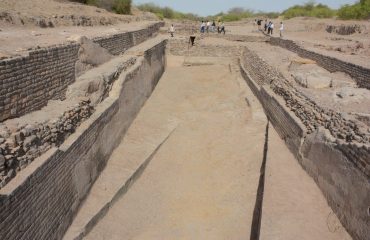
Divided by two flowing streams, the city unfolds in layers with streets and houses of varying stature (Photo: Govt of Gujarat)
Surrounded by the vast saline plains of the Great Rann of Kutch, this ancient walled city, locked in the embrace of its past, boasts a fortified castle and a ceremonial ground. Divided by two flowing streams, the city unfolds in layers with streets and houses of varying stature.
At its heart stands an imposing citadel, separating the lower and middle towns, each fortified in its own right. The smooth structures of sun-dried brick and stone masonry stand as a testament to the advanced urban planning and architectural brilliance of our ancestors.
Amidst its remarkable urban planning, this ancient city—unlike many of its modern counterparts, got its drainage system right! With its intricate underground channels and large stone drains, Dholavira effectively facilitated water flow throughout the city. Due to the complex system of small and large drains intersecting each other, this feature is considered a remarkable aspect of the Indus Valley Civilisation. It is especially astonishing given the absence of advanced technology at that time.
Moreover, Dholavira is one of the cities where the world’s earliest water conservation system was discovered. Satellite imagery reveals an intricate network of interconnected underground reservoirs extending to the city walls. This remarkable engineering feat enabled Dholavira to maintain a continuous water supply throughout the year, even in the arid desert with minimal rainfall. The system was so advanced and well-planned that parts of it remain functional today, showcasing infrastructure designed to endure for thousands of years.
Dholavira- artefacts & eventual decline
Meanwhile, during excavations archaeologists uncovered remains of bead-processing workshops and artefacts crafted from a variety of materials including copper, shell, stone, semi-precious stones, terracotta, gold and ivory. These findings highlight the prosperous and sophisticated lifestyle of the people who lived in Dholavira during the Indus valley civilisation.
The discovery of imported trade vessels further suggests that Dholavira engaged in long-distance trade, extending as far as Mesopotamia. Additionally, archaeologists unearthed 10 large stone inscriptions, believed to be the world’s first signboards, written in the ancient Indus script, which intriguingly remains undeciphered to this day.
But as it is said, everything comes to an end, Dholavira was no exception. Interestingly, according to historical experts, the city faded away silently around 4,000 years ago. Research by IIT Kharagpur suggests that a river dried up, due to disruptions in monsoons and climate change, leading to its gradual decline.
Unlike some other civilisations which had a sudden collapse, Dholavira’s downfall was slow and natural. The inhabitants, despite seeing it as a temporary setback, adapted to a simpler lifestyle, as reflected in their transition from likely typical rectangular houses, characteristic of the Harappan peak, to circular dwellings. This shift marked the final stage in the city’s decline, never to return to its former glory!
Recognising Dholavira’s remarkable urban planning and advanced water management systems, the United Nations Educational, Scientific and Cultural Organisation (UNESCO) designated it as a World Heritage Site in 2021.
Rann-Of Kutch: The Expanse of Nothingness

Rann of Kutch- expanse of nothingness (Photo: Incredible India)
But just like Dholavira has been reduced to nothingness, beyond this small settlement lies the vast Great Rann of Kutch. This salt marsh desert, known for its striking white sands, is located 85 kilometers from Kutch’s capital, Bhuj. The Rann of Kutch is often described as a “massive expanse of cracked earth,” with only a few scattered water bodies and shrub forests as traces of nature, giving the illusion of nothingness, as if no life exists at the edge of the earth.
Yet, this desert has its own identity. Amidst the emptiness, tribal centres thrive, where cylindrical mud huts serve as bases for Kutchi embroidery, bell metal craft, and the rare Rogan painting, an art form now practiced by a single surviving family.
In the Little Rann of Kutch lies a Wild Ass Sanctuary, where animals like the chinkara, blackbuck, and the chestnut-colored Indian wild ass, known as Khur roam freely, reflecting the presence of life in this vast, wild desert.
The story of Dholavira reflect the amazing achievements of the Indus Valley Civilisation, from its advanced urban planning and water management to its vibrant culture. Though the city eventually declined due to natural changes, its legacy continues to fascinate and teach us about the past, even though it has left us with many questions than answers, but the Great Rann of Kutch, often seen as a barren desert, is home to unique traditions and wildlife, showing that life can thrive even in the most unexpected places.
