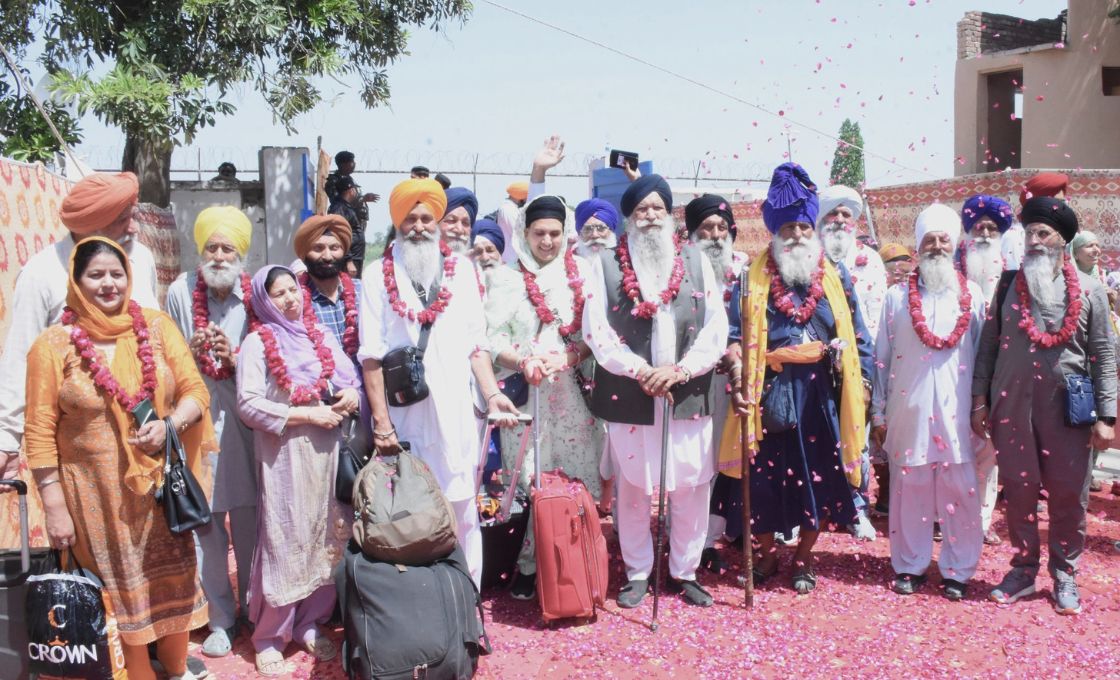
Over 2,800 visas issued by Pakistan for Indian pilgrims (Photo: Pakistan High Comission India X)
For 10 days every April, one of the world’s most politically fraught borders briefly transforms into a passage of devotion. Thousands of Sikh pilgrims cross from India into Pakistan, travelling roads their ancestors once walked before the Partition of 1947 cleaved the Punjab in two and scattered its holiest shrines across a new international boundary. This year, that tradition continues more than 2,800 Indian pilgrims have been granted visas by Pakistan for the Baisakhi pilgrimage, running from April 10 to 19.
The numbers are significant not merely in themselves, but in what they represent. The 2026 pilgrimage is the first Baisakhi crossing after a period of sharply escalated tensions between the two nuclear-armed neighbours in 2025, tensions that cast doubt on whether the annual tradition would survive yet another diplomatic storm. That it has and at relatively robust visa numbers signals that religious diplomacy between India and Pakistan retains a stubborn durability that conventional politics often cannot.
Also Read: Indian diaspora’s rise in the global political arena
Baisakhi falls on April 14 each year and carries layered meanings for Sikhs around the world. It marks the founding of the Khalsa the community of initiated Sikhs by Guru Gobind Singh in 1699, one of the most defining moments in Sikh religious history. It is also tied to the spring harvest festival of the Punjab, a celebration of the land’s abundance that predates the faith itself.
For Indian Sikhs making the cross-border journey, Baisakhi carries an additional dimension: the opportunity to pray at shrines that lie on the Pakistani side of the line drawn in August 1947. The Partition displaced millions and created two nations, but it could not relocate the sacred geography of Sikhism. Three sites in particular anchor the pilgrimage.
Gurdwara Panja Sahib in Hasan Abdal where the main ceremony on April 14 takes place is among the holiest shrines in Sikhism, associated with a miracle attributed to Guru Nanak. Gurdwara Nankana Sahib, roughly 80 km southwest of Lahore, marks the birthplace of Guru Nanak himself, the founder of the faith and Gurdwara Kartarpur Sahib, near Narowal, is where Guru Nanak spent the final 18 years of his life and is now linked to India by the Kartarpur Corridor, a separate visa-free passage opened in 2019. Together, these sites form a spiritual axis that draws Sikh devotees from across the globe.
This year, more than 26,000 pilgrims from around the world are expected to converge on Pakistan for the Baisakhi celebrations a figure that underscores the event’s global significance for the Sikh diaspora.
The pilgrimage does not happen through goodwill alone. It is underpinned by a formal bilateral agreement, the Pakistan-India Protocol on Visits to Religious Shrines, signed in 1974. The protocol establishes a framework under which Hindu, Sikh, and other religious communities can visit sacred sites across the border on designated occasions each year. Both governments notify each other of approved pilgrimage dates, issue group visas and coordinate entry through specific border crossings.
In 2026, pilgrims enter through the Attari-Wagah border crossing the only land crossing between the two countries available for civilian use before being transported to their respective shrines in Pakistan’s Punjab province.
Also Read: Once in a blue moon: Five shows that speak to Indians living overseas
The protocol has survived wars, near-wars, diplomatic expulsions, and the suspension of trade and travel ties on multiple occasions. Its durability speaks to the political sensitivity of appearing to deny religious access to minority communities, and to the quiet but consistent pressure applied by Sikh advocacy organisations on both sides of the border.
A timeline of visa grants for Baisakhi
The year-on-year numbers reflect the political weather between the two countries as much as they reflect religious demand, 2019 was a landmark year. Pakistan opened the Kartarpur Corridor in November, offering visa-free access to Gurdwara Kartarpur Sahib for the first time.
For the Baisakhi pilgrimage that year, Pakistan issued approximately 3,000 visas one of the higher figures in recent years against the backdrop of warming overtures between the two governments, 2020 saw the pilgrimage severely curtailed due to the Covid-19 pandemic. Pakistan issued a minimal number of permissions and the cross-border gathering was largely suspended.
Similar restrictions applied in 2021, when international religious gatherings remained restricted globally, 2022 saw a partial recovery, with Pakistan issuing approximately 2,500 visas as pandemic-era travel restrictions began to ease, though logistical difficulties kept numbers below pre-pandemic levels, 2023 brought the pilgrimage closer to normalcy. Pakistan issued approximately 2,700 visas for Baisakhi and the pilgrimage proceeded without significant incident, with tens of thousands attending celebrations in Hasan Abdal, 2024 saw slightly higher numbers, with Pakistan granting visas to approximately 2,750 Indian pilgrims a quiet but steady continuation of the tradition, 2025 was a turbulent year.
Heightened tensions between India and Pakistan following a series of incidents diplomatic and otherwise raised serious questions about whether the 2025 Baisakhi pilgrimage would proceed at all. The pilgrimage did go ahead, but at reduced numbers and amid an atmosphere of uncertainty, 2026, against that backdrop, sees Pakistan issue 2,800 visas a modest but meaningful uptick from the difficult year that preceded it, and a signal that the protocol continues to hold.
There is something quietly remarkable about 2,800 people crossing a border that is otherwise sealed no trains, minimal trade, frequent diplomatic freeze to pray at shrines their grandparents may have visited freely before 1947. The Baisakhi pilgrimage does not resolve the conflicts that divide India and Pakistan. It does not address territorial disputes, water rights, or the accumulated grievances of nearly eight decades. But it does demonstrate, year after year, that the two countries retain the institutional memory and, at minimum, the political will to allow faith to cross where politics cannot.