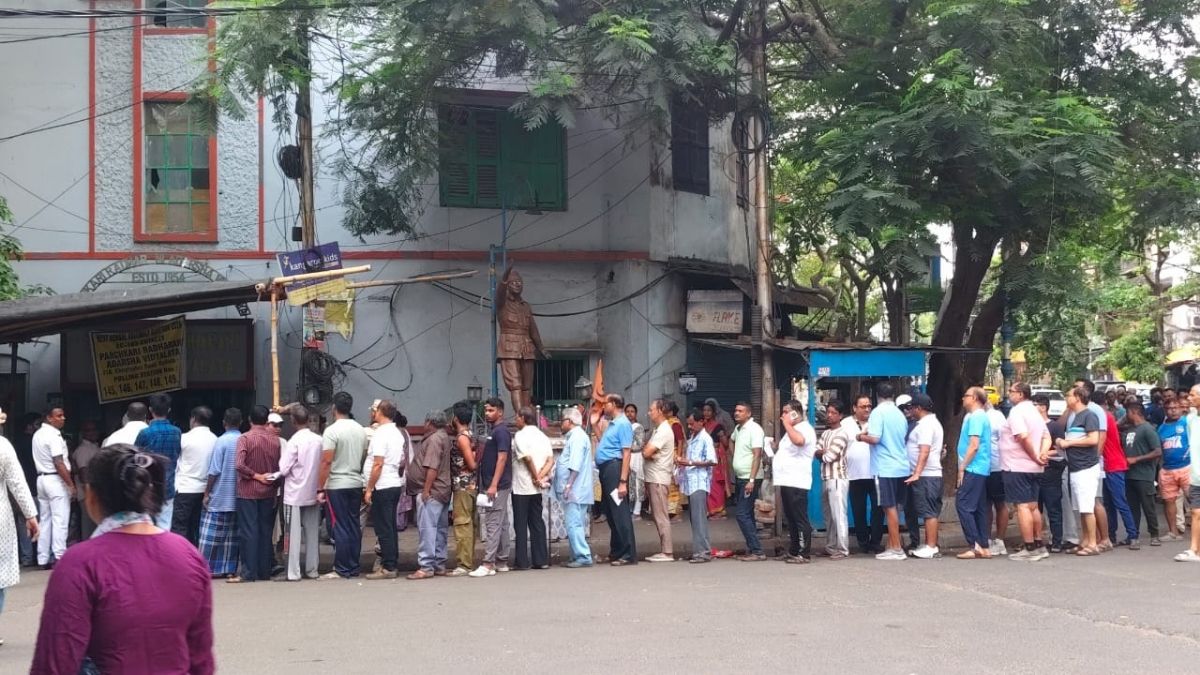
Voter turnout reached between 93 and 94 pc in West Bengal (Photo: BJP X)
Bagging a two-thirds majority, the Bharatiya Janata Party (BJP) has scored an outstanding win in the 2026 West Bengal Assembly Election, ending 15 years of Trinamool Congress rule in a state that political observers had long considered a fortress of Mamata Banerjee and a no-go area for the right wing parties, including the BJP. The party that held just three assembly seats a few years ago has dismantled one of the most entrenched regional governments in the country. In winning the state, the BJP swept across rural and urban constituencies, broke through community voting patterns that had held for over a decade, and forced Mamata Banerjee out of power including in Bhabanipur, her own constituency.
It is the kind of result that does not happen often in Indian politics. And in West Bengal, it has landed like an earthquake but for many locals, this was not the result they saw coming. Defeating TMC in Bengal, the reasoning went, was as unlikely as defeating the BJP in Gujarat. The party had built its support base across years of welfare schemes, fierce street-level organisation, and a personality cult around Mamata herself. Even those who despised the government did not fully believe it could be voted out.
Toshi Karan, a teacher in Kolkata, was among them. She watched the results come in and felt something closer to disbelief than relief.
“Honestly, if I talk about myself, I really did not expect BJP’s historic win. This was a shock, not only to the TMC party, also the people of West Bengal. Because removing TMC or defeating TMC is like defeating Modi in Gujarat. Exactly. So, that was a shock,” Karan tells Media India Group.
She acknowledges that a section of people had seen it coming those who desperately wanted change and were willing to back whoever could deliver it. But for Karan, the shock of TMC losing did not translate into comfort about who had won.
Also Read: Deletion of over 9 million voters in Bengal SIR sparks disenfranchisement concerns
“People are really hopeful now and we had no choice. And that is why people think they are choosing the lesser of two evils but BJP is not the lesser of the two evils. If Mamata was bad, BJP is worse. And I know time will prove that. I hope for the best, but I am sure BJP is not the change we need,” says Karan.
She is not alone in that feeling. Across Bengal, particularly in Kolkata, the mood among a significant section of people is not of celebration. It is a grim, exhausted resignation, the feeling of having voted not for something, but against something, and being unsure whether the alternative deserves the trust placed in it.
But not everyone was caught off guard. Animesh Sharma, a political analyst based in Delhi who tracks Bengal closely, had read the ground mood but still found himself startled by the scale of what happened.
“Honestly, we saw this coming because of the massive anger on the ground, but we didn’t think it would actually happen given how tightly the TMC has held onto the state for so long. Seeing the BJP pull off such a monumental win is wild,” Sharma tells Media India Group.
On what finally broke the dam, he pointed to a sequence of events that each, on its own, might have been survivable but together became impossible to defend.
“The turning point was really a series of breaking points for the common person where it felt like a mountain of scandals finally collapsed. Between the horrific RG Kar Medical College case and the terrifying stories of Sandeshkhali, people felt like the basic safety of women was gone. Add to that the 2024 land grabbing allegations and the SSC recruitment scam that stole jobs from students, and the ‘syndicate’ culture just became too much. While the TMC claimed central agencies were being misused, for many of us, it just looked like excuses for corruption,” he adds.
At the most local level, Sharma says, it was something far less dramatic than political scandals that shifted the rural vote, it was the daily grind of paying to exist:
“On a local level, life got harder because of ‘cut money’ where illegal commissions were demanded for every small government service. Even getting a basic permit or a house felt like you had to pay a bribe, and that constant squeezing of the poor really shifted the rural vote,” says Sharma.
On what BJP intends to do with the state it has just inherited, Sharma described a plan that amounts to a complete dismantling of how Bengal has been governed:
“Now that the government is changing, the plan is to gut the entire way the state was run. The new administration wants to replace the old local strongman style of politics with a more direct system. They are looking to overhaul the police to stop the political intimidation that became the norm. It is a total system reset, moving away from personality driven rule to one focussed on bringing in big industry and enforcing a very different kind of law and order,” says Sharma.
Whether that reset is achievable or whether it simply replaces one set of strongmen with another is the question Bengal will spend the next five years answering.
Voter turnout reached between 93 and 94 pc. Voters were drawn into electoral roll verification processes through tribunal proceedings before polling. By some accounts, the total number of deletions from the voter list through the SIR exercise runs closer to 9.1 million. The Election Commission conducted the election in two phases, and political violence long a defining feature of Bengal’s electoral cycles was largely absent on polling day.
Whether the voter roll revision was a legitimate cleansing of the electoral list or a targetted exercise that removed specific communities is now one of the most bitterly contested questions about this result. Karan says that she don’t think this was a fair fight. “I think it was rigged. They deleted 9.1 million voters through the SIR process, and that itself is not an example of a functional democracy. There were also reports of migrant workers being sent from Surat and Gujarat in large numbers to vote. And everyone knows the Election Commission works with BJP. So no, it was not a fair fight,” says Karan.
Also Read: ‘The Bengal Files’ sparks protests, politics across West Bengal
Analjyoti Ghosh, a doctor based in Kharda, in Kolkata who has watched Bengal politics says that law and order situation, women’s safety, and rampant corruption were the three things that were main factors which acted against the TMC government this time.
“Many of these factors apart from the Rajkot case, were also present in 2021. But in 2021, BJP was not this organised. It only had three seats at that point. So from three seats it went to 77, because it lacked organisational strength, and at the same time, Covid-19 was also there,” Ghosh tells Media India Group.
What changed in the five years since is that BJP built what it lacked before, a functioning party structure at the booth level, trained cadres, and a campaign capable of running across all 294 constituencies. TMC, meanwhile, appeared to misread the situation entirely
“TMC thought it had won the 2021 election against all adversaries and would win again this time. This time, nothing worked for them. People had a fair and strong alternative, so they voted against TMC. It is as simple as that,” says Ghosh.
Before the 2021 election, TMC introduced the Lakshmir Bhandar scheme, a direct cash transfer to women. It worked. In 2026, it didn’t. says Ghosh.
“At that point, Lakshmir Bhandar was a new thing for everyone this kind of scheme culture was not in Bengal before that. It was a sudden huge benefit for people. But this time, many of those same beneficiaries are saying what will INR 1,000 do for them. They need jobs. Last time it was a surprise move. But this time, that move had lost its edge,” says Ghosh.
What led BJP to win
Abdul Mannan, a political analyst based in West Bengal, says that the corruption emerged as one of the most decisive factors influencing voter behaviour.
“SSC recruitment scam and irregularities in government jobs, coal scam, cow smuggling cases, sand smuggling networks, allegations of money laundering and ‘cut money’ practices in welfare schemes these issues created a strong narrative of governance failure, prompting voters to seek an alternative,” Mannan tells Media India Group.
Government employees had their own parallel grievances, pending Dearness Allowance payments and unresolved pay commission issues pushed the middle class away from the ruling party in numbers large enough to swing tight seats. On why TMC did not see the collapse coming, Mannan says that the ruling party failed to accurately assess ground realities. Over-reliance on internal feedback systems, consultants, and centralised campaign structures created a disconnect between leadership perception and voter sentiment. Allegations of inefficiencies and corruption among local-level campaign workers further weakened their ground operations.
BJP takes over a state with deep administrative complexity, bureaucratic habits built across decades of left-front and TMC rule, and a public carrying very specific, unresolved demands. An alleged scam left 25,000 teachers without jobs, while the rape and murder of a medical student at RG Kar Medical College in xxxx left a wound that never fully closed. Industries did not come and neither did employment.
Though BJP may have won the vote promising poriborton or change, it is bound to discover that talking about change is far easier than actually carrying it out.