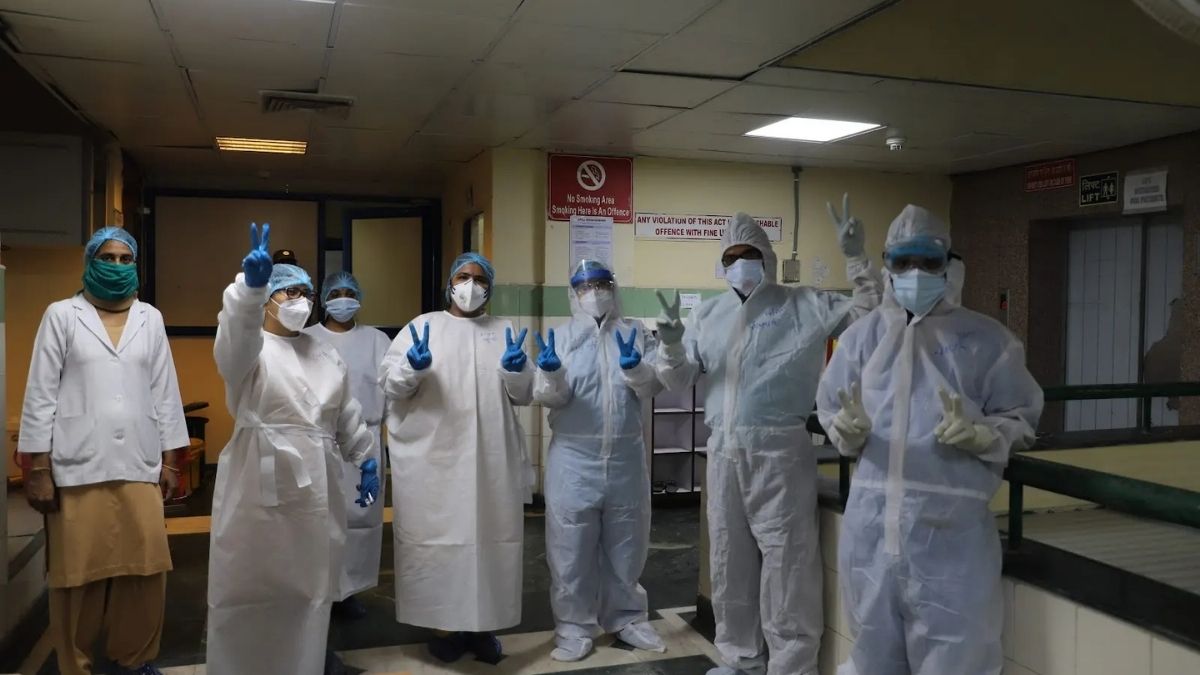
The Covid-19 pandemic caused significant fatalities among nurses globally (Photo: Aman Kanojiya)
As the world marks International Nurses Day today, India presents a paradox that is hard to ignore. Every year, the country trains nearly 300,000 nursing graduates among the highest in the world yet continues to face a deepening shortage of working nurses. The pipeline is full. The profession is draining. What sits in between is a system that has consistently failed to make nursing in India a viable long-term career.
India has approximately 2.3 million registered nurses serving a population of 1.4 billion. Against the World Health Organisation’s benchmark of 3 nurses per 1,000 people, India manages just 1.7, which is 43 pc below the minimum threshold. The country needs roughly 2 million additional nurses to meet that standard. Each year, its 1,900-odd nursing colleges produce around 300,000 graduates. The shortage, then, is not a problem of training capacity. It is a problem of retention and of working conditions so poor that a growing number of nurses choose to leave the country, rather than work within it
Of India’s 2.3 million registered nurses, a significant portion works in urban tertiary hospitals. Rural and semi-urban health centres face persistent vacancies. According to the Rural Health Statistics 2022-23, over 24 pc of sanctioned nursing posts at Community Health Centres across the country were lying vacant.
The nurse-to-patient ratio in general wards of government hospitals frequently stretches to 1:20 during peak hours. The Indian Nursing Council’s own guideline recommends 1:6. In intensive care units, where the standard is 1:2, many facilities operate at 1:5 or worse.
Also Read: International Nurses Day: Blurring lines of gender in healthcare
Private hospitals, which now account for a large share of India’s hospital beds, present a different set of problems. A WHO-commissioned study on working conditions of nurses in Delhi’s private hospitals found that salaries for freshers were often below INR 15,000 a month, and did not exceed INR 45,000 even after more than a decade of service with no job security, no union representation, and no guaranteed leave.
Government hospital nurses fare better on security and benefits. But recruitment is slow, sometimes delayed by years contractual appointments without benefits are increasingly common, and promotion timelines are long.
Savita Kashyap, Head Nurse at Medanta, an upscale hospital in Delhi, has spent over 8 years watching these conditions from the inside.
“The major challenges nurses face in India are heavy workload due to staff shortage, low salaries in many hospitals, stressful working conditions with long duty hours, and limited career growth opportunities. Many nurses experience burnout and lack of recognition despite their important role in patient care,” Kashyap tells Media India Group.
India is the world’s second-largest source of internationally migrating nurses, after the Philippines. Estimates suggest that between 20 and 50 pc of India’s nursing graduates seek to work abroad at some point in their career.
OECD data from 2017 recorded at least 56,000 Indian nurses working across just four countries the United States, United Kingdom, Canada, and Australia. That figure does not count the Gulf, where Indian nurses form a substantial part of the healthcare workforce. In Saudi Arabia alone, where foreign nationals make up 62 pc of the nursing workforce, India and the Philippines are the dominant source countries. In the UK, Indian nurses account for the second-highest of any country. Indian nurses also make up 6 pc of the nursing workforce in the United States and 5.5 pc in Canada.
Kerala is the single largest source state for nurse emigration. Between 2016 and 2019, outflows from Kerala accounted for 85 to 95 pc of total national nurse emigration annually.
The financial logic is straightforward. A nurse in India earns an average of INR 300,000-400,000 a year. The same nurse, with equivalent qualifications, can earn the equivalent of INR 2.5-4 million annually in other countries, along with free accommodation, health insurance, and structured career progression included. Research on Indian nurses in the Gulf found that those working in the US earned up to 82.7 pc more than comparable wages in India, while Canada offered around 28 pc more.
Insha Ahsan is currently doing her internship at SKIMS (Sher-i-Kashmir Institute of Medical Sciences) in Srinagar, and has just completed her BSc in Nursing the reality of the profession is already setting in.
“Despite the high demand for nurses in India, securing a placement after completing my course is still challenging. Most hospitals prefer experienced candidates, and as a fresher, it becomes difficult to access good opportunities. The salary offered to fresh nurses is often very low compared to the responsibilities expected from us, which makes the transition from student to professional quite stressful,” Ahsan tells Media India Group.
Her account of the daily workload is equally bad. “My working hours as a nursing intern are highly demanding. We are responsible for patient care, drug administration, documentation, emergency duties, ward management and continuous monitoring of patients during both day and night shifts. The workload is physically and mentally exhausting at times, and I feel that young nurses are often overworked very early in their careers while still adapting to the clinical environment,” she adds
On top of that, Ahsan says the financial recognition simply is not there. During her internship, she does not receive any stipend despite working long shifts and performing major patient care responsibilities regularly. “Nursing interns contribute significantly to hospital work, yet the financial support and recognition are often inadequate. Fresh nurses work with full dedication, but the opportunities, salary, and support available after graduation are still limited,” says Ahsan.
A study commissioned by the World Health Organisation in Delhi found documented instances of public humiliation, workplace harassment, denial of basic rights such as association and assignment of non-clinical administrative work on top of already high patient loads. Nurses were routinely asked to manage ward records and administrative discharge processes alongside direct patient care, reducing the time actually spent with patients.
A 2023 study in the Indian Journal of Critical Care Medicine found that over 58 pc of nurses in Indian hospitals reported moderate to high levels of burnout. Nearly 40 pc said they had seriously considered leaving the profession or the country.
The Covid-19 pandemic added further strain. Nurses absorbed the highest frontline exposure in overstretched hospitals, often without adequate protective equipment in the early waves and with no structured mental health support afterward.
Career growth within India is also limited. Specialisation pathways are few. The post of nursing superintendent or chief nursing officer, which exists in hospital hierarchies on paper, is frequently left vacant or deprioritised. Pay structures across private and government sectors are inconsistent and opaque.
The consequences of this outflow are not abstract. India’s push toward universal health coverage through Ayushman Bharat, said to be the world’s largest government-funded health insurance scheme, is believed to have significantly expanded patient access to hospitals. But hospital beds are increasing faster than nursing staff. More patients reaching hospitals does not improve outcomes if the nurse-to-patient ratio on the ward deteriorates.
Research published in The Lancet, a leading medical research publication, has consistently linked low nurse staffing to higher rates of preventable in-hospital deaths, hospital-acquired infections, and medication errors. India’s rural health infrastructure is the most exposed: primary and community health centres in many states have normalised operating well below staffing norms, with nurses sometimes managing wards alone through night shifts.
The policy conversation around nursing in India is not new. The Indian Nursing Council, established under a 1947 Act, has long been the regulatory body. The National Health Policy of 2017 acknowledged the need to strengthen nursing as a profession. Reforms, however, have moved slowly against the structural realities of how hospitals, particularly private ones have chosen to cut costs.
“Improving salary, staffing, and professional development can help retain skilled nurses in India. Policy reforms should focus on better salary structures, fair promotions, and proper nurse-patient ratios. Adequate staffing can reduce workload and prevent stress and burnout among nurses. To improve the lives and morale of nurses in India, there is a need for better salaries, safe staffing, supportive working conditions, mental health support, career growth opportunities, and greater professional recognition,” says Kashyap.
Ahsan, at the start of her career, says that strengthening nursing leadership, ensuring job security, and investing in professional development are essential steps to retain skilled nurses and improve the overall healthcare system in India.
“Nurses are truly the backbone of the healthcare system, but their contribution often remains under-recognised,” says Ahsan.
The numbers have been visible for years. India trains hundreds of thousands of nurses annually, faces a domestic shortfall of nearly 2 million, and continues to export a large portion of the graduates it produces to countries willing to pay them more and treat them better.
On International Nurses Day, the gap between the scale of the problem and the urgency of the response remains the most important figure of all.