
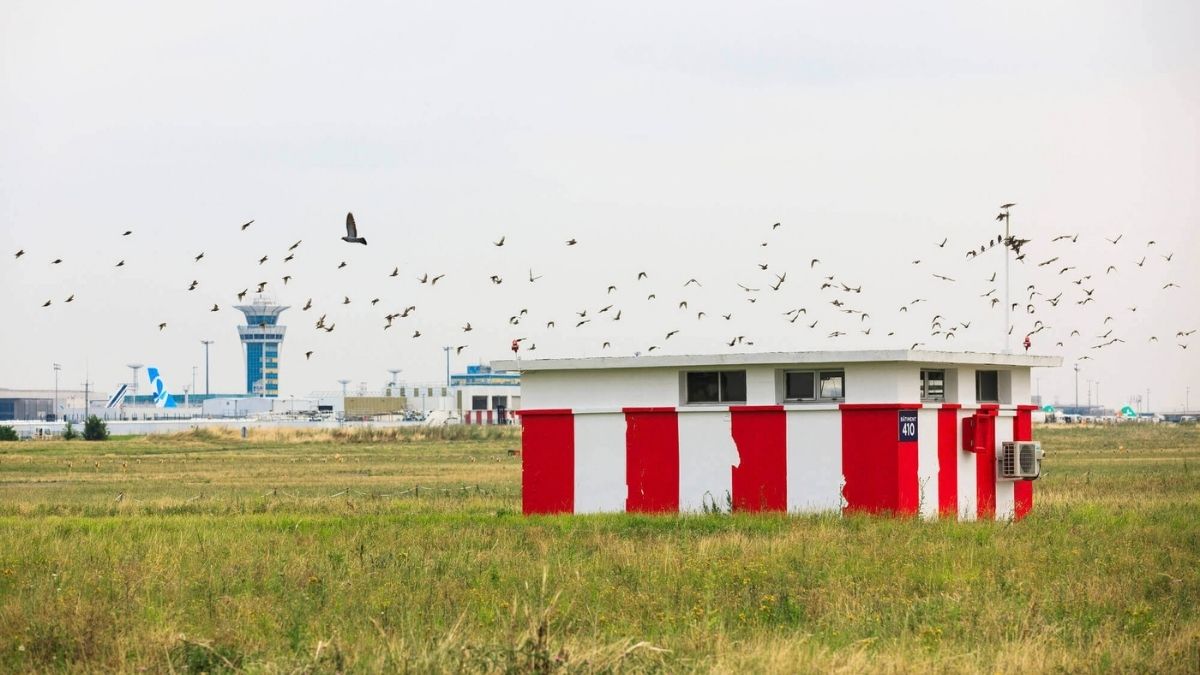
Birds frequently come into contact with aircraft at low altitudes near airports (Photo: Gwen Le Bras/Groupe ADP)
Bird strikes are becoming a growing concern at Indian airports, but the problem is not just about aviation safety. It is also about how urbanisation and shrinking habitats are pushing birds closer to aircraft.
India recorded 1,782 bird-hit incidents at airports in 2025, more than double the 775 reported in 2021. The number rose from 1,131 in 2022 to 1,371 in 2023, before reaching 1,278 in 2024 and 1,782 in 2025. The problem has continued into 2026, with Patna Airport reporting a 133 pc rise, while Delhi’s Indira Gandhi International Airport has seen bird strikes increase around 3.5 times in 2025 to 2026.
A study of 634 wildlife strikes recorded at seven Indian airports, conducted by the Wildlife Institute of India and Salim Ali Centre for Ornithology and Natural History, a government-affiliated wildlife and bird research institution, found that 629 of these strikes involved birds, while more than 98 pc occurred at low altitude. The findings show that birds frequently come into contact with aircraft at low altitudes, highlighting the role of areas surrounding airports.
Also Read: Meghalaya bans roadside picnics in Sohra over environmental concerns
For environmentalist Rakesh Khatri, who is also known as the ‘Nest Man of India’, the problem begins long before a bird reaches an airport. He says rapid urbanisation has taken away the spaces where birds traditionally nested and fed.
“Making nests was especially necessary because one of the biggest problems in urban construction is that there is no space left anywhere for birds. Secondly, we stopped planting native trees and started planting more ornamental trees. And birds always build their homes in native trees,” Khatri tells Media India Group.
He says the disappearance of suitable habitats has forced birds to increasingly depend on human settlements. Khatri began making nests after losing his father at the age of 14 and says he has made around 1.09 million nests over 14 years.
According to Khatri, the problem becomes particularly serious around airports because birds are attracted by food and garbage from surrounding settlements.
“As far as the area around airports is concerned, because there is habitation, and wherever there are homes, the airport is fine within its restricted area, it is larger birds that collide more often because food or garbage is thrown outside. Collisions happen when larger kites and other birds come there,” Khatri tells Media India Group.
Also Read: 70 environmental organisations urge DRC to retain logging moratorium
According to him, smaller birds generally do not fly at the same heights as larger birds and therefore have fewer encounters with aircraft.
Rakesh Khatri
“Smaller birds never collide with aeroplanes; they do not fly that high and cannot handle that kind of air pressure. Larger birds can normally handle it, so they are the ones who mostly collide with aircraft,” he says.
Khatri also highlights the concentration of food around residential areas can therefore bring larger birds into spaces close to aircraft movement.
“The problem is that there is dense population around your airports and food is easily available; people feed them regardless, and we can’t stop feeding them either. Birds are dependent on us after all; they come there to feed and end up colliding. That is the biggest problem,” says Khatri.
He says even seemingly harmless acts of throwing food can have unintended consequences for birds.
“Otherwise, it is very odd when people just toss food. Birds get attracted seeing that something was thrown and assuming it must be food. It is a very simple thing. The elders in your family, when offering water to the Sun God in the morning, used to add broken rice grains. As soon as they poured the water, birds would see something thrown and immediately fly down to eat it. So birds just get attracted and end up walking straight into death. Birds are delicate creatures anyway, they die instantly upon impact,” he adds.
Also Read: Manipulated data, ponds of drinking water: BJP’s clean environment measures in Delhi
The environmental cost, however, is difficult to quantify because official bird-strike data records aircraft encounters rather than confirmed bird deaths. The number of strikes therefore cannot be treated as an equivalent number of birds killed. Still, the rising frequency of encounters indicates how often birds are entering areas where aircraft operate.
Khatri also raised concerns about food waste generated within airport premises.
“I have personally seen many times near the airport, the staff on duty, after eating their meals, toss leftover food right over the wall. So that becomes the biggest reason birds get attracted and come there to eat. That’s the real problem,” adds Khatri.
He believes airports need to address such sources of attraction through better waste management and designated areas for food disposal.
“If you eat food and there are leftovers, don’t just throw them out in the open; place them somewhere proper so they can pick it up themselves. They will pick it up and eat it,” he adds.
Encroachment and construction around airports add another layer to the problem. “Encroachment is the biggest issue if you look at it properly; people build homes right up to the boundary walls of the airport. Look at Mumbai, Kolkata or Bengaluru people are building homes or offices right next to the airports. On paper, it is a restricted area, yet it is completely residential,” says Khatri.
Also Read: UNIVITY joins Zero Debris Charter to safeguard orbital environment
He further questioned the way urban development is taking place beyond airport boundaries.
“And the rate will keep rising. What can be done when there is so much encroachment on the roads everywhere? I am astonished that if people get space, they will build homes right on top of roads,” he adds.
For Khatri, airport authorities also need to provide birds with safer alternatives rather than focusing only on removing them from airport areas.
“The airport authorities should plant more fruit trees along their basic boundary wall so birds get a habitat. The poor bird keeps flying around looking for a place to build a nest until someone shooes it away thinking it will create a mess. So that needs to be addressed slightly,” says Khatri.
He also suggested installing suitable nesting spaces and planting fruit-bearing trees that can provide both shelter and food. “If they plant fruit-bearing trees on which birds naturally nest, that would also save them,” he adds.
Urban planning needs to make space for birds instead of forcing them into increasingly unsafe environments. Khatri has worked with architects and builders to encourage the installation of birdhouses within buildings and said birds have occupied nests installed in apartment walls, including high-rise buildings in Noida and Gurugram.
“Imagine these small birds for whom we build nests — there are five types: Magpie Robin, Bulbul, Silverbill and Sparrow. They usually nest at a height of 3-5 m, but I have dozens of photographs from high-rise buildings in Noida and Gurgaon where birds have gone up to the 20th floor to build their homes inside them,” says Khatri.
With bird strikes continuing to rise, Khatri fears the problem could become more severe. “Yes, and the rate is rising so much right now, yet no one is thinking about them,” he adds.
As cities expand around airports, reducing bird deaths will require more than measures taken on runways. Better waste management, control of food sources, protection of suitable habitats, responsible urban planning and coordination between airport and civic authorities could help keep birds away from dangerous aircraft movement areas while allowing them to survive in increasingly urban landscapes.
