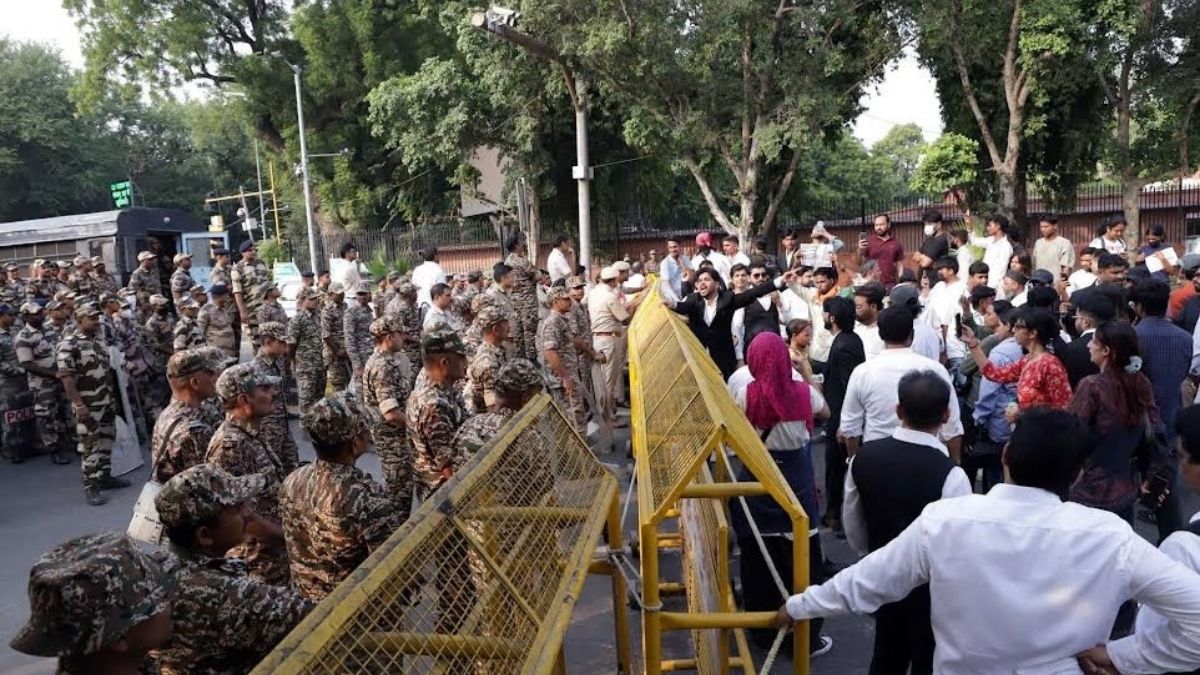
Delhi Police has designated Ramlila Ground, Burari Ground and CBD Ground in east Delhi as alternative venues for protests and demonstrations (Photo: Aman Kanojia)
The decision of the Union Government to remove Jantar Mantar, an historic site in central Delhi, as a designated protest site in Delhi has drawn criticism from activists and opposition, who warn that shifting demonstrations away from the centre of political power could make it harder for citizens to reach decision-makers and draw public attention to their demands.
Delhi Police has designated Ramlila Ground, Burari Ground and CBD Ground in east Delhi as alternative venues for protests and demonstrations, following recommendations from a committee under the Union Ministry of Home Affairs.
The decision removes a key location for demonstrations against government policies and decisions. While alternative venues have been provided, critics argue that allowing people to assemble is not enough if their protests lose visibility and their demands become easier for those in power to ignore.
Also Read: Thousands detained in CJP protest against Chief Election Commissioner in Delhi
The Cockroach Janata Party, a grouping of young activists, has condemned the decision, calling it arbitrary and an assault on the right to protest and peaceful assembly. The CJP questioned why Jantar Mantar was being removed as a designated venue and says that the site belonged to the people of India.
CJP also challenged Delhi Police to respond to its request to hold a demonstration at Jantar Mantar, giving the authorities 24 hours to act. Its objection is centred on the loss of access to a location that has historically brought protesters close to the institutions they seek to hold accountable.
The controversy comes amid opposition protests against Chief Election Commissioner Gyanesh Kumar over allegations concerning electoral rolls.

Adeeb Khan
Adeeb Khan, an activist and advocate, based in East Delhi says the decision raised concerns about the practical exercise of the constitutional right to peaceful protest.
“Article 19 of our Constitution gives us the right to engage in peaceful protest. Though that right is not absolute, there are certain reasonable restrictions on it, it should be the government’s responsibility to manage properly,” Khan tells Media India Group.
Khan says that Jantar Mantar’s location in central Delhi is crucial to the effectiveness of demonstrations because of its proximity to Parliament and other government institutions.
“Jantar Mantar is not just a protest site, it has immense historical significance. So, if we want to convey our voice to the government, naturally, we have to go near them to make ourselves heard,” says Khan.
He says that that removing the site’s designated status would distance protesters from the authorities and reduce the pressure on the government to respond to their grievances.
Also Read:Supreme Court should immediately suspend goofed-up SIR
“By de-notifying this protest site, it is clear that the government simply does not want to hear our voice,” he added.
The alternative venues, he says, may not offer the same visibility or accessibility. Although protests have previously taken place at Ramlila Ground, Khan raised concerns about reaching the other locations and attracting public attention.
“No one will hear our voice from there,” he says, warning that protests held farther from central Delhi could receive less media coverage and place less pressure on decision-makers.
The decision raises a broader question about the difference between permitting a protest and allowing it to have an impact. A designated venue may satisfy the formal requirement of providing space for a gathering, but its location can influence whether demonstrators reach their intended audience, attract media coverage and compel officials to respond.
Delhi Police has said the change follows the recommendations of the Home Ministry-appointed committee and that revised standard operating procedures for demonstrations at the new venues will be issued separately.
For Khan, the issue is whether the right to protest will remain effective after the shift.
“In a democracy, permission to protest does not just mean permission to gather in a field, but having the right to convey your voice to the government in an effective way. By de-notifying Jantar Mantar and allocating these separate sites, this right will be suppressed to a large extent,” says Khan.
Jantar Mantar: History of protests
Jantar Mantar became Delhi’s designated protest site in 1993, following restrictions on demonstrations at the Boat Club near India Gate. The change came after a massive farmers’ protest led by Mahendra Singh Tikait in 1988, when thousands of farmers gathered in central Delhi to press their demands. Authorities subsequently sought a location that was close enough to the seat of power for protesters to be heard but easier to regulate.
Over the following decades, Jantar Mantar became a focal point for demonstrations on issues ranging from corruption and farmers’ distress to women’s safety and electoral accountability. On April 5, 2011, activist Anna Hazare began a hunger strike there demanding a strong Lokpal law to tackle corruption. The agitation grew into a nationwide movement and helped reshape the political landscape.
Also Read: Protests continue at Jantar Mantar despite police crackdown
The site also hosted protests following the 2012 Delhi gang rape, a 40-day agitation by Tamil Nadu farmers in 2017 and demonstrations by prominent wrestlers in 2023 against former Wrestling Federation of India chief Brij Bhushan Sharan Singh. These movements helped establish Jantar Mantar as a place where local grievances could become national issues.
Jantar Mantar’s status has faced challenges before. In October 2017, the National Green Tribunal ordered a halt to protests at Jantar Mantar over concerns including noise pollution and conditions in the surrounding residential area. However, in July 2018, the Supreme Court rejected a blanket ban on protests at Jantar Mantar and the Boat Club, while allowing authorities to regulate demonstrations.