
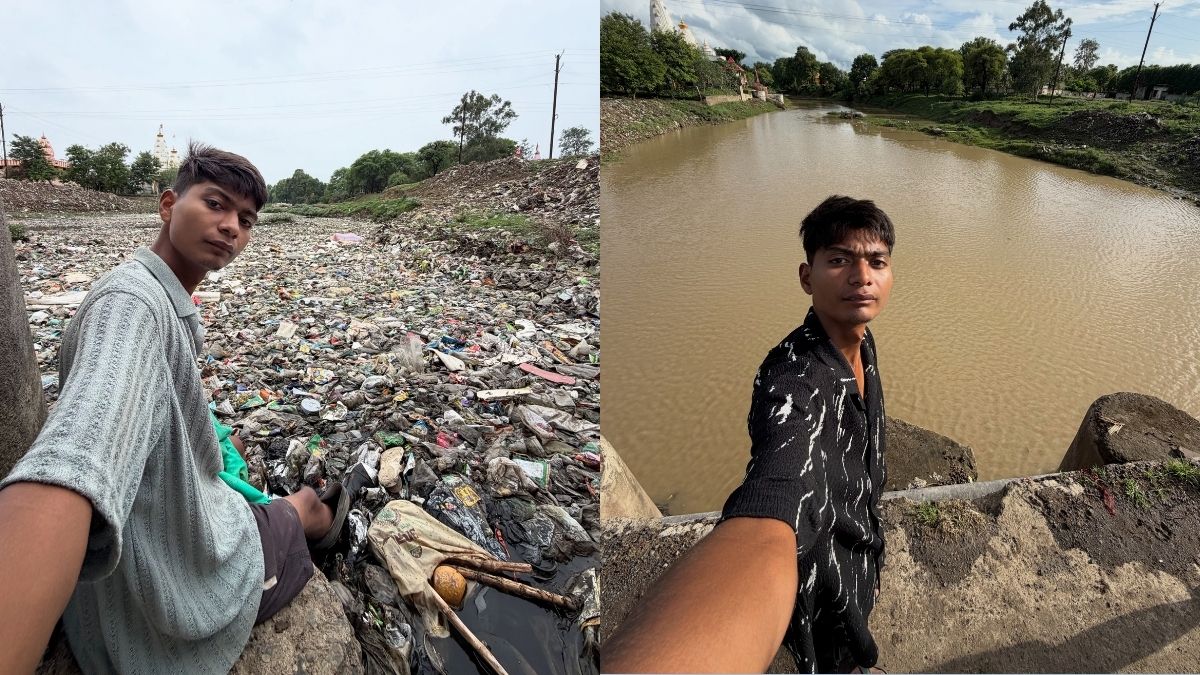
The Ajnar River cleanup has drawn attention to the gaps in sewage treatment and waste management in Madhya Pradesh (Photos: Bittu Tabahi/Instagram)
Earlier in September, social media and media reports across India were abuzz with the story of a youth who reportedly undertook the massive and thankless task of cleaning up a small river near his hometown in Madhya Pradesh.
On January 26 this year, Surendra Singh Choudhary, a 20-year-old BSc student who lives in Biaora town in Rajgarh district of Madhya Pradesh, began cleaning Ajnar River, which is highly polluted with discharge from industries and domestic waste flowing into it without any treatment.
Initially, some of his friends had joined in for a few days, but even when they opted out, he continued much of the work himself. Reports say he has spent around USD 350 of his own money on the effort, including installing dustbins, while working without adequate protective equipment. He has also reported infections and peeling skin on his hands and feet.
The Ajnar River originates near Andalheda village in the Rajgarh district of Madhya Pradesh, India, and flows for an approximate length of 52 km before entering neighbouring Rajasthan to join the Kalisindh River. Reports say that industrial companies and local manufacturing units around the river have been cited by activists for illegally dumping chemical waste and untreated wastewater into nearby pits, fields, and water bodies. These discharged toxins, they add, have led to frequent deaths of cattle, wild animals, fish, and crabs.
Also Read: From Ken-Betwa to Polavaram: India’s unfinished rehabilitation story
When the government failed to intervene and take measures to not just stop the pollution, but also cleanup the river, Choudhary began cleaning the river on his own.
His campaign attracted wider attention after industrialist Anand Mahindra and former England cricketer Kevin Pietersen shared his work on social media. Boyan Slat, founder of The Ocean Cleanup, also responded to his campaign, while Madhya Pradesh Chief Minister Mohan Yadav later met Choudhary in Bhopal.
As usual, municipal action followed the high publicity. Biaora Municipality deployed earth moving equipment to remove accumulated waste from the river.
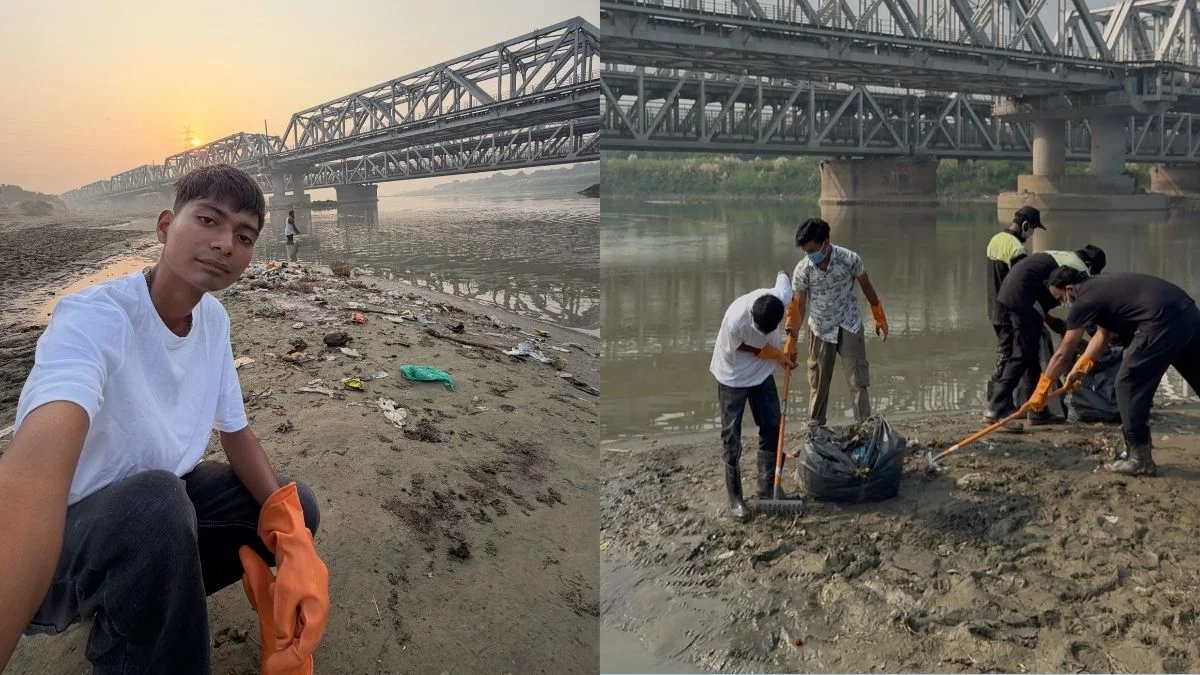
Volunteers join the campaign to remove waste from the riverbank
However, removing accumulated waste does not address the source of the pollution. According to municipal officials, five major drains discharge wastewater into the Ajnar. The civic body has prepared a proposal for a USD 1.65 million sewage treatment plant (STP), but the project has yet to translate into a permanent solution for the wastewater entering the river.
Also Read: Meghalaya bans roadside picnics in Sohra over environmental concerns
The status of the proposal is therefore important. Administrative and technical approvals, funding, tendering and a construction timeline will determine whether the proposed plant moves beyond planning and addresses the five drains discharging into the river.
The Ajnar case also reflects a wider sewage-treatment gap in Madhya Pradesh. According to the Central Pollution Control Board’s 2020-21 assessment, the state generated an estimated 3,646 million litres per day (MLD) of sewage, against installed treatment capacity of 1,839 MLD and operational capacity of only 684 MLD. The figures are from 2020-21 and do not represent current capacity, but show the scale of the infrastructure gap.
At the national level, urban India generated an estimated 72,368 MLD of sewage in 2020-21, while operational treatment capacity stood at 26,869 MLD, according to CPCB data.
Solid waste adds another challenge. India generated around 185,195 tonnes of municipal solid waste per day in 2023-24, while Madhya Pradesh accounted for about 6,853.5 tonnes per day, according to government data. These figures do not mean that the waste enters rivers, but the Ajnar cleanup shows how gaps in local waste management can directly affect urban waterways.
As the problem of polluted water bodies is not limited to a single district or a state, Choudhary and his team turned up in Delhi earlier last week and undertook symbolic cleaning up drives in different parts of the National Capital Region, including in Delhi, Noida and Gurugram.
Choudhary has shown what individual effort can achieve by physically removing waste from the river. But a citizen-led cleanup cannot replace the monumental task of sewage treatment, waste collection, enforcement and regular river monitoring.
His story ultimately reflects yet another basic gap in civic responsibility, while a young resident has taken on the visible work of cleaning, the systems needed to prevent sewage and waste from entering the lives of the common person remain the responsibility of the government and local administration.
