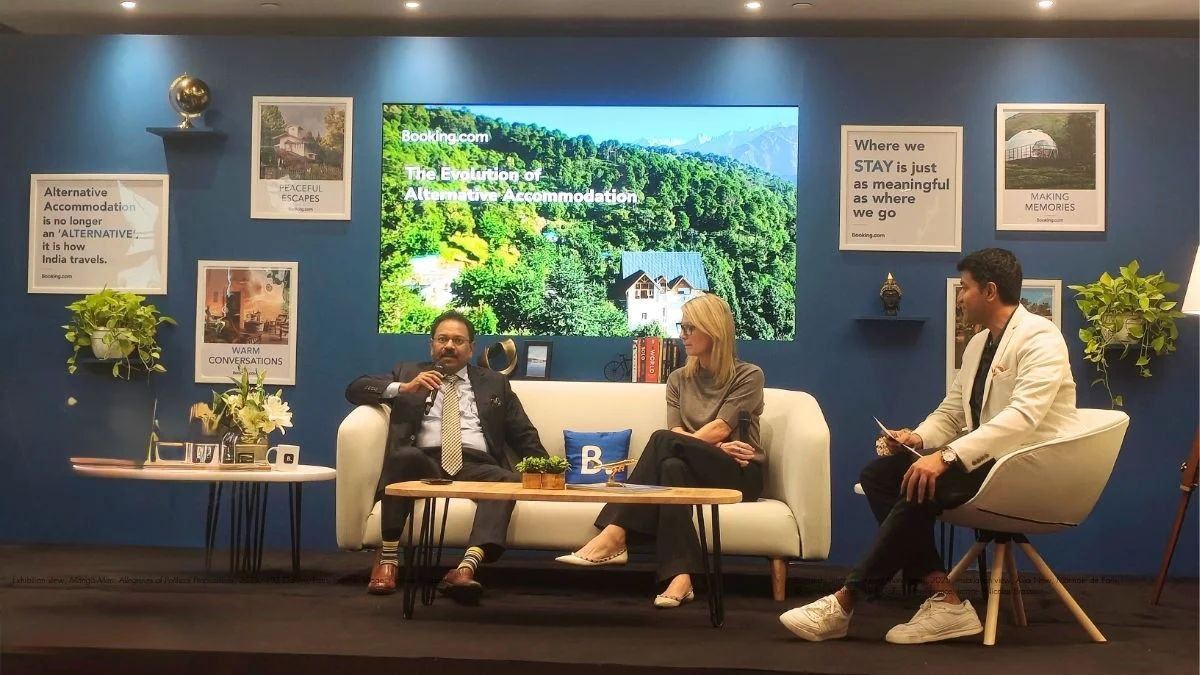
Booking.com has launched How India Travels 2026 – The Homes Edit, a report prepared in partnership with travel research and M&A advisory firm Videc Consultants, in New Delhi on Wednesday
Booking.com, a leading travel portal, has launched How India Travels 2026 – The Homes Edit, a report prepared in partnership with travel research and M&A advisory firm Videc Consultants, in New Delhi on Wednesday, projecting that India’s alternative accommodation market will nearly double from INR 233.1 billion in FY26 to INR 415.1 billion by FY29.
The report estimates that the total alternative accommodation market will grow at a Compounded Annual Growth Rate (CAGR) of 21.2 pc between FY26 and FY29, compared with 11.2 pc for the overall accommodation market. The online alternative accommodation segment is projected to expand from INR 93.4 billion to INR 186.6 billion during the same period, at a CAGR of 25.9 pc.
The category includes homestays, villas, apartments, serviced apartments, bed and breakfasts, guesthouses and other non-hotel properties. The report identifies group holidays, multigenerational family travel, celebrations, longer stays and business trips as key use cases driving demand.
Also Read: Booking.com survey lists ‘Most Welcoming Places in India’ for 2023
The report was launched in the presence of Suman Billa, Additional Secretary and Director General of Tourism at the Ministry of Tourism, Santosh Kumar, Regional Head, South Asia, Booking.com, Laura Houldsworth, Managing Director, Asia Pacific, Booking.com, and officials from Videc Consultants.
“Demand is exploding, but the supply side is not keeping up,” said Billa, pointing to the gap between India’s accommodation capacity and the requirements of its growing travel market.
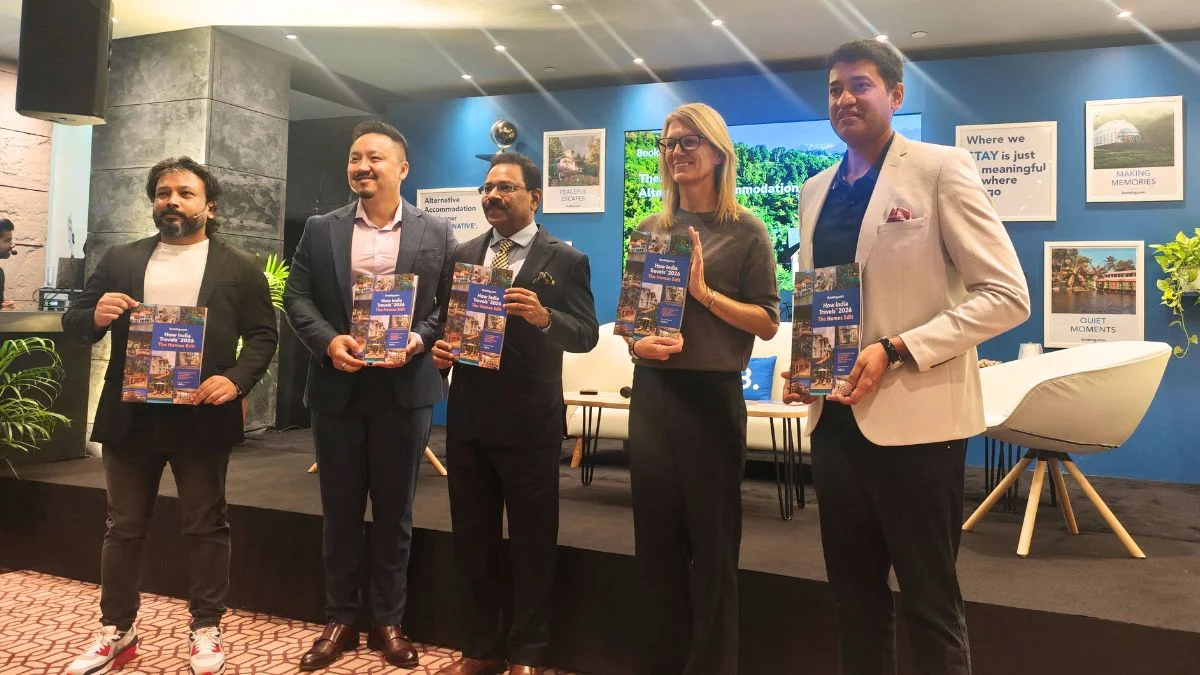
The report was launched in the presence of Suman Billa, Santosh Kumar, Laura Houldsworth and officials from Videc Consultants
“Today we have about 200,000 branded hotel rooms in the country. We have roughly 1.5 million unbranded hotel rooms, but by all estimates, we should have at least double that number, if not triple, to meet the demand,” he said.
Billa said that even with new hotels in the pipeline, alternative accommodation could help bridge the shortfall by bringing existing residential properties into productive use.
According to Videc Consultants’ India Travel Market Opportunity Study, the number of digitally distributed alternative accommodation listings crossed 200,000 in FY26, an increase of 26 pc from FY25. The report notes that branded hotel room supply grew in single digits over the same period.
The total alternative accommodation market was valued at INR 233.1 billion in FY26, against INR 68.9 billion in FY23. Its online segment increased from INR 21.6 billion to INR 93.4 billion over the same period. By FY29, the total segment is projected to reach INR 415.1 billion, while online bookings are expected to account for INR 186.6 billion.
Also Read: Top 10 international destinations for New Year 2023: Booking.com survey
India’s overall travel market is projected to increase from INR 5,971 billion in FY26 to INR 8,200 billion by FY29, while the total accommodation market is forecast to grow from INR 1,571.2 billion to INR 2,158.6 billion.
Online searches for alternative accommodation grew 6 pc between FY24 and FY25, compared with 2 pc for hotels. However, alternative accommodation still accounted for around 13 pc of lodging gross booking value (GBV), indicating that rising interest has yet to translate into a proportionate share of bookings.
The online share of the alternative accommodation market increased from 31.3 pc in FY23 to 40.1 pc in FY26 and is projected to reach 44.9 pc by FY29. The report says that much of the market continues to operate offline, with operators receiving bookings through calls and messaging alongside digital channels.
Kumar said the report was developed to address a lack of publicly available research on the segment in India.
“In 2025, we came up with the Inbound Edit, which looked at how foreign travellers view India as a destination, the experiences that bring them back as repeat visitors and how India can continue to build these experiences,” he said.

Santosh Kumar
“For this year, we have chosen to double-click on the accommodation sector, specifically looking at one segment within it, which is alternative accommodation. When we were conceptualising the report, we tried to find what else was available in the public domain on this segment. Unfortunately, there has not been a lot of publicly available research, at least in the Indian context,” Kumar said.
He said the report brings together Booking.com data, external research, a consumer survey and interviews with industry and government representatives to provide a wider picture of the market.
The report identifies a shift in alternative accommodation supply beyond established beach and hill destinations towards cities, religious centres, smaller towns and emerging leisure corridors.
Nearly half of the listings were located in cities and metros in FY26. The report also found that listings in Tier-II locations, including Greater Noida, Ghaziabad, Indore and Ayodhya, had expanded, with some markets recording more than double the listings in June this year compared with June 2025.
Destinations within a two-to-five-hour journey of major source cities are becoming viable weekend markets as road connectivity improves. However, the report says growth remains uneven, with some destinations lacking enough properties to support efficient operations and premium operators facing shortages of properties that meet their standards.
Kumar said alternative accommodation could help distribute tourism demand beyond the most frequently visited destinations and add capacity during peak periods.
“When we think about the group trips that we take, the multigenerational family trips, people travelling for milestones and celebrations, these are use cases that alternative accommodation fits in beautifully,” he said.
A consumer survey done by Booking.com found that 94 pc of respondents considered alternative accommodation in some form during their most recent leisure trip. Of these, 62 pc compared hotels and alternative accommodation extensively, while 32 pc briefly considered alternatives. About 4 pc looked at only one type of accommodation and 2 pc had already decided what they wanted before searching.
When asked about future bookings, 40 pc said they would definitely try alternative accommodation, while 47 pc said they would probably try it, says the report.
Preferences varied by trip type. For trips with friends, 44 pc preferred alternative accommodation, compared with 38 pc who preferred hotels; 18 pc said their choice depended on the circumstances. For workations or long stays, 40 pc preferred alternative accommodation and 42 pc hotels. For family holidays with children, 38 pc preferred alternative accommodation, while 44 pc favoured hotels.
The report found that around 95 pc of villa transactions were leisure-led. Villas are primarily used for group holidays, family gatherings, celebrations and reunions, while homestays appeal to travellers seeking local interaction and apartments cater to longer stays and business travel.
The average stay in a homestay was around 1.65 nights in the first half of 2026, compared with 2.05 nights in apartments and 1.69 nights in villas. Business travel accounted for around 14 pc of apartment transactions, according to the report.
Alternative accommodation is also gaining a role in corporate travel, particularly for team trips, extended assignments and stays requiring additional living or working space.
Half of the business travellers surveyed said they frequently used alternative accommodation for business travel, while 35 pc had used it occasionally, 8 pc had done so when traditional hotels were unavailable, 5 pc had not used it but were open to trying it, and 2 pc preferred hotels only.
Among business travellers considering alternative accommodation, 59 pc cited group business travel as a likely use case, 53 pc cited extended business trips or relocations lasting five nights or more, and 50 pc cited short, solo client visits. A further 48 pc considered alternative accommodation for conferences or large industry events.
The main reasons for choosing these stays for work included additional living space or a separate bedroom or workspace, cited by 41 pc, the ability to accommodate family members or colleagues, cited by 40 pc, and a more localised experience, cited by 39 pc. Better value for longer stays was cited by 37 pc.
Houldsworth said the demand for alternative accommodation was also being driven by changes in travel preferences across Asia Pacific, including a greater focus on cultural immersion and multigenerational trips.
Also Read:Inbound tourism to India to surpass 2019 levels by 2025: Booking
“Some of the trends that we have seen among travellers across the region, certainly in the last 12 to 24 months, maybe even since Covid-19 pandemic, include this desire for experiential travel. It is no longer just about getting away for a week or two for a holiday. People want to experience something unique and immerse themselves in the culture of a location,” she said.
“That tends to lead to an alternative type of accommodation because you feel more connected to the local culture. That uniqueness typically comes with this type of accommodation,” Houldsworth added.
She said that Artificial Intelligence was helping travellers discover properties based on the kind of experience they wanted rather than a specific accommodation type.
“AI is allowing people to be more human in the way they search. Traditionally, I would have had to know what I wanted or be able to describe it. Now I can say, ‘I want to experience something’, and AI is helping to surface these types of accommodation,” she said.

Laura Houldsworth
Houldsworth added that intra-regional travel within Asia Pacific was the fastest-growing travel corridor, increasing by more than 8 pc in the previous year. She said India led the region in multigenerational travel, a trend that supported demand for villas and homes capable of accommodating several generations together.
“Travelling with families is not always easy when it comes to finding a space for three generations. Sometimes even two generations can find it hard to find a space. Alternative accommodation, villas and houses allow for that,” she said.
According to Houldsworth, around 37 pc of bookings on Booking.com globally were being made in the alternative accommodation segment, which she said had grown by about 4 pc in the second quarter compared with the previous year.
Despite growing demand, the report identifies consistent quality, safety, check-in arrangements and reliable visitors support as areas requiring improvement. It found that 88 pc of respondents agreed that hotels felt safe and secure and offered consistent, predictable quality.
Property owners surveyed increasingly viewed hosting as a business. 61 pc said they enjoyed the entrepreneurial aspect, 54 pc cited additional income and 45 pc said they valued meeting and interacting with guests. Other motivations included avoiding leaving properties empty and covering expenses such as taxes, insurance and maintenance.
The study was conducted online in June 2026, gathering 2,359 consumer responses and 1,131 responses from alternative accommodation property owners and managers. Of the consumer respondents, 87 pc were Indian residents and 13 pc were non-resident Indians or foreign visitors.