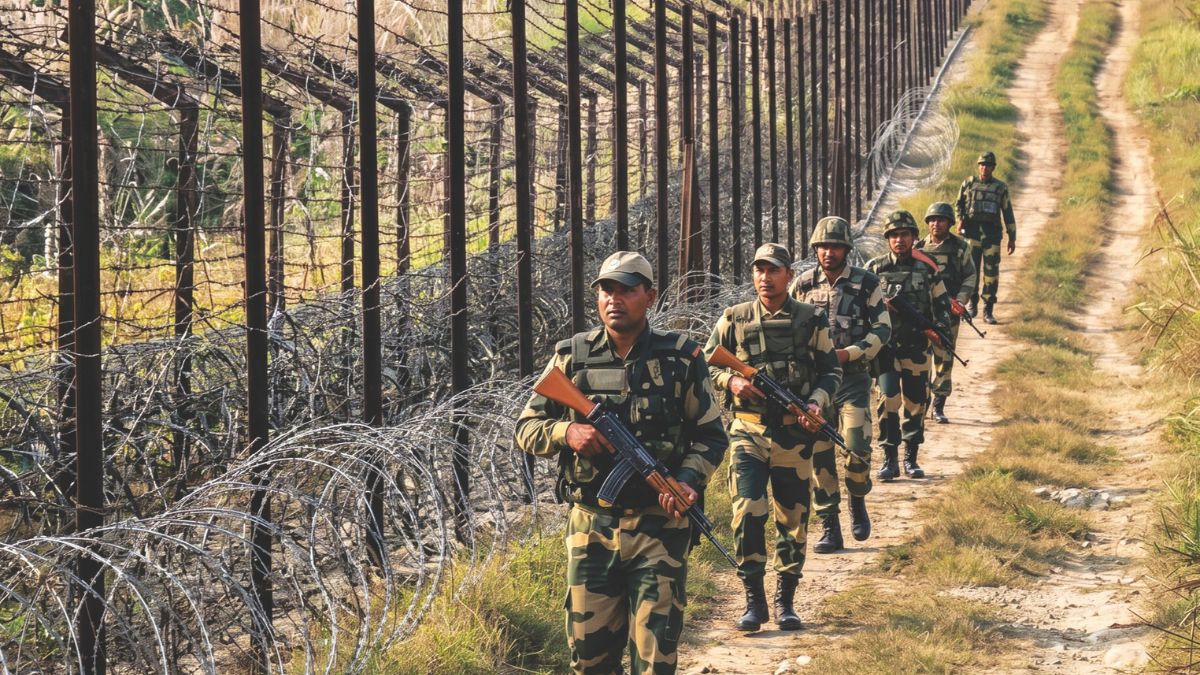
Security personnel patrol along a fenced border, where traditional barriers are increasingly backed by technology
Countries across the world have been reinforcing their borders, though with different objectives. For some, it is a matter of plugging holes that allow thousands of economic migrants to slip through and for some others, it is a matter of securing borders against an unfriendly neighbour and for a few countries, it is to counter not just economic migrants or an enemy nation, but also to counter terrorism.
India is one of the few nations that faces the triad of threats and hence the country has been trying to strengthen its border security. Stretching across 15,106 km of land through deserts, high mountains, dense forest, riverine plains and terrain that shifts with every monsoon, Indian borders present a security challenge that no government has ever fully resolved.
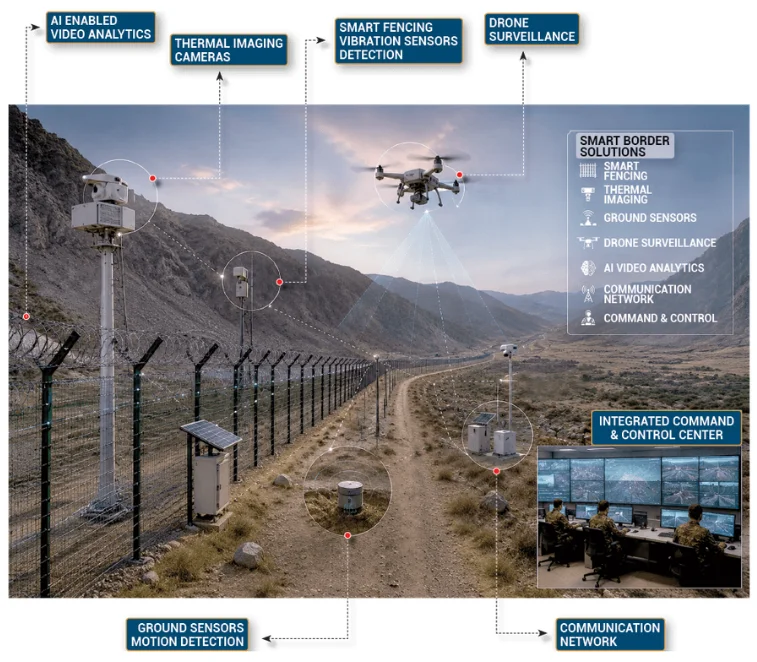
Smart border systems combine drones, thermal cameras and ground sensors for real-time surveillance and faster response (Infographics: Hitesh Mehta/Media India Group)
That approach is changing, not abruptly but in ways that are reshaping how India thinks about border security. Thermal sensors, artificial intelligence, drone surveillance, underground detection systems and integrated command centres have moved from experimental deployments to operational fixtures along the country’s most sensitive frontiers. The shift has been years in the making and it carries implications not just for how borders are monitored, but for what border security is expected to do.
Colonel Sanjeev Malik (Retd) watched much of this change from within the system. A former Indian Army officer with more than three decades of service across military operations, aviation and defence procurement, he has been associated with the evaluation and induction of major defence platforms and now advises organisations on defence, aerospace and public policy.
“In the early years, surveillance relied predominantly on physical patrolling, observation posts, fencing, floodlighting, and the experience of personnel on the ground. While these methods were effective, they were inherently constrained by terrain, weather, visibility, vegetation, seasons and the sheer scale of India’s borders,” Malik tells Biz@India.
Also Read: Embraer and Adani Defence & Aerospace announce strategic partnership
What followed over the next two decades, he says, was not simply a technical upgrade but a structural one. “The most important change has not been the introduction of individual technologies but the shift from a manpower-centric model to a sensor-centric surveillance framework. Today, multiple sensors can work simultaneously, providing a far more comprehensive operational picture than was previously possible,” says Malik.

Col Sanjeev Malik
That picture now includes thermal imaging cameras that can detect movement in complete darkness and through fog, ground surveillance radars, laser-based intruder alarms, aerostats floating above sensitive sectors, and seismic sensors buried underground to pick up vibrations from footsteps or digging activity. Along the Bangladesh border, where the Brahmaputra and its tributaries make physical fencing structurally impossible across large stretches, a dedicated project called BOLD-QIT Border Electronically Dominated QRT Interception Technique was inaugurated in March 2019 in Assam’s Dhubri district.
It uses optical fibre cables, microwave communication, digital mobile radio, and day-and-night cameras to feed live data to BSF control rooms. The idea was to monitor a riverine stretch electronically instead. As of early 2025, over 3,232 km of the 4,097 km long India-Bangladesh border have been covered with physical fencing, leaving approximately 864 km still incomplete.

Dr R K Arora
Dr R K Arora, a recipient of the President’s Police Medal for Meritorious Service, has spent more than three decades working across border security, cybersecurity, technology innovation, and counter-terrorism says that smart fencing, surveillance sensors, thermal imagers, and drones have certainly improved situational awareness and enhanced detection capabilities along select stretches of India’s borders.
“However, their overall effectiveness remains limited because India still lacks a fully integrated border technology architecture where sensors, command centres, response teams, and intelligence inputs operate seamlessly on a common platform,” Arora tells Biz@India.
The gap he identifies is not about hardware. It is about integration. Technology can ȵag an intrusion, but if the alert reaches a control room that cannot immediately task a response unit with reliable communication, the detection means very little. “The real challenge lies in integrating surveillance with rapid response and intelligence-led operations,” says Arora.
Also Read: Agniveer: One rank, one uniform, three paths
Arora says that Israel, which manages borders that are far shorter but acutely contested, has built a genuinely networked system in which sensors, intelligence, and response are wired together in near real time.
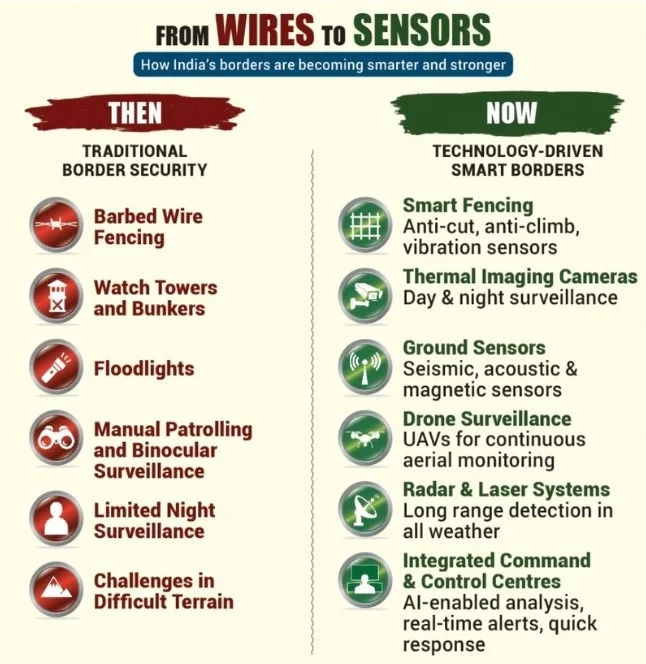
India’s shift from traditional border security to smart fencing, sensors and AI-powered surveillance
“India has made significant progress through initiatives such as CIBMS and deployment of advanced surveillance systems, but it is still behind countries like Israel in terms of integrated, layered, and network-centric border management,” says Arora.
He also points to the United States, which has spent billions of dollars on its southern border without resolving the fundamental challenge. India, he notes, operates across terrain that makes both those cases look relatively simple by comparison. Deserts, mountains, rivers, and dense forests each demand different technologies, different maintenance regimes, and different operational responses. No single system works across all of them.
The Ministry of Home Affairs approved a budget of approximately INR 13.2 billion for the Border Infrastructure and Management scheme covering 2021 to 2026, covering fencing, roads, floodlights, outposts, helipads, and technology deployment. It is a significant commitment and it signals that the government regards the technological modernisation of borders as a long-term programme rather than a one-time procurement exercise. But as Arora says, sustained funding is only part of the equation. Equipment that is not regularly maintained in extreme climatic conditions floods, sandstorms, sub-zero temperatures or high humidity degrades quickly. The technical workforce capable of servicing advanced surveillance infrastructure in remote locations is still limited.
Saurav Pratap Singh works on the technology side of this equation. A cybersecurity professional and SIEM engineer with certifications in ethical hacking and cloud security, he has followed the deployment of AI-driven surveillance systems closely. He points to thermal imaging cameras as among the most reliable tools available.
“Thermal imaging cameras are highly effective during night operations and in low-visibility conditions such as fog or dust. They can detect human and vehicle movement at significant distances, making them particularly useful along borders where intrusions often occur after dark,” Singh tells Biz@India.
Also Read: From boots to BrahMos: Indian defence exports rise up value chain
Underground seismic sensors, he notes, add another layer by detecting vibrations from footsteps or digging, though they carry a known limitation.
“They can sometimes generate false alarms due to wildlife, environmental factors, or weather conditions, requiring validation through other surveillance tools,” says Singh.

Saurav Pratap Singh
Satellite monitoring, meanwhile, works at a different level entirely it is not suited to real-time tactical surveillance but provides strategic intelligence about terrain changes, new construction near border areas, and large-scale movement patterns that other systems cannot track.
“The most effective approach is the integration of these technologies into a common operating picture. When thermal cameras, sensors, drones, and intelligence inputs work together, security forces gain a much higher probability of detecting and intercepting infiltration or smuggling attempts,” says Singh.
That integrated picture is also where the human being remains indispensable. Malik is precise about the boundary between what machines can do and what they cannot.
“There is an important distinction between detecting activity and understanding intent. Artificial intelligence can identify anomalies, but it cannot fully replicate human judgment developed through years of operational experience. A trained soldier can assess context, interpret subtle indicators, evaluate intent, and make decisions that take into account factors beyond what sensors can measure,” says Malik.
Technology provides scale, speed, and persistence, it cannot provide accountability, judgment, or the ability to read a situation that does not fit the pattern the algorithm was trained on.
Also Read: Forces face moral dilemma over Artificial Intelligence in defence
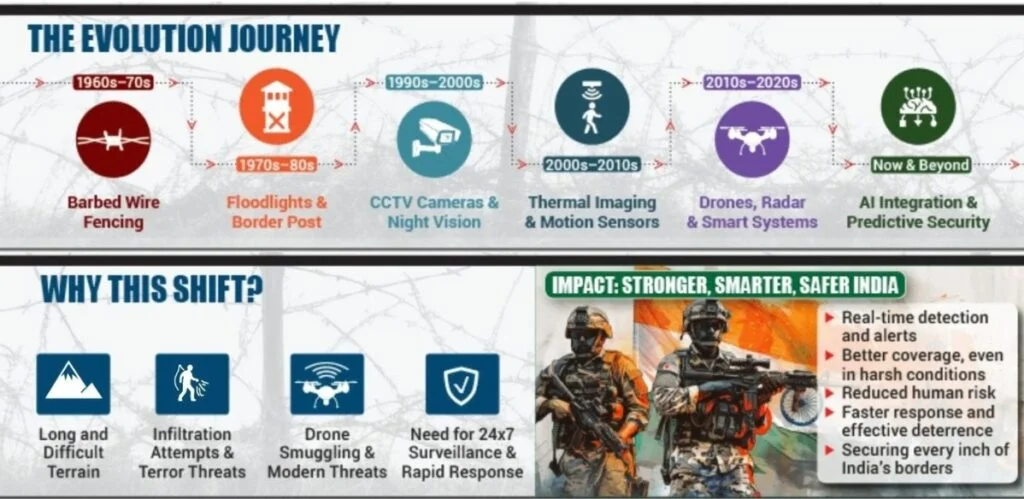
The evolution of border surveillance and why technology is now central to securing India’s borders
The evolving nature of the threat underlines this point. Border management today extends well beyond infiltration. Narcotics trafficking, weapons smuggling, human trafficking, and drone-based delivery of contraband have all grown in scale and sophistication. Following a terror attack near Kathua in March 2025, the Union Home Minister announced plans to bring the entire India-Pakistan border under comprehensive electronic surveillance within four years, with anti-drone systems, tunnel detection systems, and high-mast lighting identified as priority areas. The announcement reflected the seriousness of the drone threat in particular commercially available unmanned systems are now routinely used to drop weapons and narcotics across the western border, a problem that smart fencing cannot address on its own.
“The success of border technology depends less on the equipment itself and more on integrated implementation. Technology, trained manpower, sustainable budgets, and accountability must work together. A dedicated central implementation body under MHA with clear ownership, performance metrics, and long-term funding is essential. Otherwise, India risks facing the same implementation challenges witnessed in earlier CIBMS initiatives and even on the US-Mexico border, where substantial investments did not always translate into desired operational outcomes,” says Arora.
India has built more capability along its borders in the last decade than in the previous five put together. The wire is still there. The sensors have simply joined it. Now it is a question of looping them together with a manned centre to monitor and respond. The sooner this circle is closed, the faster will India be able to secure its rather-porous borders.