
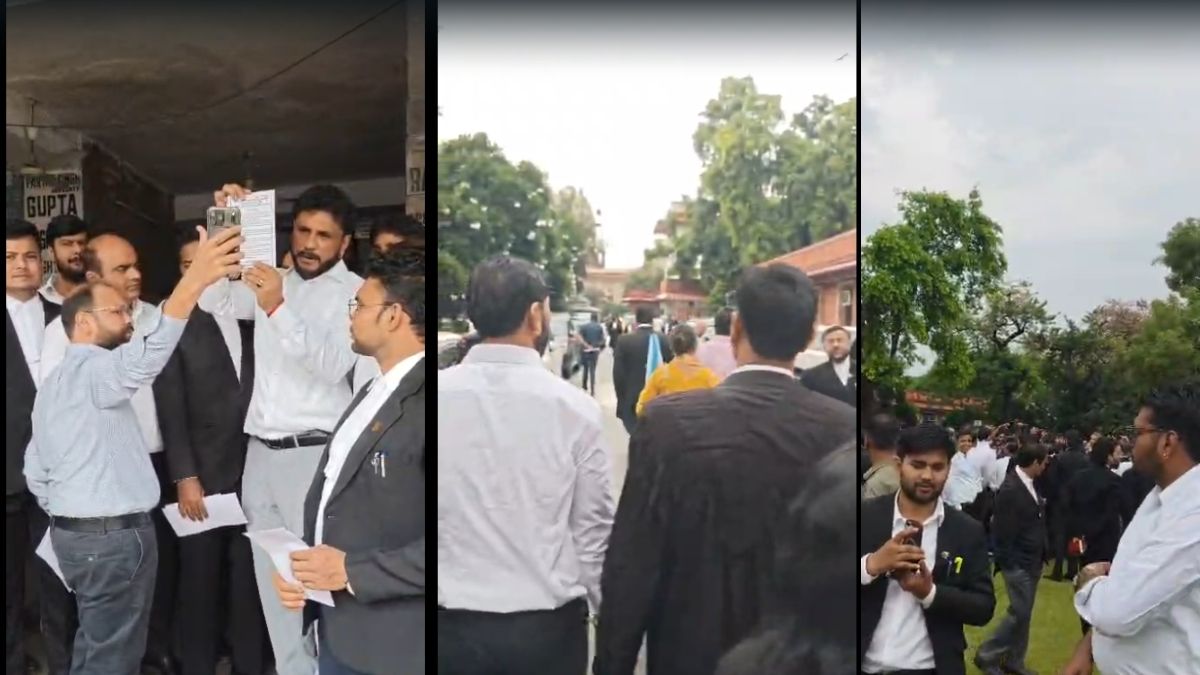
The protest reflects wider concerns among lawyers over Bar Council independence, advocate representation and financial and social security (Photo: Adeeb Khan)
Advocates in Delhi, protesting against alleged harassment, inadequate facilities and lack of professional security, gathered outside the Supreme Court in New Delhi on Thursday as part of their agitation which completed its 22nd day.
The lawyers also raised questions over their treatment within the justice system and urged the wider legal fraternity to unite behind their demands.
The protesting advocates gathered near Gate D of the Supreme Court, demanding better working conditions and equal treatment within the justice system. Addressing fellow lawyers, a protest organiser said advocates were recognised as officers of the court but were not receiving the respect and facilities that should accompany their professional responsibilities.
“We are demanding that we be given security, respect, facilities and freedom,” the speaker said, urging lawyers across the country to support the agitation.
The speaker alleged that advocates, including those with decades of experience, continued to face harassment and inadequate facilities. The protester argued that lawyers should be treated with the same dignity as other participants in the justice system and questioned whether accountability for contempt was applied equally.
The address also raised concerns over restrictions on strikes by lawyers. The speaker argued that if advocates were considered an important part of the justice system, their working conditions and professional security should also be addressed.
The protesters said their demands extended beyond the immediate group participating in the demonstration, describing the agitation as a struggle for the wider legal community.
Adeeb Khan, a Delhi-based lawyer who participated in the protest, said one of the main demands was to end the influence of the judicial Bench in the affairs of the Bar, particularly in the election process of the Bar Council of Delhi (BCD). Khan said an order providing for the nomination of two members by the Bench, rather than through elections, had prompted concerns among advocates about the independence of their representative body.
“The Bench is a separate body, it is the body of the judges, and the Bar is the body of the advocates,” Khan told Media India Group, arguing that the two institutions should remain independent of each other. He said advocates did not interfere in the functioning of the Bench and wanted the judiciary to maintain a similar separation from the Bar’s affairs.
Khan also highlighted the financial difficulties faced by first-generation advocates, particularly during their initial years in the profession. He said newly enrolled lawyers in several states struggle to meet basic living expenses because they may have to work for three to four years without earning a sustainable income.
Referring to Bihar, Khan said a notification had provided for a monthly payment of INR 5,000 to advocates, but alleged that the scheme had not been implemented effectively. He called for financial assistance from Bar bodies or the Supreme Court to help newly enrolled lawyers establish their practices and remain in the profession.
Also Read: RSF condemns ‘unprecedented’ detention of 40 journalists during electoral roll protests in India
“Many talented advocates are not able to sustain in this profession. And we are losing a very good advocate,” Khan said.
Khan further said that a stronger Bar was necessary for effective accountability and access to justice. He alleged that advocates petitions were sometimes not heard by the Supreme Court and that the court’s response to issues raised by lawyers needed to improve. These were his criticisms of the institution and were not independently established by the protest.
Mohammad Saddam, another Delhi-based advocate who attended the protest, said the lawyers had approached the Supreme Court because they believed its orders could ensure that their demands were implemented across government departments and institutions.
“Instead of protesting in many places, if we ask from the Supreme Court, because the Supreme Court is the most powerful judicial body in the country, so if the Supreme Court makes an order in our favour, then our demands will have to be met,” Saddam told Media India Group.
Saddam said the protesters wanted transparency and expected the court to intervene in matters concerning advocates’ welfare. He added that lawyers had repeatedly approached the Bar Council to seek financial support for newly enrolled advocates but had not seen the assistance implemented effectively.
“Our third question is that we have tried to convince the Bar Council many times to support the advocates in the initial stage. If they are not getting any help from home, then our advocates will support the Bar Council together. But they just say that it is okay, but it has not been applied anywhere,” Saddam said.
Explaining why the lawyers had decided to approach the Supreme Court directly, he said, “Where will the advocates go? They cannot go to anyone, they cannot meet any officials.”
Saddam also linked the demands for advocates welfare to broader concerns about unemployment and corruption. He said educated young people were struggling to find jobs and alleged that irregularities in recruitment processes were adding to their frustration.
“Everywhere, many people are highly educated, but they do not have employment. If they do not have employment, what will they do? Our government is not giving them a job anywhere,” Saddam said.
He also alleged that recruitment examinations were affected by paper leaks and other irregularities, adding that young people were struggling to find opportunities despite their qualifications.
“So what should we do? So the only way to remove corruption is to protest. And by protesting, we will take our own rights,” Saddam said.
The protest comes amid wider concerns within sections of the legal fraternity over the independence of Bar Councils, representation of advocates and their financial and social security. According to a media report lawyers had been protesting outside the Supreme Court and had called for greater autonomy for Bar Councils, democratic elections instead of nominations, and stronger welfare measures for advocates.
Also Read: Government accused of stifling protests by shutting down Jantar Mantar protest site
Explaining why the lawyers had chosen the Supreme Court as their protest site, Khan said the demonstration had continued peacefully near Gate D for more than three weeks, but the protesters felt their demands had not received adequate attention. He said advocates from Delhi and other parts of India had joined the October 15 march to press for action on their concerns.
Khan said the protesters expected the Supreme Court to consider their demands and pass a reasonable decision on advocates welfare. He warned that if their concerns continued to be ignored, the agitation would continue peacefully, with protesters potentially moving inside the Supreme Court premises to occupy a designated corner.
“The Supreme Court is our home, our temple, so we will continue to sit peacefully in the Supreme Court,” Khan said.
The latest demonstration follows a separate protest-related incident on October 10, when advocates were detained near the Supreme Court ahead of a planned demonstration by the Cockroach Janata Party. According to media report, around 50 to 60 lawyers were detained and later released following intervention by Chief Justice of India Surya Kant after the Supreme Court Bar Association raised concerns.
