

Outlook of Digital Payments in India finding new dimension
In the wake of India adjusting to the gradual sedimentation of the demonetisation fiasco, global telecom body GSM Association and Boston Consulting reports that the digital payments industry in the country is set to reach USD 500 billion by 2020, with over 50 pc of internet users in the country using digital modes of transaction.
The report was prepared over BCG research in six countries — Brazil, China, Germany, India, South Korea and the US. “In India, BCG estimates that digital technologies will influence up to 45 pc of all retail sales by 2025,” the report on ‘Embracing the Digital Revolution: Policies for Building the Digital Economy’ said, adding, “BCG projects that more than 50 pc of India’s Internet users will use digital payments by 2020, when the size of digital payments industry in the country will be USD 500 billion.”
As India leaps toward a digital economy, the adoption of digital payment platforms is on the rise as well. Before the demonetisation drive, which started on November 8, 2016, there were a handful of digital wallet services such as Paytm, FreeCharge and MobiKwik. But, none of them offered comprehensive digital payment structure and had their own limitations. As the government shifted focus towards a cashless society, the entire paradigm of digital payment options in the form of apps and services had a new way to look at things.
New services such as Bharat QR, Unified Payments Interface (UPI), BHIM, and National Unified USSD Platform started entering the market, increasing their penetration. These services were introduced alongside existing banking services such as internet banking, mobile banking and immediate payment service (IMPS).
Let’s look at four new digital payment platforms that promise to take digital transactions in the country to a new level.
Bharat QR code
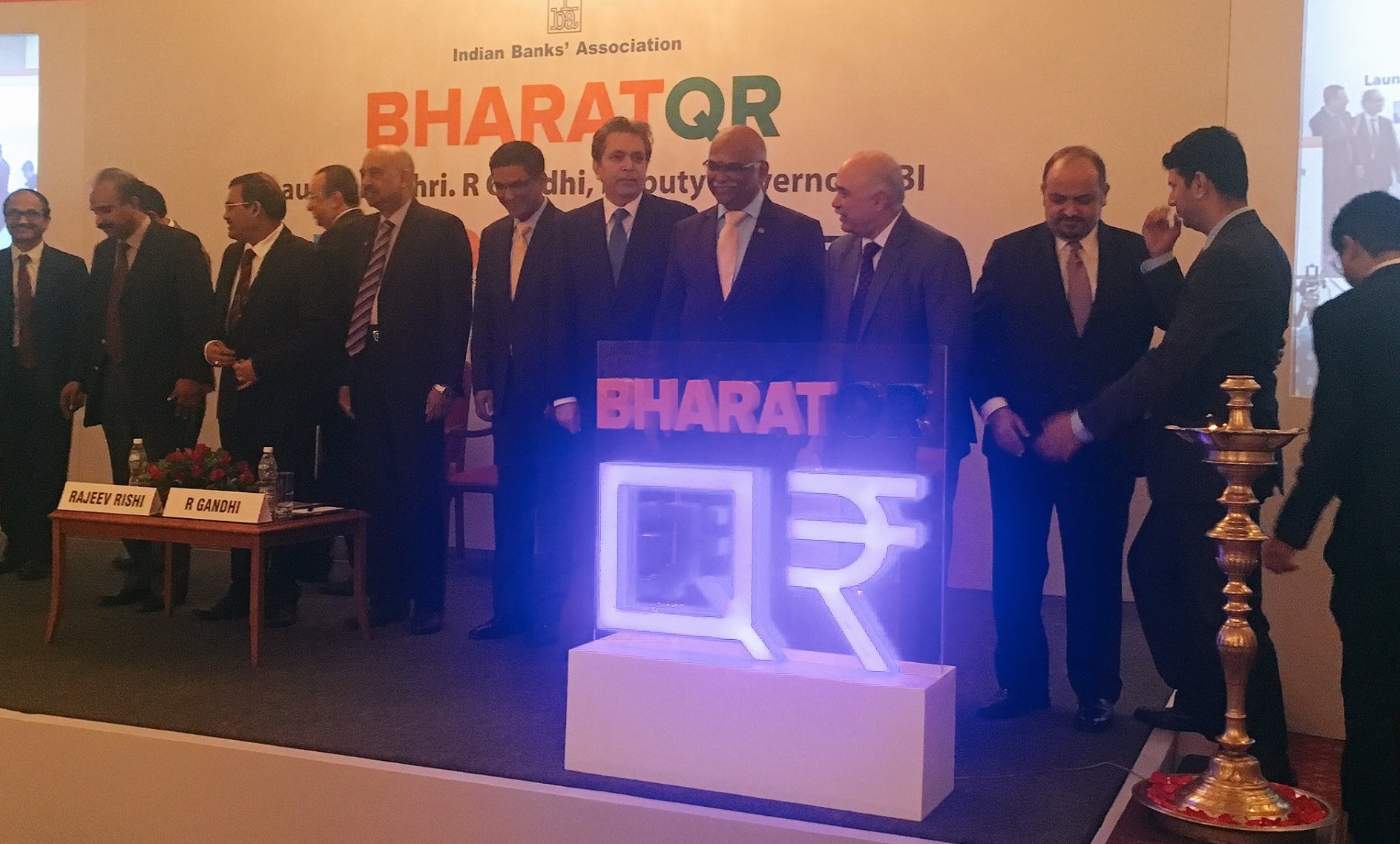
Bharat QR launch: 14 banks are partnering this flagship government programme that was unveiled in Munbai in the presence of RBI’s Deputy Governer Rama S. Gandhi
A joint initiative from the National Payments Corporation of India (NPCI) and payments companies such as MasterCard and Visa led the Bharat QR code project in the Indian market. The prime focus is to enable digital payments without a card or card swiping machines.
Quick Response (QR) codes carry information that could only be decoded with the help of a QR code scanner and that is exactly what Bharat QR does. Banks have been integrating Bharat QR services to their existing mobile apps and therefore no extra app or service is required to access Bharat QR.
To use Bharat QR code for digital payments, users need to have an internet enabled smartphone and bank app compatible with Bharat QR code. Using the bank app to scan the QR code eliminates the need of entering required information like phone number or card number manually to make the transaction. Rather, all it takes is to scan the QR code and the amount gets transferred within bank accounts.
Unified Payments Interface (UPI)
Very similar to Bharat QR, UPI is not an app but a service. The UPI significantly reduces the steps involved in fund transfer process like entering card details, net banking password, IFSC etc. And, it facilitates instant fund transfer through virtual payment address (VPA) using mobile platform.
To use the UPI services, all you need is an internet enabled smartphone equipped with UPI supported banking app that supports UPI services. In addition, the user is required to create a Virtual Payment Address (VPA), which is sort of an email ID like halid@icici or sunainaa@kotak. These VPAs act as the address to direct payments and can be used to receive or transfer money. These VPAs are well thought out replacements that eliminate the need to add/enter any other information such as the account number, IFSC etc. before transferring funds and thus, simplifies the whole fund transfer process significantly.
Bharat Interface for Money (BHIM)
Here is the third one: BHIM, which is quite unlike Bharat QR and UPI. It is a service based on an app developed by the NPCI to promote digital transactions using UPI.
Needless to mention that to use the BHIM app, the user needs to have an internet enabled smartphone and UPI compatible bank account, in addition, as the BHIM app works on UPI protocols and it requires mobile number linked to the bank account to make a transaction. With the help of BHIM app, the user can manage multiple bank accounts that support UPI services in one single app. The app also enables other features such as quick bank balance check, switch accounts and send money to non-UPI supported banks with the help of IFSC and account number. The app also supports fund transfers to Aadhar registered bank accounts.
National Unified USSD Platform (NUUP)
The fourth on the list is unlike all the above-mentioned services that require an internet enabled smartphone and an app; this is rather based on unstructured supplementary service data (USSD) codes. The USSD codes don’t require any internet connection or smartphone and can simply work by transmitting information using GSM network. There are different banks that follow different protocols to use NUUP service, and therefore the user needs to check with the bank to confirm the USSD code for various services. Moreover, as the NUUP services are based on USSD codes, the service is limited to checking account details, generate mini statements, fund transfer via MMID (a code allotted by banks on mobile banking registration), IFSC or Aadhaar number, and generating OTPs, Mobile-PIN.
Whether these new digital payment channels make it big in India remains a question, but, to have a clear idea about these systems and the changing practices in the transaction system of the country remains imperative. Get in touch with Asiacom, to get digital payment-related solutions that can boost your online business.
