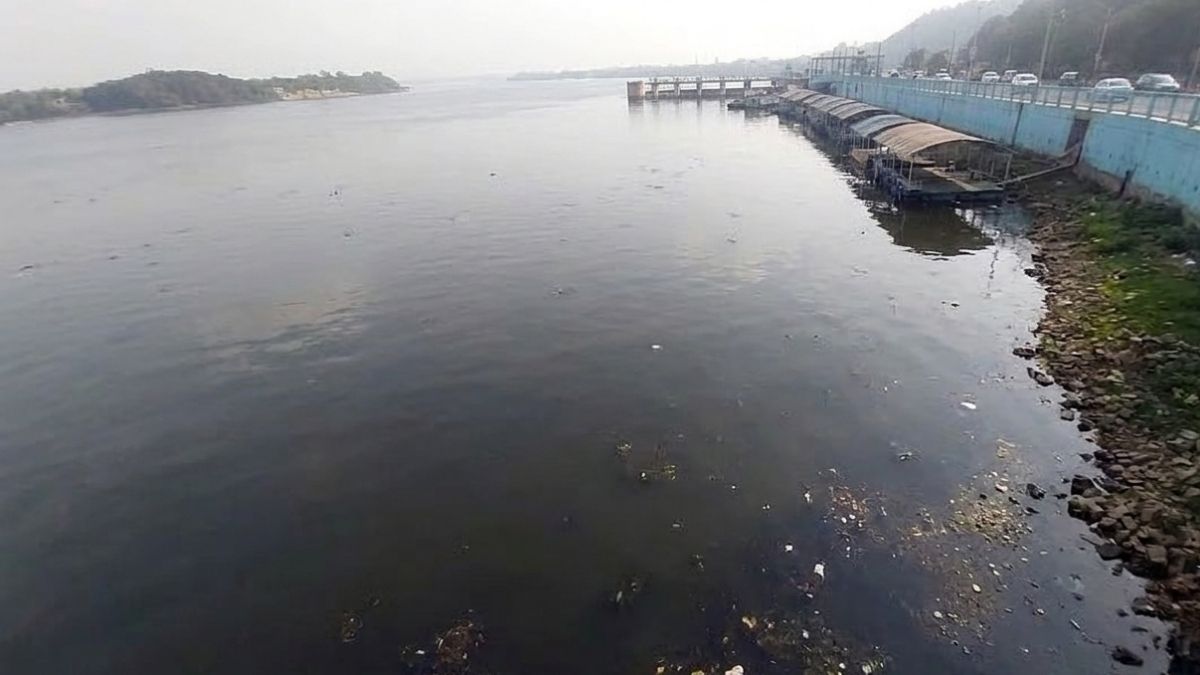
Upper Lake, a key source of drinking water for Bhopal, faces growing pressure from pollution, encroachments (Photo: Ramesh Gite)
One of the most important sources of urban water supply in Madhya Pradesh, the Upper Lake in Bhopal is threatened with incessant dumping of construction material as well as by encroachments.
The dire situation of the lake forced the National Green Tribunal (NGT) to intervene and recently the country’s top green court directed Bhopal Municipal Corporation (BMC) to stop the dumping of soil, earth, construction debris and other solid material within the Full Tank Level (FTL) area of Upper Lake. It also directed authorities to ensure that silt and water hyacinth removed from the lake are properly handled and transported to designated disposal sites.
The order follows a media report alleging that several truckloads of soil were dumped near the Bhadbhada intersection, opposite Hotel Taj, within the lake’s FTL area. In July, the NGT took suo motu cognisance of the report and formed a joint committee to inspect the location and submit a factual and action-taken report within six weeks. The matter was listed for further hearing on September 28.
Bhoj Wetland, comprising Upper Lake and Lower Lake, covers 32.01 sqkm and in 2002 it was designated a Ramsar site, placing it in a global list of important wetlands worldwide. Upper Lake is a major source of drinking water for Bhopal and supports aquatic life and bird habitats. Its protection is therefore not simply a conservation concern but a matter of public interest.
Dumping soil and construction debris within the lake’s water-holding area can increase sediment accumulation and reduce storage capacity. Depending on the material, it may also affect water quality and aquatic habitats. The extent of damage at the reported site needs scientific assessment, but the possibility of long-term harm makes preventing further dumping essential.
Prof Ganesh Channa, Founder and President of the World Environment Council, a non-profit organisation based in New Delhi, says the allegations require an independent inquiry into responsibility and possible administrative failures.
“If the civic body entrusted with protecting the city’s environment is found responsible for damaging a critical waterbody, the matter demands serious scrutiny. Accountability must extend to everyone found to have authorised, carried out or negligently permitted the violation,” Channa tells Media India group.
“The key question is not merely who dumped the debris, but how it continued despite environmental safeguards. An independent inquiry must establish the facts, identify administrative failures and ensure appropriate legal action. No authority can claim the power to protect a lake while allowing its degradation,” he adds.
Also Read: New water pollution monitoring system set to make a splash
The problem extends beyond dumping. In separate proceedings, the NGT has raised concerns about encroachments around Upper Lake, construction within the FTL area and the need for accurate demarcation of the lake’s boundaries. These cases point to the pressure that urban development places on protected waterbodies and the difficulty of safeguarding them when land-use restrictions are not consistently followed.
The Wetlands (Conservation and Management) Rules, 2017, restrict solid waste dumping and construction waste disposal in protected wetlands. The reported incident raises questions about whether these safeguards are being enforced effectively. Authorities must establish who was responsible, whether the site was clearly demarcated and why the dumping was not prevented.
“The gap is between legal protection and protection on the ground. Ramsar recognition gives Bhoj Wetland international significance, but a designation alone cannot stop encroachment or prevent irresponsible construction practices. The real test is whether regulations are enforced consistently, violations are detected early and offenders face consequences,” Channa says.
Sewage pollution adds to the lake’s environmental challenges. The NGT has separately addressed concerns about untreated wastewater entering Upper and Lower Lakes. Dumping, encroachment and sewage require different solutions, but together they place pressure on the wetland’s ecological health.
The Madhya Pradesh government’s Environmental Planning and Coordination Organisation publishes water-quality monitoring reports for Upper Lake. Comparing recent measurements with earlier data could help determine whether water quality has changed near the reported dumping location. Parameters such as turbidity, the cloudiness or haziness of water, suspended solids and dissolved oxygen would be relevant, although any link between the dumping and changes in water quality would need to be established scientifically.
Also Read: World Water Day: Pollution aggravates water scarcity in India
Channa says the lake’s deteriorating condition during these visits makes it important to examine the reported dumping and encroachment on the ground.
According to Channa, BMC must clarify whether the dumping has stopped, whether any material has been removed and whether action has been taken against those responsible. The joint committee’s findings should also be made public so that residents can understand the scale of the incident and the administration’s response.
Not just ecologists, but local residents are also worried about the fate of the lake. Ramesh Gite, a resident of Khanugaon locality in Bhopal, says protecting Upper Lake requires authorities to go beyond general assurances and investigate specific allegations of dumping.
“If soil and construction debris are being dumped within the lake’s protected area, the authorities should investigate who is responsible and where the material is coming from. There should be proper monitoring so that such activity does not continue unchecked,” Gite tells Media India group.
Gite also calls for greater transparency about the lake’s condition and the action taken by civic authorities.
“The authorities should inspect the site, compare its present condition with earlier records and make their findings public. Otherwise, it is difficult for us to know whether the situation is improving or getting worse,” he adds.
He says the lake’s importance as a drinking water source makes monitoring pollution particularly important.
“Any unusual smell, change in water colour or floating waste should be investigated instead of being ignored. The authorities should conduct regular water-quality tests and share the results publicly. We also need a clear way to report pollution and find out what action has been taken,” Gite says.
On enforcement, Gite says that environmental rules should apply equally to residents, businesses and government agencies.
“The authorities should disclose who is responsible for any confirmed violations, what action has been taken and whether the affected area has been restored. Protecting the lake should not depend on who is responsible for the damage,” he adds.
According to the residents and ecologists, while the NGT order is an important step, but its significance will depend on the outcome. If dumping has occurred within a protected area, the response must go beyond removing visible debris to preventing further violations and ensuring that construction waste is disposed of lawfully.
“The Upper Lake is not simply a piece of real estate or a site for construction activity. It is a vital water resource, an ecological asset and part of Bhopal’s natural heritage,” Channa says.
“The National Green Tribunal’s intervention should lead to measurable action, not merely temporary compliance. Authorities must establish accountability, publish scientific findings, restore any confirmed damage and prevent further violations. Citizens also deserve transparency about the condition of the lake that supports their daily lives,” he adds.