
Climate-friendly farming practices can reduce agricultural emissions and improve soil health
The octogenarian United Nations ended the general debate of the 81st UN General Assembly session on September 28. It produced many important observations on peace, artificial intelligence, war and the future of the United Nations. Hardly any dealt directly with food security or sustainable farming. Acute crises and geopolitical interests crowded out sustainability issues. The week’s high-level meetings also covered climate, sea-level rise and pandemics, but none was devoted to how the world grows its food. That silence raises a vital question, what has the world actually done to make farming sustainable?
From limits to inputs
For about 10,000 years, farming depended on what a family, a field and a season could produce. Soil and water set the limits, and the damage was localised. In the 20th century, those limits got blurred, lifted and even vanished.
Faced with famine in the 1960s, countries such as India adopted high-yielding wheat and rice, along with a generous dose of chemical fertilisers and large-scale irrigation networks. It worked. Between 1960 and 2000, cereal output in developing countries tripled while cultivated land grew by only about 30 pc. Wheat yields alone roughly tripled.
But the change carried a hidden price on ecology. Use of synthetic nitrogen fertiliser has grown eightfold since the early 1960s, and crops now absorb a smaller share of what is applied. Farming moved from working within natural limits to crossing them.
Why the pressure kept building
Four drivers pushed the global farming industry in the same direction. The first was people, or more specifically many more of them each year. The world had fewer than 3.7 billion in 1970, nearly 9 billion now and is heading towards 10 billion by 2050. The second was land. More than 95 pc of our food grows on land, little new land is available for farming, and the land used per person fell by a fifth between 2000 and 2017.
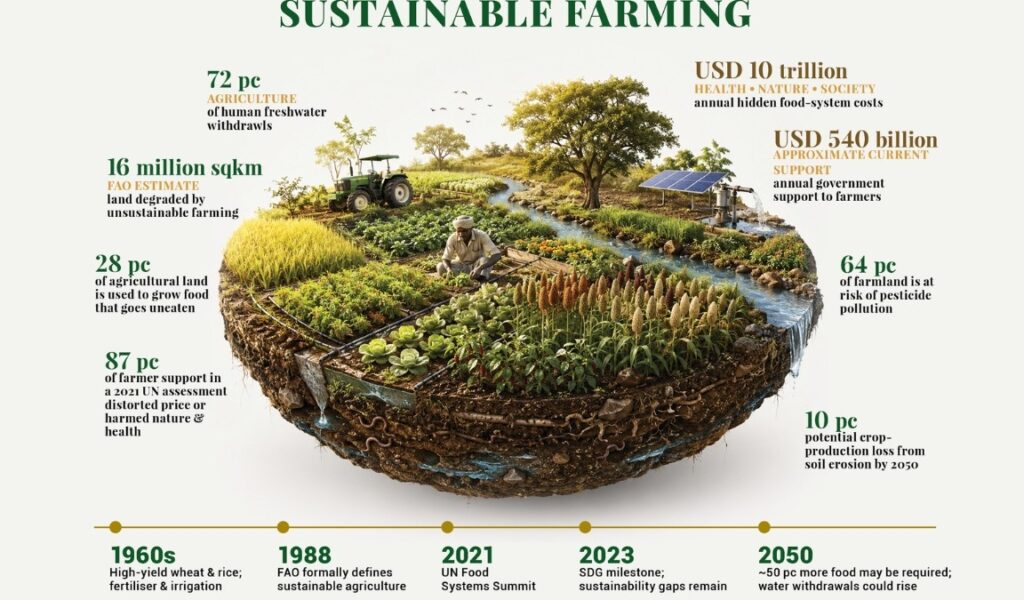
The third was money. Governments spend roughly USD 540 billion a year supporting farmers. A 2021 assessment by three UN agencies found that about 87 pc of that support distorts prices or harms nature and health. In short, public policy rewarded more output. Better care of soil and water was secondary. The fourth was wasteful behaviour and infrastructure. The food produced was wasted on farms, in transit, in storage and in plates . As per FAO, about 14 million sqkm of agricultural land, roughly 28 pc of the world’s total agricultural area and an area as large as the size of the US and India combined, are used to grow food that goes uneaten. Of the waste occurring at the consumer stage, approximately 60 pc happens in households, 28 pc in food service namely restaurants, hotels or canteens, and 12 pc at retail.
The bill lands
The costs are now hard to ignore. The Food and Agriculture Organisation (FAO) estimates that more than 16 million sqkm of land, over a 10th of the planet’s land area, has been degraded by unsustainable farming practices. Agriculture accounts 72 pc of the freshwater that humans withdraw, about 64 pc of farmland is at risk of pesticide pollution. FAO also warns that soil erosion alone could cut crop production by 10 pc by 2050.
When FAO tried to add up the damage to health, nature and society that never shows up in food prices, it arrived at USD 10 trillion a year, no less than 10 pc of global GDP every year.
Thirty-eight years of promises
The world did notice the rising consumption of resources by agriculture which had become increasingly unsustainable. In 1988, 16 years after the Stockholm Conference on Human Environment, FAO’s Council formally defined sustainable agriculture as farming that conserves land, water and genetic resources while staying economically viable and socially acceptable.
In 1991, a conference at Den Bosch in the Netherlands, attended by about 120 countries, called for fundamental change. The Rio Earth Summit in 1992 carried the idea forward, and in 2021 UN Food Systems Summit followed, and by 2025 some 128 countries had drawn up national plans for their food systems. Under the global biodiversity framework, governments have also agreed to cut at least USD 500 billion a year in harmful subsidies by 2030. Definitions, declarations, targets and summits were in plenty. Results were seen wanting!
Also Read: Indian food processing industry: Limited appetite for value-added exports
What the scorecard says
There is good news, and it should be stated plainly. About 645 million people faced hunger in 2025, which is 14 million fewer than the year before and about 43 million fewer than at the 2022 peak. That was substantial The number of people who cannot afford a healthy diet fell from 2.97 billion in 2021 to 2.69 billion, a progress that made chins smile a bit.
Sustainable farming can help reduce water use, soil degradation and hidden food-system costs
On sustainability itself, though, the evidence is even thinner. The official indicator for the share of farmland that is productive and sustainable still lacks enough country data, so the UN uses a stand-in measure. It places the world at a moderate distance from the goal and only slightly better off than in 2015. The Food Systems Countdown Initiative found that just 20 of 42 food system indicators are moving in the right direction, and none fast enough to reach the 2030 goals.
A system that feeds but does not nourish
Producing more food was supposed to mean healthier people. The numbers tell a different story. A healthy diet now costs about USD 4.28 per person per day, up from USD 3.44 in 2021. Adult obesity has climbed from 12.1 pc in 2012 to 16.2 pc in 2024. About 150 million children under five remain stunted, and anaemia among women of reproductive age is getting worse.
FAO’s analysis shows that more than 70 pc of the hidden costs of our food systems come from unhealthy diets. A farming system that cannot deliver nutritious food at an affordable price is not sustainable, whatever it does for yields.
The road to 2030 and beyond
The year 2030 is the milestone year in the human calendar of sustainability as that is the year by when the 17 Sustainable Development Goals are targetted to be achieved. SDG number 2 is about ending hunger, achieving food security, improving nutrition and promoting sustainable agriculture. On current trends, around 512 million people will still be undernourished in 2030, and more than half of them will live in Africa.
Feeding a population near 10 billion could require 50 pc more food by 2050. Using today’s methods, that could raise farm water withdrawals by as much as 35 pc. Meanwhile, if present trends continue, government support to farmers could reach USD 1.76 trillion by 2030. Pouring more money into the same methods will not change the outcome. The task is not a better forecast but changing the course. Unfortunately, the window for changing the course is closing fast.
A revised map
The old map relied on declarations and voluntary national plans. A better one should rest on three foundations.
The first is honest measurement. Countries need funding to collect farm-level data, so that the world can track sustainability instead of estimating it. The second is the way the money flows. The UN does not propose ending farm support. It proposes moving it from harmful payments towards research, infrastructure and rewards for good practice, as the UN’s own subsidy report notes was done in Andhra Pradesh, in India, with natural farming, and in China, with cuts in fertiliser and pesticide use. The third is true cost accounting, so that the USD 10 trillion hidden in the system appears in public budgets, procurement and corporate reporting. Each step needs a date and a public review. The UN has estimated that the transition needs an extra USD 300 billion to USD 400 billion a year. That is large, but modest beside the hidden costs we have long been paying.
What is still missing
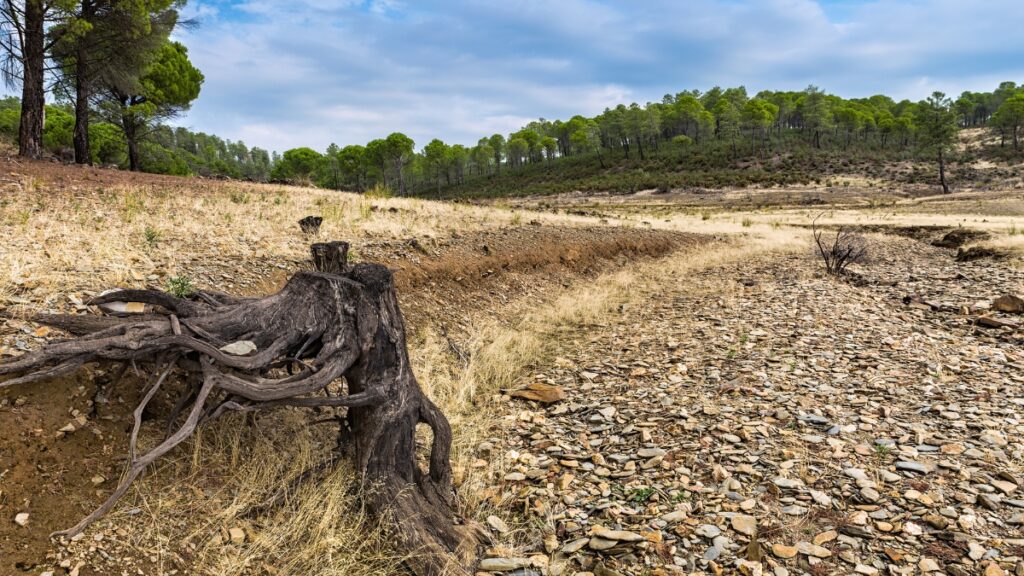
Prolonged dry conditions and water scarcity cause soil moisture loss and stress surrounding vegetation
To make farming really sustainable, there are several missing elements and the biggest gap of them all is capital, both financial and human capital. The people who actually farm are far away from learning about sustainability. Financial capital hardly goes in developing the human capital in the agricultural universities. Agriculture education and food processing technologies receive only a small fraction of global climate finance. Farmers with small land holdings, who are not just an overwhelming share of global agricultural workforce but also produce the majority of the food in developing countries, remain cut off from awareness about sustainable practices.
Also Read: Indian market flooded with poor quality, unhealthy foods amidst weak regulation, low awareness
Higher education in most countries does not include education about sustainable farming. One recent commentary also notes that the global target to cut harmful subsidies says nothing about how those subsidies could be diverted to raise human capital. Network of Universities of Agriculture for sustainable farming is unheard of.
The gaps between regions are just as wide. Africa now has more hungry people, about 309 million, than Asia, with 292 million. In 2025, 56.6 pc of Africans faced moderate or severe food insecurity, against 20.3 pc in Asia and 8.7 pc in North America and Europe. Two in three Africans could not afford a healthy diet, more than double the share in Asia or Latin America. Asia and Latin America have improved steadily, while Africa’s rise in hunger has only just stopped.
Sustainability also means different things in different places. In some regions the task is to cut excess fertiliser and water. In others, especially across Africa, it is to rebuild soils and raise yields so that farmers can earn a living.
What is also being missed is true sustainable farming, based on ‘climate-friendly practices’ that tackle greenhouse gas emissions. Agriculture accounts for roughly 40 pc of global human-induced methane emissions, which translates to about 10-12 pc of total global greenhouse gas (GHG) emissions when measured in carbon dioxide equivalents (CO2 e). That includes methane from animal-cattle stocks, manure and other sources.
Flooded rice paddies are the only crop that creates anaerobic or oxygen-free conditions where bacteria produce methane. Moreover, that contributes to only 8 pc of methane generated from the entire agri-sector. That too can be reduced by moving away from flooded paddy fields and use ‘Alternate Wet and Dry (AWD) method, which has additional advantage of reducing water usage for paddy, without any way not affecting the yield.
Universities that are now obsessed with AI and digital technologies, however, are overlooking these opportunities to conduct research in agricultural practices to reduce GHGs from farming to reduce methane emissions from cattle, manures and biochar.
Overall, a single global prescription will not work. But a singular question remains, whether sustainable farming will always be just a target, an illusion, like lasting peace? But while gauging the price of missing peace is a complicated process, the cost of unsustainable farming is very clear and visible in our daily lives. We can count hungry people, measure degraded soil, estimate hidden costs and redirect subsidies. Hunger has now fallen three years in a row, which shows that coordinated action works.
Yet almost 40 years after sustainable farming was first defined, there have been far too many slippages on the route to achieve the targets set by UNSDGs. We are still stuck in geopolitics and hoping to track sustainability with AI, without realising that small farmers who get less than 1 pc of climate finance cannot be funded by AI! What is missing is the constructive partnership. Until that is forged , the world’s efforts at sustainable farming will deserve the title of this article!
(Rajendra Shende is a former Director UNEP, Founder Director Green TERRE Foundation, coordinating lead author, IPCC that won Nobel peace prize, Prime Mover SCCN, IIT Alumnus. The views expressed here do not necessarily reflect those of Media India Group.)
