
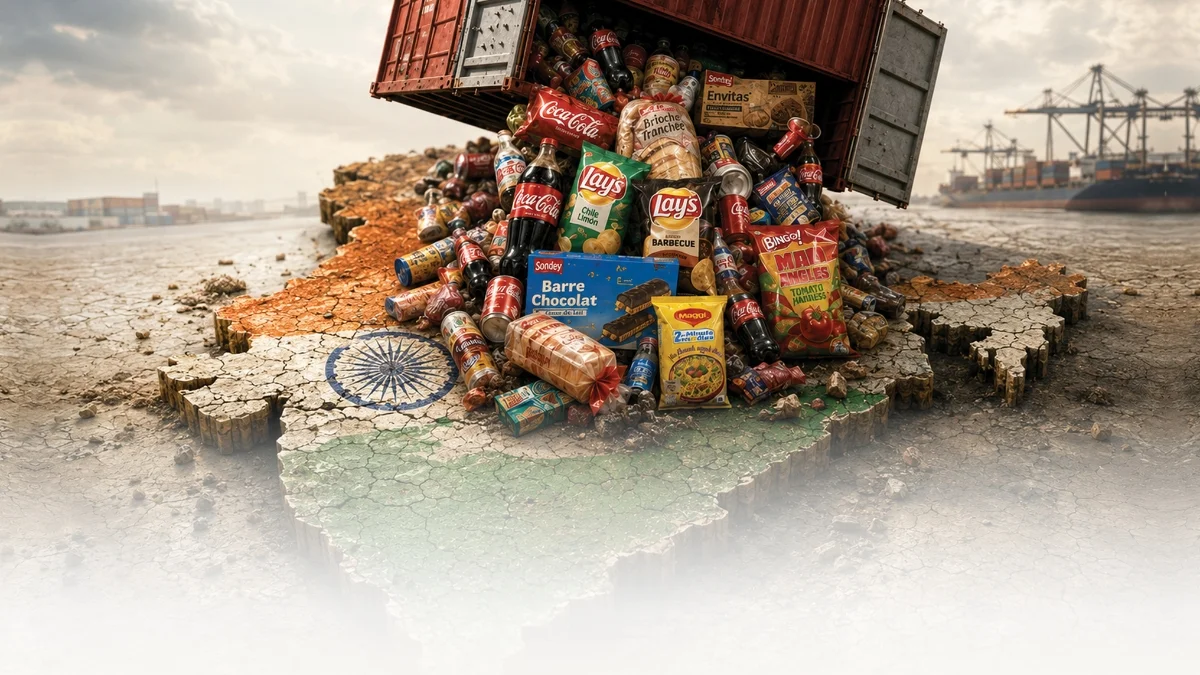
With high dosage of sugar, salt and preservatives, many companies, Indian or foreign, are literally dumping poor quality and unhealthy products in India
The branding, the packaging and the visuals are identical, right down to the shade of the colours. On face of it, a Kit Kat, a popular chocolate brand manufactured by Swiss food giant Nestlé in India is precisely like the one made and sold by the same company in its home ground, Switzerland. The same is true of a can of Fanta, an orange-flavoured carbonated beverage manufactured by American giant Coca Cola and countless other products manufactured by global food multinationals that one can find on the shelves of almost every grocery store.
But moment you turn the pack over and look at the ingredients used in the product that you realise that two are as similar as chalk and cheese. A Fanta sold in a European country like France has 6.3 gm of sugar for each 100 ml of the beverage, while the same Fanta in India has more than double the amount of sugar, with 13.7 gm of sugar per 100 ml or 45 gm sugar in each 330 ml can of the beverage. Thus a can of Fanta in India has twice the daily limit of sugar recommended by nutritionists.
It is not just sugar. Whether unbranded, a domestic brand or a global multinational brand, food products sold in India have far higher amounts of salt, oils, added chemicals and preservatives than those sold in tightly regulated markets of the developed countries or even developing nations like China.
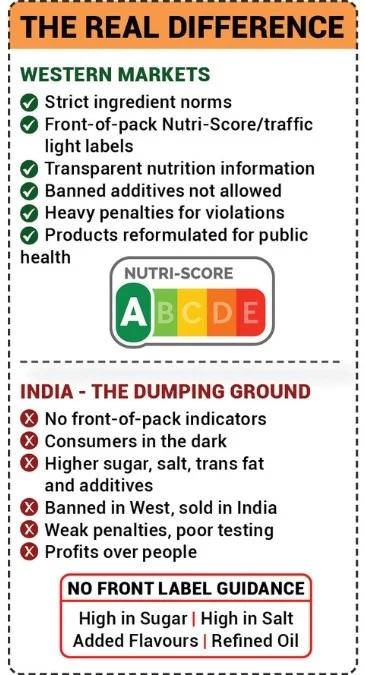
Differences in food labelling standards highlight the need for clearer nutritional warnings and stronger consumer protection in India
Two years ago, a study by the Access to Nutrition Initiative (ATNI) revealed that major multinational companies, including Nestlé, Coca Cola, PepsiCo and Unilever, score significantly lower on nutritional health ratings in low-income and developing countries like India.
It said that products sold by these companies in low-income nations averaged a Health Star Rating of 1.8 out of 5, compared to an average score of 2.3 out of 5 for the exact same or similar brands sold in high-income Western countries, where a score above 3.5 is considered a healthier choice.
The reports added that everyday items like chocolates, cereals, soft drinks and infant nutrition products frequently use more sugar, cheaper vegetable oils, and lower amounts of key ingredients, such as cocoa or milk, in India than they do in Europe or Australia.
According to nutritionists, this disparity stems from various factors, namely the tendency of companies to follow the lowest possible standards rather than adopting the higher standards that they are obliged to follow in developed countries. Another key factor is poor implementation of the regulations governing food products, mainly due to the lack of adequate capacity and punitive powers for the food safety regulator, the Food Safety Standards Authority of India (FSSAI) and finally the low level of awareness amongst consumers in India.
Prachi Pandit, Founder and Director, of Arbuza Regenerate, a company focussed on nutrition, is a nutrition scientist translating complex science into behaviour change, better health, and lasting impact. Pandit has long campaigned for improving nutrition and awareness about nutrition in India.
“Food quality has three parts. There is the rule book on what standards exist. There is the checking, whether anyone enforces them. And there is the buyer, what we, as consumers, actually demand. On the rule book, the gap is smaller than people think. India’s standards are largely aligned with Codex Alimentarius. That is the international food code set up by the FAO and WHO, and most countries use it as their reference. In some areas we have moved early, for example capping trans fats in oils and fats. The checking is where we fall behind. When I say enforcement, I mean something very simple. Someone picks a packet off a shop shelf and sends it to a lab. If it fails, the penalty is big enough that the company does not do it again. FSSAI’s own data shows that about one in four food samples failed between 2014–15 and 2024–25. But only about 170,000 samples were tested in 2024–25, for 1.4 billion people. And in 2024, Hong Kong and Singapore suspended some Indian spice blends. That showed our producers can meet strict standards when a foreign buyer insists on it,” Pandit tells Biz@India.
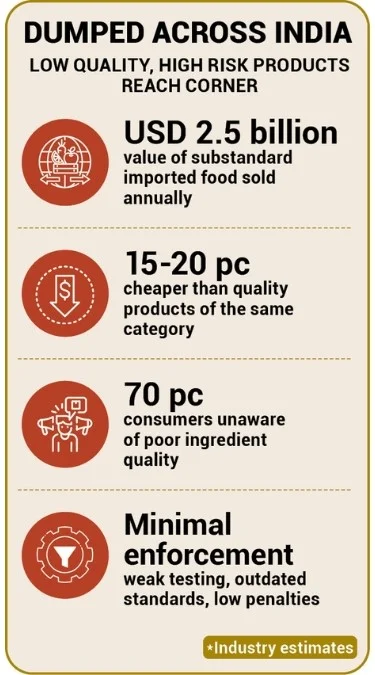
Industry estimates point to gaps in food safety enforcement, leaving Indian consumers exposed to potentially substandard imported products
Pandit also blames the buyers for the poor choices made by them when choosing what to buy. “As buyers, we also have to take responsibility. In my clinic, clients bring me “no added sugar” snacks sweetened with dates or fruit concentrate. They bring protein bars with nearly as much sugar as a chocolate bar, and “baked not fried” namkeen full of salt and fat. The claim is on the front and the truth is on the back, and very few of us turn the packet over. We choose on price, taste and convenience, and we rarely complain. Companies give us what we reward. So the rule book is not the main problem. The checking is weak, and as buyers we reward the wrong things,” says Pandit.
One of the reasons behind the companies’ tendency to push lower-quality products in India is the extremely price-sensitive nature of the market. And to keep retail prices low and affordable for mass consumption, corporations swap out expensive ingredients, like real cocoa or dairy for cheaper alternatives like refined sugar and palm or vegetable oils.
Pandit says that companies tend to follow the lowest possible standards in India for purely commercial reasons.
“India is one of their fastest-growing markets, and warning labels work, so they would hit their core products. Some products are also made differently here. In 2024, Public Eye reported that Nestlé’s Cerelac in India had nearly 3 g of added sugar per serving, while versions sold in Germany and the UK had none. Companies follow the minimum a market enforces, not the best they already meet elsewhere,” says Pandit.
“So my take is simple. If a company already knows how to make a product with less sugar or salt for one market, it should not need a law to offer the same to Indian consumers. One product, one standard. Biology does not change at the border. If anything, research from Pune, including studies I worked on, shows Indians develop diabetes younger and at a lower body weight. Our need is greater, not smaller,” she adds.
A weak-kneed, weak-willed regulator
One of the biggest challenges in improving the quality of food sold in India and how it is packaged is the current state of the FSSAI, the national food regulator, which is perceived to be weak in enforcing rules or even bringing in rules that would make a significant impact on the manufacturing companies and force them to sell healthier products.
But FSSAI has historically lacked adequate capacity to deal with the immense size of the market, which has millions of unregistered, informal producers and tens of thousands of registered Small and Medium Enterprises (SME) along with several large companies, Indian or foreign.
Also Read: Our key objective at SIAL is to help Indian food exporters develop global markets
For over two years, the FSSAI has been trying to push through a regulation requiring front of packaging labels to warn consumers, if certain products have extremely high levels of salt, sugar or preservatives etc.
In a meeting called on March 19 this year, the FSSAI is said to have faced an onslaught from the MNCs which pushed back against the warning labels, alleging that they were ineffective. Instead, the companies urged FSSAI to focus on encouraging portion control. According to reports leaking the details of the meetings, in that meeting, Mili Bhattacharya, a senior executive of Coca Cola is said to have dismissed the need for front of packaging labels. “It is very simplistic to believe that a consumer who does not already read ingredient lists, will be so informed by seeing a symbol or an icon on the label that their diet significantly improves,” Bhattacharya reportedly said.
She added that warning labels were pointless because they would not prevent consumers from otherwise having sugary and salty foods. And finally, she added, Indian doctors had done a good job teaching their patients what food should be avoided, she said.

Prachi Pandit
According to the reports, after this meeting, the FSSAI told the Supreme Court of India that it was “difficult” to match international standards on packaging, echoing the industry position. The court had earlier said India can consider Israel-style labelling, where a red label is applied even if one among salt, sugar or fat is high.
FSSAI’s admission to the top court led to a huge backlash from consumer groups, nutritionists and activists who all slammed the industry for failing to make healthier products and they also attacked the FSSAI for giving in to the industry, instead of getting them to follow the best practices from around the world and also of ignoring the severe damage that these products are inflicting upon the health and wellbeing of Indian consumers.
According to the World Health Organisation, more than 1 billion people on the planet are living with obesity, with 70 pc of the population residing in low-and-middle-income countries. The number of obese and diabetic people has been on an alarming increase in the past two decades and according to scientists, Indians ought to be even more careful about what they consume than people from around the world, as they are highly prone to obesity and diabetes.
Fast food and snacks such as potato chips, cola beverages have been found to be contributing factors in propelling the obesity epidemic globally and in India. According to British medical journal, The Lancet, around 450 million Indians could be obese or overweight by 2050.
Caught off-guard by the sharp backlash, FSSAI went back to the Supreme Court and said it had proposed front-of-pack warning labels on packaged food and drinks, reversing its position. The FSSAI has proposed a red-coloured hexagonal shape for food products which are high in any two or more nutrients-saturated fat, sugar or salt. The mechanism will “facilitate informed food choices, particularly in relation to children and other vulnerable groups of the population,” it added.
Also Read: Indian food processing industry: Limited appetite for value-added exports
Pandit says that while labels will help in informing or warning the consumers, they need to be made with the average consumer in mind.
“A label alone would not change a habit. Still, the case for it is clear. ICMR’s INDIAB study estimates that 101 million Indians have diabetes and another 136 million have prediabetes. A WHO–ICRIER analysis found that retail sales of ultra-processed foods grew about 13 pc a year between 2011 and 2021. The nutrition panel on the back does not work for most people. It is small, usually in English, and you have to do per-100 g arithmetic to use it. In my field work in low-income urban settlements, I saw mothers buying INR 5–10 packs of biscuits and namkeen for their children every day, trusting the packaging and the advertisements, never the label. A clear warning on the front reaches those households. After Chile brought in warning labels, purchases of high-sugar drinks fell by about a quarter, and many companies changed their recipes,’’ says Pandit.

Same brands, different labels: Western markets vs India
“My Fair Trade work has shown me that a small, clear symbol on a pack can change what people pick up. FSSAI’s proposed red warning symbol, modelled on Canada’s, is the right direction. Let’s make it simple enough for a child to read, and appealing enough that people want to read it,” she adds.
Pandit says that FSSAI needs to review its consulting processes as investigative reporting found that industry representatives outnumbered consumer groups about six to one in FSSAI’s labelling consultations, and that industry pushed for star ratings over warnings.
She says that FSSAI should include more consumer groups as well as involving clinical nutritionists, doctors and researchers, who hold that evidence of what processed food is doing to the health of Indian consumers.
For a healthier eating, what India needs is an all-round approach of creating greater consumer awareness as well as firm and independent regulator, that is not only well-equipped but also well-informed but is also regularly in contact with various stakeholders, and not just the industry. It would also help if there was greater societal pressure on companies to apply the highest standards that they follow anywhere in the world, not the lowest, when catering to the world’s largest market.
With processed foods here to stay for the foreseeable future, it is critical that they become healthier and more nutritious. The USD 140 billion question here is whether FSSAI lead the industry on this path?
