Goa nightclub fire exposes accountability gap in India’s safety norms
With attention on owners, public officials go scot-free
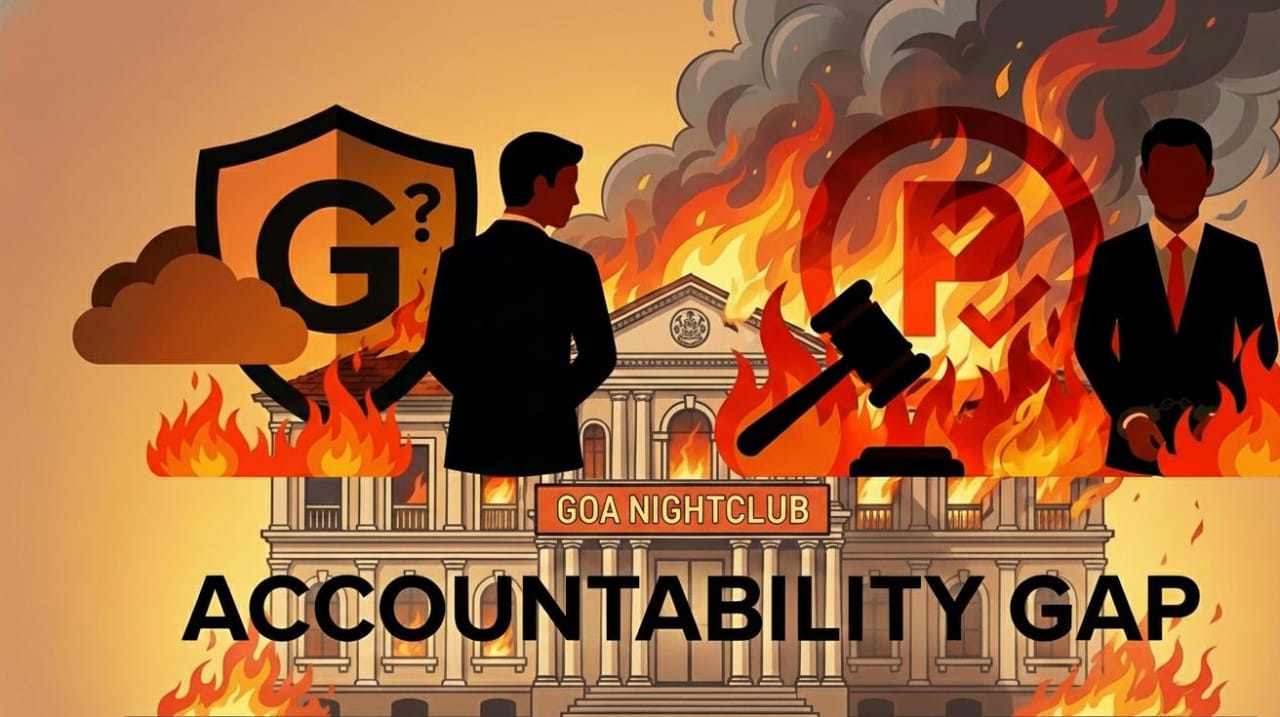
Private officials were named while the role of government officials who cleared, licensed or overlooked the venue remained largely untouched
The deadly nightclub fire in Goa has reignited national outrage not just over how such incidents can take place repeatedly, in places which violate practically every safety and building norm, but few question the officials who turn a blind eye to thousands of similar death-traps operating all over the country.
Private officials were named while the role of government officials who cleared, licensed or overlooked the venue remained largely untouched
Almost a week after a devastating fire reduced a popular nightclub in Goa to ashes, killing over 28 persons, the law-enforcement authorities in India continue to push hard for rapid extradition of owners of the nightclub, who are currently in police custody in Thailand. The fate of the two brothers is still unknown though the national media continues to feature all developments in the case prominently on a regular basis.
In the early hours of December 6, a fire tore through Birch by Romeo Lane, a popular nightclub in Arpora village, North Goa. What began as a late-night dance event ended in catastrophe, killing at least 25 people and injuring dozens more. Four tourists and fourteen staff members were among the dead, according to official figures. Many victims were trapped inside as toxic smoke spread rapidly through the poorly ventilated structure, turning minutes into a deadly countdown.
The incident immediately triggered nationwide outrage and renewed scrutiny of safety compliance in nightlife venues. Audits were ordered, arrests were made, and licences were suspended. Yet amid this flurry of action, a familiar pattern emerged: private actors were named, while the role of government officials who cleared, licensed or overlooked the venue remained largely untouched.
The deadly incident has also reignited a national debate on repeated public safety and regulatory failure. While venue owners face arrest and scrutiny, over alleged violation of numerous building and safety norms, the tragedy has raised sharper questions about why government officials responsible for enforcing the safety and building norms and for carrying out regular inspections, licences and safety clearances are rarely held criminally accountable, even though their alleged guilt is no lesser than the owners and operators of such establishments, even though each such tragedy has left behind a long trail of deaths and destruction of property.
Preliminary investigations revealed that the nightclub, Birch by Romeo Lane lacked a valid No Objection Certificate (NOC) from the Fire Department, a mandatory requirement under Indian fire safety law. Fire department assessments found that basic safety infrastructure including alarms, sprinklers, emergency lighting, extinguishers and clearly marked exits was either missing or non-functional. Narrow access roads delayed firefighting operations, while blocked or inadequate exits trapped patrons inside.

Pankaj Vats
“I don’t know whether the fire safety system there was working or not, or whether it was even installed properly. But the people who died there were victims of systemic failure,” says Pankaj Vats, Fire Expert, tells Media India Group.
“The emergency exit was not proper, staff were not trained, and people underestimate the risks associated with fires until it is too late,” Vats adds.
According to the First Investigation Report filed by Goa Policen the nightclub was operating without mandatory construction and fire clearances and had hosted high-risk performances involving open flames and pyrotechnics without proper safeguards. Political leaders in Goa publicly questioned how licences were issued or renewed despite glaring violations, pointing to failures at the level of local panchayats, municipal bodies and licensing authorities.
Yet even as club owners face arrest and extradition proceedings, the officials who signed off on paperwork, conducted inspections, or failed to act on violations have so far faced only suspensions or departmental inquiries.
According to Anshum Verma, a lawyer based in Delhi, this imbalance reflects a deeper structural problem in India’s governance framework.
“The aftermath of the Goa tragedy shows clearly who is penalised and who is protected. Venue owners are arrested, but government employees responsible for safety clearances are merely suspended, not prosecuted,” Verma tells Media India Group.
Verma explains that criminal prosecution of officials is “almost non-existent” not because laws are absent, but because institutional protections shield public servants from legal consequences.
One major barrier is Section 197 of the Code of Criminal Procedure, which requires prior government sanction before prosecuting a public servant for actions taken during official duties.
“In practice, governments rarely grant sanction against their own officials, which blocks criminal trials at the very threshold,” Verma says.
Another layer of protection comes from the ‘good faith’ clauses embedded in many municipal and fire safety statutes. These provisions protect officials from prosecution for actions or inaction carried out in supposed good faith.
“Negligence is often reframed as an administrative oversight. Officials claim they were understaffed, overburdened, or that violations escaped notice,” Verma adds.

Anshum Verma
Equally damaging is the diffusion of responsibility within bureaucracy. Building plans are cleared by one department, fire safety by another, and operating licences by a third.
“When disaster strikes, each officer says, ‘I only checked the paperwork, not the site. This fragmentation makes it extremely difficult to fix criminal liability on any one official,” he adds.
Legal experts says that this culture of impunity undermines the very purpose of India’s safety regulations. Umar Masoodi, another lawyer, points out that courts have repeatedly recognised that government officials owe a statutory duty to protect life.
“Government officials have been held legally accountable in India, most notably in the Uphaar Cinema fire case. Courts acknowledged that licensing and regulatory authorities played a role in safety failures,” Masoodi tells Media India Group.
However, Masoodi adds that such cases remain rare. “Criminal prosecution requires proof of gross negligence or conscious disregard for life, not mere administrative lapse. Additionally, prior government sanction is often required, and that sanction is frequently delayed or denied,” he says.
As a result, accountability for officials is usually limited to departmental action or civil compensation, rather than criminal conviction.
“The burden of responsibility is diffused across departments, making it difficult to identify individual culpability,” says Masoodi.

Umar Masoodi
Meanwhile, survivors’ accounts and forensic evidence suggest that many deaths in the Goa fire were not caused by flames but by smoke inhalation, as people were trapped in lower levels of the building with no viable escape routes. Police records show the first distress call came minutes after the fire began around IST 21:45 , but firefighters battled the blaze for nearly two hours before bringing it under control.
The club’s layout, poor ventilation and blocked exits transformed what could have been a containable fire into a mass fatality event conditions that could not have existed without repeated inspection failures.
In the wake of the tragedy, state governments across India ordered surprise inspections of nightclubs, restaurants and hotels. Goa’s State Disaster Management Authority directed all establishments to strictly comply with fire and electrical safety norms, maintain valid NOCs, adhere to occupancy limits and ensure functional fire systems. Non-compliance now risks closure under the Disaster Management Act.
But critics says that post-tragedy audits are a predictable ritual, offering little assurance that the system itself will change.
“Paper codes are not the problem. The problem is enforcement without accountability. Unless officials face real legal consequences for reckless clearances and ignored violations, these tragedies will repeat,” Verma adds.
Fire experts echo that enforcement must be matched by public awareness and training.
“I have seen exits blocked by storage boxes or décor. That casualness by owners, inspectors and patrons costs lives,” says Vats.