
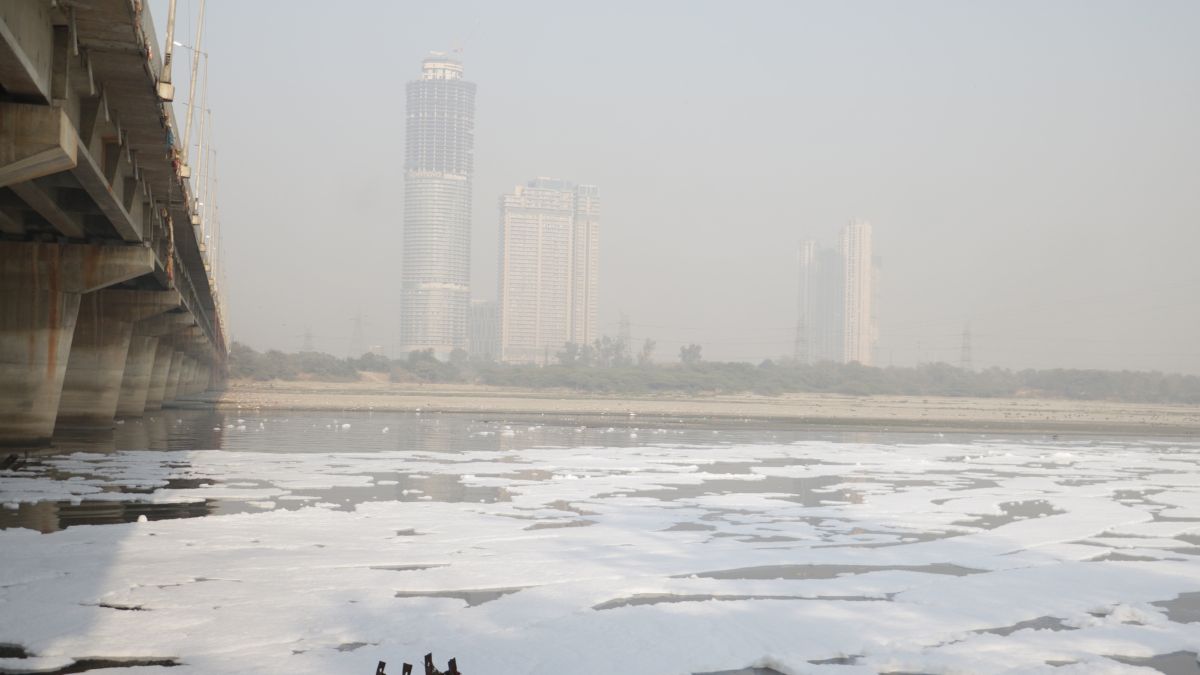
Last year, news of severe water contamination emerged from various cities in India, with rivers like Yamuna pictured here, choked with pollution (Photo Media India Group/ Sunil Yadav)
Weeks after severe water contamination killed at least 20 persons and led thousands to be hospitalised, news of poor water quality have emerged from all over the country, almost every day, raising serious questions on the reliability of sanitary certifications in India.
Questions were raised on the slogan “Indore rahega number one” when what is said to be India’s cleanest city came into the limelight in recent weeks, when over 20 people allegedly died and over 1,400 fell sick after consuming contaminated water over a period of weeks.
The incident dates back to December 2025 when residents of Bhagirathpura, a densely populated locality in Indore, home to over 15,000 people, reported foul smell, bitter taste and discolouration of water. Despite repeated complaints, no action was taken by the government. People experienced vomiting, diarrhoea, dehydration and weakness. As per reports by laboratories, bacterial contamination in the municipal water supply affected the residents.
The large-scale deaths made national headlines and raised questions on the veracity of the tags of cleanest cities awarded by the government and more worrying, within days, residents from a number of other cities across the country complained little action despite their complaints about receiving contaminated water in their homes.
In the past few days, cities, including Gandhinagar, regions around Hyderabad, Greater Noida, Rohtak and Jhajjar, have been in focus for their poor water safety norms.
In Gandhinagar as well, the contamination that was caused by a leak in the water pipeline led to a typhoid outbreak, leaving over 145 people admitted to hospitals.
Also Read: Manipulated data, ponds of drinking water: BJP’s clean environment measures in Delhi
While water contamination in the country often breaks out during the monsoon season due to overflowing and flooding, a news report highlighted that over 34 reported incidents show that the issue is no longer a seasonal phenomenon and highlights the old and broken infrastructure of India, which needs to be worked on.
As per news reports, between January 2025 and January 2026, at least 5,500 people fell sick in 26 cities of the country, including 16 state capitals across 22 states and Union territories, due to the consumption of contaminated water.
As per the World Health Organisation report, over 830,000 deaths globally are caused by water contamination.
As per a research article published in the Journal of Water and Health, 17 pc of households in India receiving piped water supply have reported illness, while 5 pc households dependent on rainwater harvesting, reused water and other sources have also faced illness.
In a report by the Central Groundwater Board, nearly a fifth of the samples collected in the country exceeded permissible limits for pollutants, including nitrates, with significant quantities of radioactive uranium also present.
India also violates the set standards for water by the World Health Organisation. The standards are violated through the inadequate implementation of stricter national laws, which cause high pollution from the untreated sewage and industrial discharge.
As per media reports, India ranks 120th out of 122 countries on the Global Water Quality Index, with more than 70 pc of the surface water contaminated and considered unfit for consumption.
Additionally, as per the Bureau of Indian Standards, the total dissolved solids have a desirable limit of 500 mg/L and a maximum permissible limit of 2,000 mg/ L, whereas the WHO recommends a more optimal range of 150 to 300 mg/ L and a maximum limit of 1,000 mg/L.
As per news reports, an estimated 20 to 30 pc of tested groundwater samples in the country exceed one or more safety parameters with contamination hotspots in states such as Madhya Pradesh, Rajasthan, Uttar Pradesh, West Bengal and parts of South India.
Also Read: World Water Day: Pollution aggravates water scarcity in India
Aditya Jaiswal, a hydrogeologist and water conservation specialist, says that a significant part of water-borne diseases continues to remain under-reported in the country and are treated locally without formal diagnosis or reporting.
“In many rural and urban areas, illnesses such as diarrhoea, typhoid, hepatitis, and skin infections are getting normalised and are treated locally without a formal diagnosis or reporting. Weak disease surveillance, limited lab access and fragmented health records mean water-related morbidity rarely gets linked back to water quality. As a result, the contamination remains invisible in official data even though communities bear the health burden,” Jaiswal tells Media India Group.
He adds that cities struggle with contaminated water due to infrastructure integrity and governance.
“Common problems include intermittent supply leading to back-siphoning, leaking pipelines running alongside sewage drains, aging distribution networks and poor last-mile monitoring. Treatment plants may meet standards set at the outlet; however, the water quality degrades during transmission. In most cities, the water quality monitoring ends at the plant and not at the consumer’s tap,” he adds.
Similar disturbing reports also emerged from Greater Noida’s Sector Delta 1 in Uttar Pradesh, where dozens of residents, including children who complained of the same symptoms after sewage reportedly mixed with drinking water supply.
In urban India, municipal corporations and urban local bodies are legally responsible for the supply, quality and safety of drinking water. State level agencies including public health engineering departments, water supply boards and urban development boards design and operate the distribution of water.
Despite the presence of several bodies, the struggle with water contamination point to system failure of water governance rather than just isolated lapses, and also raise concerns about the violations of basic right to safe drinking water.
Safe drinking water and sanitation are recognised by the United Nations as a fundamental human right essential for health, dignity and well-being.
Jaiswal says that while the smart cities in the country have improved in their data dashboards, sensors and command centres, water quality safety still continues to be a neglected area.
“The focus has been more on visible assets and digital governance rather than underground networks, source protection or wastewater drinking separation. Without investments on distribution network rehabilitation, real-time water quality sensors and independent audits, smartness, remains largely cosmetic in the water sector,” says Jaiswal.
The situation is set to worsen as a report by NITI Aayog’s Composite Water Management Index highlights that India’s water stress could be severe by 2030. Diseases due to water contamination could also spread rapidly through unsafe water and could also turn fatal if proper care and treatment is not done.
Several experts have also warned that such breakouts often go beyond diarrhoeal outbreaks and have an immunological and psychological effect.
Jaiswal highlights that while policies in the countries emphasise on source sustainability, universal access and quality assurance, the implementation is fragmented.
“Responsibilities are split across departments, budgets prioritise capital expenditure over operation and maintenance, and community-level monitoring is weak. Water quality testing is often compliance-driven rather than risk-based. There is also limited accountability when contamination is detected penalties, corrective actions, and public disclosure are rare,” he says.
He adds that while India has made a slight progress in coverage of piped water supply, the country still lags on detection and prevention.
“We need a shift from reactive testing to continuous, risk-based monitoring, including real-time sensors, GIS-linked contamination mapping and stronger public health water data integration. Sewage and drinking water planning must be done together, not separately. Compared to the global best practices especially in leak detection, asset management and transparent reporting, we are still behind, but the solutions are known and achievable if governance and funding priorities align,” Jaiswal adds.
