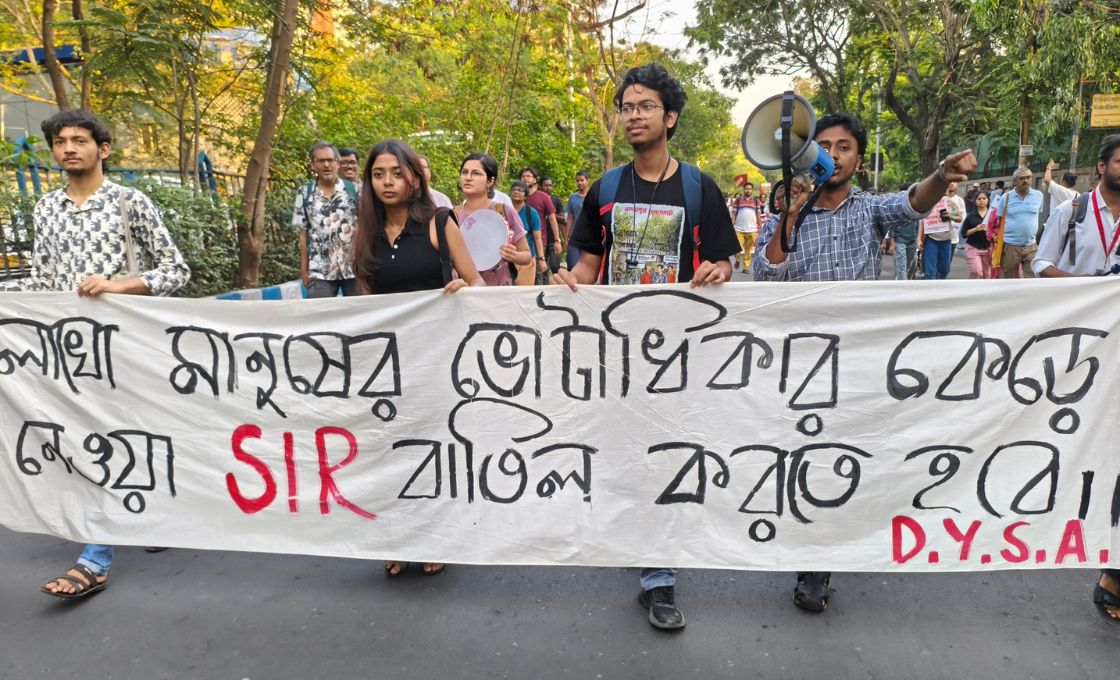
Several protests have been organised in West Bengal against the Election Commission's rushed revision of electoral rolls (Photo: Social Media)
With days to go for the first phase of elections to the West Bengal Assembly, the number of eligible voters are yet to be finalised as the highly controversial Special and Intensive Revision (SIR) carried out by the Election Commission of India, has led to a massive deletion of over 9.1 million voters from the electoral rolls for the elections. The number is set to keep evolving as the few people who have the means and the time to take legal recourse to protect their constitutional rights have moved the courts for reinstatement of their names and the process is far from complete.
It is one of the largest mass deletions from a voter list in the history of Indian democracy and it is happening right now, with polling just days away.
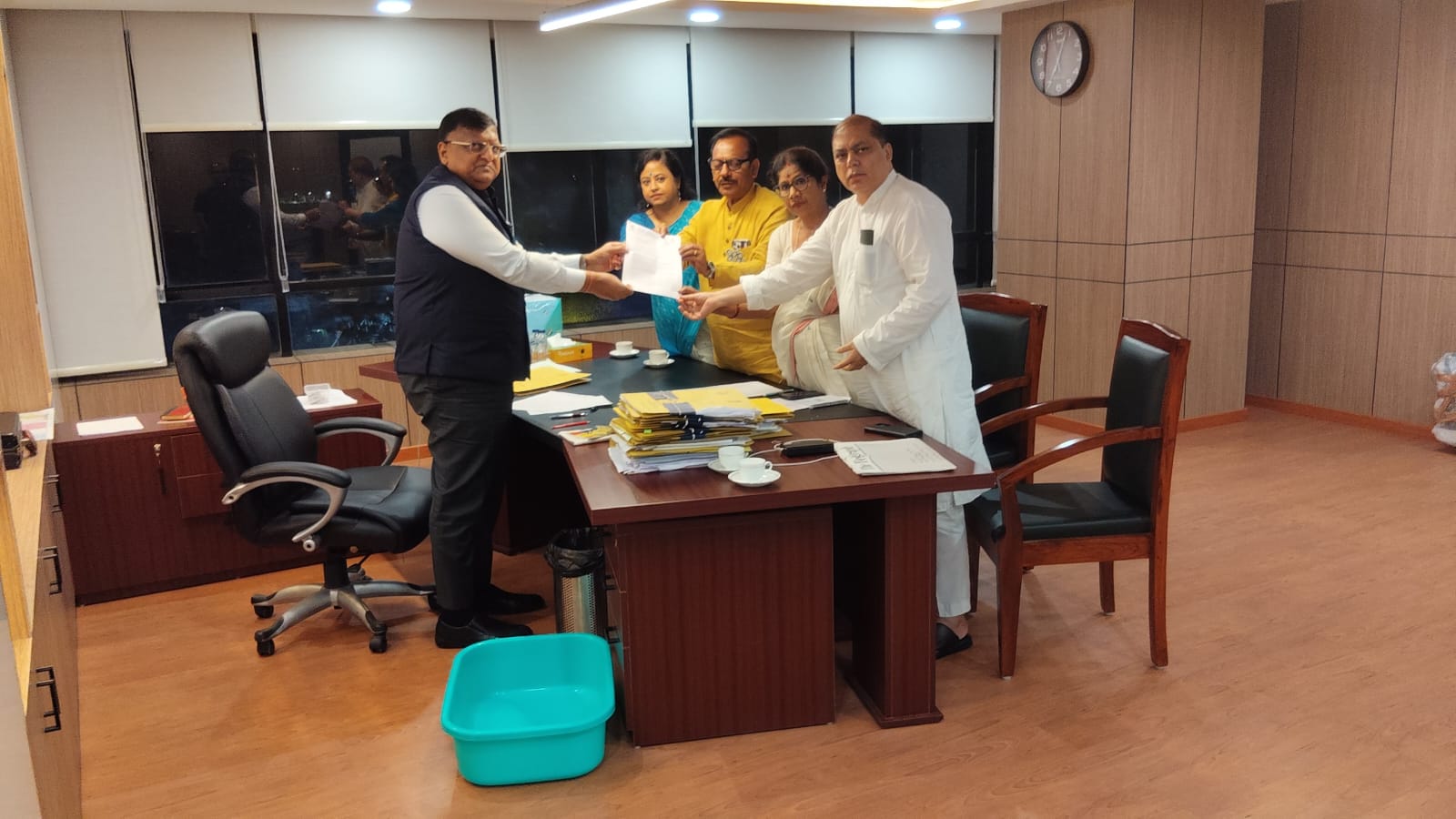
A delegation of AITC handing over a protest note to Election Commission officials in Kolkata (Photo: AITC)
Attacked by the Opposition parties across the country, the Election Commission has called the SIR as a routine act of civic hygiene a necessary cleansing of a bloated, inaccurate voter database riddled with duplicates, deceased voters, and people who have shifted address. On paper, it sounds responsible, even desirable. Every democracy needs clean rolls. However, the defence put forth by ECI has been rejected by the opposition parties which have accused it of carrying out the SIR at the behest of the Bharatiya Janata Party in order to carry out a targetted deletion of their supporters from the voters’ list.
Also Read: ‘The Bengal Files’ sparks protests, politics across West Bengal
The deletion unfolded in two waves. The first sweep removed approximately 6.3 million. Then came a second phase: voters placed under an “Under Adjudication” category, a bureaucratic limbo where names were flagged for scrutiny. Of those adjudicated, nearly 2.7 million more were declared ineligible, bringing the total to 9.1 million deletions across the state.
The SIR is not a new, similar exercises have been conducted in Andhra Pradesh, Maharashtra, Haryana, Odisha and most recently Bihar ahead of that state’s 2025 elections. But conducting a revision of this scale and consequence in the weeks immediately before polling rather than after an election raises a question that neither the Election Commission nor the central government has answered. If it was so crucial, why was this not done in the post-election window, when the stakes of an error would not be the immediate loss of a citizen’s right to vote?
Electoral rolls can be revised at any time. The choice to conduct an intensive revision now compressing the voter base by roughly 12 pc, without providing adequate time for affected citizens to seek restoration before the rolls were frozen is a political and administrative decision, not a technical inevitability. Critics say that after the elections, a deletion would have meant bureaucratic inconvenience. Before the elections, it means disenfranchisement. The difference is not administrative. It is democratic.
Abdul Mamun, Founder of Indian Political Strategy Thinkers (IPST) a Kolkata-based professional platform to analyse India’s evolving political landscape, points out that nearly 25 pc of individuals placed under the “Under Adjudication” category ultimately found their names on the exclusion list.
“From the current trend, it seems likely that the remaining 1.4 lakh names still pending may also be excluded in the ongoing phase. If that happens, the total exclusions could breach 10 million, roughly one in every 10 registered voters in Bengal,” Mamun tells Media India Group.

Abdul Mamun
Across India, it is entirely normal for a voter’s name to be spelled differently across Aadhaar card, ration card, and voter ID. It is normal for addresses to be inconsistent, for birth certificates to not exist, for a widow to carry her late husband’s surname on one document and her father’s on another. “These are not signs of illegality. They are signs of poverty, of bureaucratic neglect, of a state that never adequately invested in documentation infrastructure for its most vulnerable citizens,” says Mamun.
Also Read: West Bengal CM unveils Sister Nivedita’s plaque
He adds that this is the documentation trap and the SIR walks right into it. By treating inconsistency in records as a red flag, the process ends up disproportionately targetting the poorest, least literate voters: the ones who could never afford legal help to sort their paperwork, who never had a functioning postal address to begin with, who never knew that a spelling discrepancy between two government-issued documents could one day cost them their franchise.
“While the SIR process is designed to function in a standard and systematic manner, the way it is being implemented in practice raises serious concerns. Many genuine voters whose documents are not perfectly aligned are being placed under the ‘Under Adjudication’ category and when proper verification processes are not followed thoroughly, people are subjected to unnecessary hardship and uncertainty,” says Mamun.
Mamun also flags what he describes as an apparent demographic pattern in the exclusions, noting that the removals seem to have occurred roughly in a Hindu-Muslim ratio of 2:1.5, adding that the full implications of this need careful examination and such patterns raise important questions about fairness and transparency in the process.
West Bengal has a Muslim population of approximately 27 pc, concentrated heavily in border districts and dense urban pockets. If deletions are occurring at a disproportionate rate among Muslim voters even structurally, even unintentionally it would represent a skew in the democratic playing field ahead of an election that every political formation in the state has described as existential. The Election Commission has not released community-wise data on the deletions. That absence of transparency is, in itself, a problem.
Ashik Gosaliya
There are, however, voices that push back against the criticism of the SIR, sayings that the exercise is being misunderstood. For them, the debate is not about exclusion, but about legality and the integrity of the electoral process an uncomfortable but necessary correction rather than a political overreach.
Ashik Gosaliya, a Political Analyst based in Delhi, says that a clean electoral roll is the very foundation of democratic legitimacy. He pushes back hard on the framing of mass deletions as disenfranchisement. “Large-scale deletions are not about disenfranchisement, but about restoring the rule of law. When illegal residents occupy spots on our rolls, they dilute the legitimate voice of genuine citizens and undermine the sovereignty of the nation,” Gosaliya tells Media India Group.
Also Read: Bihar voter list overhaul weeks before elections sparks debate
Gosaliya is equally dismissive of allegations that the process is politically motivated. “Claims of bias are often used as a shield to stall necessary enforcement. This process is rooted in sovereignty, not partisanship. Identifying and removing foreign nationals is a constitutional obligation that rises above political considerations it is an administrative responsibility to ensure that only Indian citizens determine the country’s future. Any deletions are carried out strictly on the basis of insufficient legal documentation, not political affiliation,” he adds.
He adds that he believes that there is no reason for legitimate citizens to fear a transparent, document-based verification process. In fact, such an exercise strengthens their rights. “By clearly identifying Bangladeshi nationals, we are safeguarding the interests of Indian citizens. Valid identity documents and proof of ancestry act as a robust safeguard for genuine residents. Strong and unambiguous enforcement also helps eliminate the grey areas that allow illegal migrants to blend into communities and place additional strain on public resources,” says Gosaliya.
According to him, the removal of the alleged illegal migrants is essential to ensure that government benefits reach their rightful, legal beneficiaries. “Once identified, foreign nationals must be deported to their home country in order to maintain the sanctity of our borders and uphold the integrity of the system,” he says.
However, critics insist that the Indian Constitution is unambiguous and grants every adult citizen the right to vote. It is not a privilege dispensed by the state. It is not conditional on the quality of one’s paperwork. It is a fundamental right and the Election Commission’s mandate is to protect it, not to construct barriers around it.
The Supreme Court has consistently held over decades that deletion from electoral rolls must follow due process. Voters must receive notice. They must have a genuine opportunity to contest their removal. The burden of proof cannot be placed so heavily on the citizen that it functionally negates the right itself.
The All India Trinamool Congress (TMC), has not taken the deletions quietly. Chief Minister Mamata Banerjee has made the SIR controversy a central plank of her election campaign. At public gatherings and through media statements, she has claimed that the exercise is partial, with names of members of certain communities being deleted from the electoral roll and has warned that it might disempower genuine voters. She has specifically accused BJP of targetting Matua and minority communities a charge the BJP denies.
A TMC delegation of senior ministers, including Chandrima Bhattacharya, Sashi Panja, Aroop Biswas, Manas Bhuniya, and Malay Ghatak, met the Chief Electoral Officer and submitted a memorandum listing their grievances.
Senior TMC leader Manas Bhuniya said in a statement that “I have witnessed 41 elections in the past, but had never seen the Constitution trampled in such a way,”
Also Read: Bengal’s voters say not surprised by results of assembly elections
The party has also taken its fight to the highest court in the land. TMC MP Derek O’Brien filed an application before the Supreme Court challenging procedural actions of the Election Commission during the SIR exercise, alleging that the ECI was issuing instructions to Booth Level Officers through informal channels like WhatsApp.
Tensions boiled over on April 8, when a TMC delegation led by O’Brien met Chief Election Commissioner Gyanesh Kumar. O’Brien alleged that the interaction turned hostile when the delegation questioned the transfer of officials ahead of polling. “We asked him how free and fair elections could be ensured if officials were being transferred. That is when he told us to leave. What I saw today is a shame,” O’Brien said in a statement. The Election Commission, in turn, maintained that O’Brien had interrupted proceedings and that elections in Bengal would be conducted in a “fear-free, violence-free, intimidation-free” manner.
Mamata Banerjee maintains that the more than 2.7 million voters still under adjudication should be granted voting rights, citing the Supreme Court’s position that such individuals are genuine voters, and said those excluded would approach tribunals.
Organisationally, the TMC has urged affected voters to apply for restoration to the electoral roll through every available legal means. But with the rolls now frozen and polling days away, the window for remedy has effectively closed leaving millions to navigate election day not knowing whether their names will appear on the list at all.