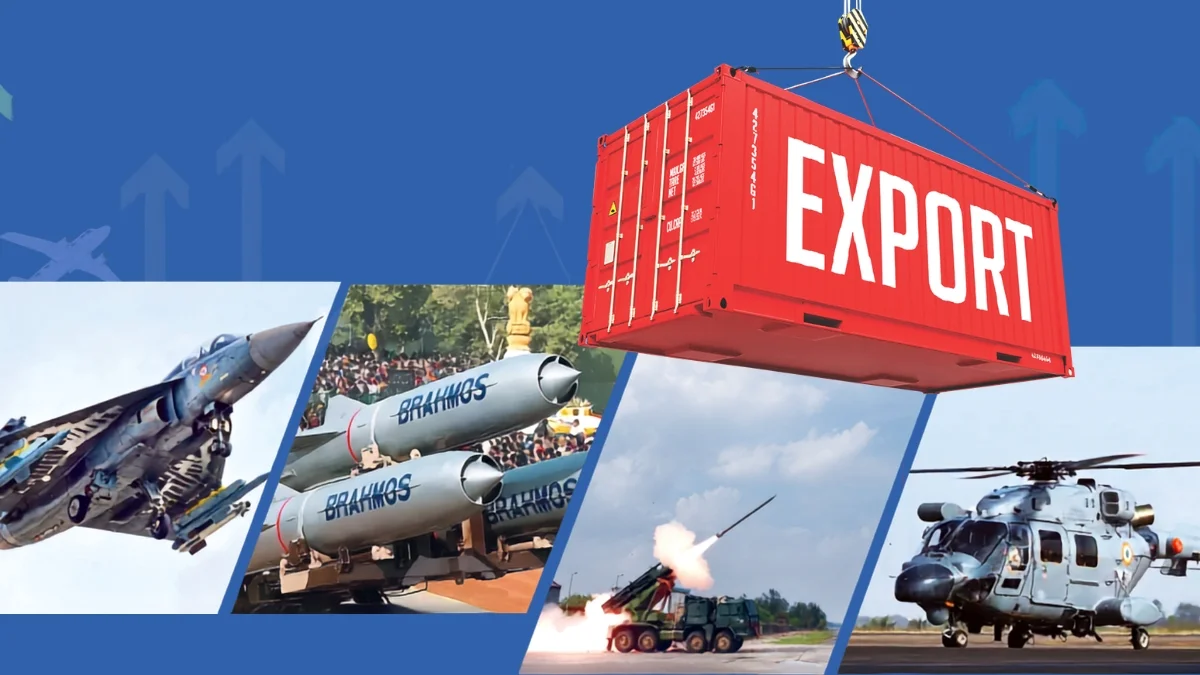
India’s defence industry is increasingly targetting global markets with homegrown military equipment
While many may know India as the world’s largest importer of defence equipment, that spends close to USD 8 billion on arms imports each year, few know that India is also emerging as a significant exporter of defence products, which recorded a peak of USD 4.1 billion in exports last year.
Defence exports, per se, are not new for India, a country that has had a sizeable footprint in low-tech areas like uniforms, camouflage nets and protective gear like helmets, bulletproof jackets and shoes. However, with advances made by the domestic manufacturing sector, India has been moving up the value chain and has exported a variety of high-tech equipment including helicopters, missiles, armoured vehicles and the like.
According to the Ministry of Defence, exports rose from approximately USD 2.76 billion in FY 2024-25 to USD 4.1 billion in FY 2025-26, representing a year-on-year increase of 45.29 pc. The increase of nearly USD 1.58 billion in a single year is larger than India’s total defence exports recorded in FY 2021-22 and has brought renewed attention to the country’s emergence as a supplier of military equipment in international markets.
The chunk of exports were made by Defence Public Sector Undertakings (DPSUs) that contributed USD 2.2 billion or about 54.84 pc, while the rapidly rising private sector contributed USD 1.81 billion or about 45.16 pc of total exports. According to data released by the government, the total volume of defence exports has risen nearly 60-fold in the last few years.
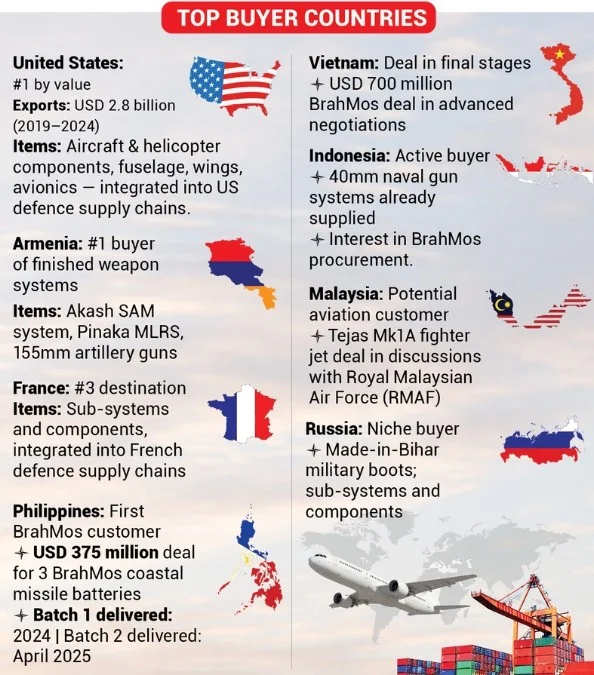
Armenia, the US, France and the Philippines are among India’s key defence export markets, with growing demand for complete weapon systems
Not just rising in total value or volumes, Indian defence exports have also undergone an extensive shift in moving from parts of high tech products to complete weapon systems. A notable example is the USD 1.7 billion order placed by Armenia for Akash air-defence systems, Pinaka rocket launchers and Swathi radars. Similarly, after a decade of integration in the Indian defence forces, BrahMos, a highly versatile and advanced missile system jointly developed by Russia and India, is being increasingly targetted at the export markets and several countries, including the Philippines have picked up the missiles that can be fired from land, a vehicle, an aircraft or even a ship. Its successful execution also strengthened BrahMos export prospects in Southeast Asia, leading to an agreement with Vietnam and advanced talks with Indonesia.
Among India’s defence customers, Armenia has emerged as the largest buyer in recent years. Since 2022, the country has signed contracts covering Akash air defence systems, Pinaka multi-barrel rocket launchers, Advanced Towed Artillery Gun System artillery guns, Swathi Weapon Locating Radars, anti-tank missiles and ammunition. Defence industry estimates place the cumulative value of these contracts at between USD 1.5 billion and USD 2 billion.

Jyoti Gupta
The shift reflects a broader change in the nature of India’s defence exports. According to Jyoti Gupta, Senior Research Analyst and Economist at Ashika Institutional Equities, export growth is increasingly being driven by what she describes as mid-tier, scalable systems rather than top-end strategic platforms.
“Missile systems such as BrahMos and Akash have emerged as India’s most visible export successes, while artillery systems like Pinaka, naval platforms and aerospace subsystems are also gaining traction in international markets,” Gupta tells Biz@India.
She says these systems are attracting buyers because they offer operational capability at a competitive cost and often face fewer geopolitical restrictions than comparable Western platforms.
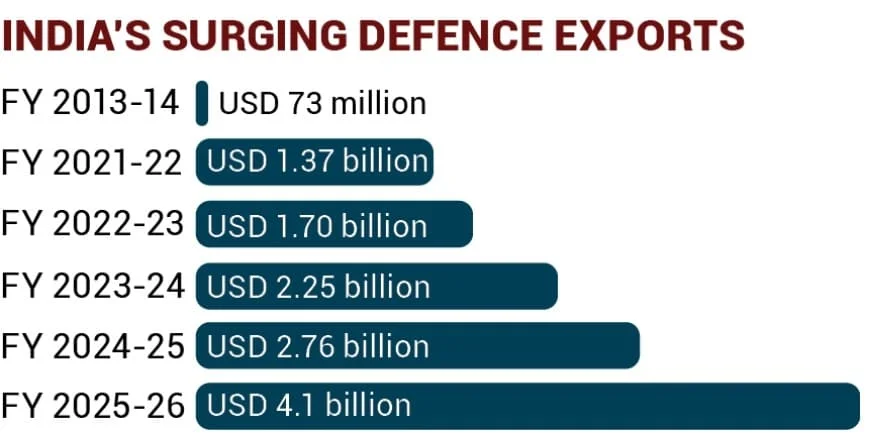
India’s defence exports surged to USD 4.1 billion in FY 2025-26, up 45.29 pc year on year
While missile and artillery contracts dominate headlines, the United States remains one of India’s most important defence export destinations. Unlike Armenia and the Philippines, which purchase complete weapon systems, exports to the US are largely linked to aerospace and defence supply chains, mainly as part of the defence offset deals that are signed during major purchases. Indian companies supply aircraft fuselages, aerostructures, defence electronics, electronic warfare components and specialised subsystems to major American defence manufacturers.
Gupta says that beyond complete weapon systems, aerospace components and subsystems continue to play an important role in India’s export portfolio. Indian companies are becoming increasingly integrated into global original equipment manufacturer (OEM) supply chains through the supply of low-cost avionics, structural parts and Maintenance, Repair and Overhaul (MRO) services.
European countries have also become significant markets. France, Germany, Belgium and the United Kingdom import aerospace components, defence electronics, ballistic helmets, bulletproof jackets and specialised military equipment from Indian manufacturers.
Companies such as Tata Advanced Systems, Larsen & Toubro and Mahindra Defence have expanded their global footprint through exports of armoured platforms, mine-protected vehicles and defence subsystems.

Yash Patil
According to Yash Patil, Supply Chain and Operations Analyst at a Defence PSU, India’s export growth is being driven by two parallel trends, namely direct sales of defence systems to foreign governments and increasing participation in international defence manufacturing networks.
“India’s defence export growth appears to be coming from two different sources. One is direct sales of defence systems to foreign governments, such as the BrahMos deal with the Philippines and exports of artillery systems to countries like Armenia. These are high-visibility deals and can significantly boost export numbers when large deliveries are made,” Patil tells Biz@India.
Patil adds that the longer-term driver may be India’s growing role in global defence supply chains. Over the past decade, offset policies linked to major defence acquisitions and industrial partnerships have helped Indian companies become suppliers to some of the world’s largest aerospace and defencе manufacturers.
“One example is the 2016 Rafale fighter aircraft deal between India and France, which carried offset obligations worth billions of dollars. The programme created opportunities for Indian firms to partner with French aerospace companies, particularly through collaborations involving Dassault Aviation and Safran. What began as offset-related manufacturing has increasingly evolved into long-term commercial relationships and integration into global aerospace supply chains,” says Patil.
Also Read: Embraer and Adani Defence & Aerospace announce strategic partnership
“However, my view is that while offsets played an important role in creating the ecosystem, the larger opportunity today lies in long-term manufacturing and supply-chain partnerships,” Patil says.
While India already designs and manufactures missiles, warships, artillery systems and aircraft platforms, the larger challenge is moving up the defence value chain by gaining greater control over critical technologies, intellectual property, high-value subsystems and global market access.
According to Patil, offsets have helped Indian companies in three ways: By providing access to advanced technologies and manufacturing processes, enabling firms to move from build-to-print manufacturing towards design and engineering participation and integrating Indian suppliers into global aerospace and defence supply chains. Once qualified by major OEMs, Indian firms can secure recurring export business across multiple programmes.
The next phase of India’s defence export growth will depend less on assembling platforms and more on developing high-value components such as engines, avionics, sensors, propulsion systems, electronics, advanced materials and software-defined systems.
From a strategic perspective, these recurring supply-chain relationships may ultimately prove more durable than individual platform sales because they generate sustained export demand beyond a single contract cycle.
Gupta describes India as a fast follower with selective innovation pockets in the global drone industry. While the United States dominates high-end strategic drones through platforms such as Predator and Reaper, Israel remains a leader in tactical drones and loitering munitions and China has established a strong export presence through aggressive pricing and large-scale production.
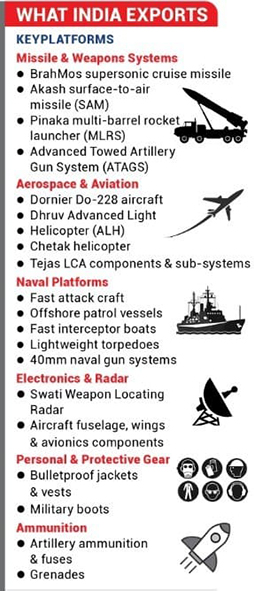
India’s defence exports now span missiles, artillery, aerospace, naval platforms, electronics and protective equipment
“India’s strengths lie in lower-cost manufacturing, a growing private-sector ecosystem and strong software engineering capabilities that can support future advances in artificial intelligence and autonomy. However, India continues to lag behind leading drone-exporting nations in long-endurance high-altitude systems, advanced sensors, satellite communications and export-financing mechanisms,” adds Gupta.
One example of this emerging trend is Flying Wedge Defence & Aerospace, which reportedly secured a USD 30 million export order for its Kaala Bhairav tactical drone. The order is among the first major international sales involving an Indian-developed military drone platform and reflects the growing maturity of the country’s unmanned systems sector.
Helicopters have also contributed to India’s defence exports through HAL’s Advanced Light Helicopter (ALH) Dhruv programme. Ecuador became the first export customer in 2008 with a USD 45 million order for seven helicopters, while Mauritius, Nepal and the Maldives also inducted the platform for surveillance, utility and search-and-rescue roles. Though modest compared to recent missile and artillery exports, helicopter sales helped establish India’s presence in the global military aviation market.
“Beyond missiles and artillery, aerospace platforms such as helicopters, trainer aircraft and unmanned aerial vehicles represent an important long-term export opportunity. As India’s aerospace manufacturing ecosystem matures, exports are expected to move beyond components and support services towards complete airborne platforms,” an official of Bharat Dynamics Limited, a leading Defence PSU which is a partner in BrahMos, tells Biz@India, on the condition of anonymity.
Having progressed from exporting low-value military equipment to supplying advanced weapon systems and aerospace products, India’s defence export sector has established a stronger presence in international markets. Sustaining this momentum will require greater investment in research and development, particularly from the private sector, to develop critical technologies, high-value subsystems and intellectual property that can support the next phase of export growth and enhance competitiveness in the global defence industry.