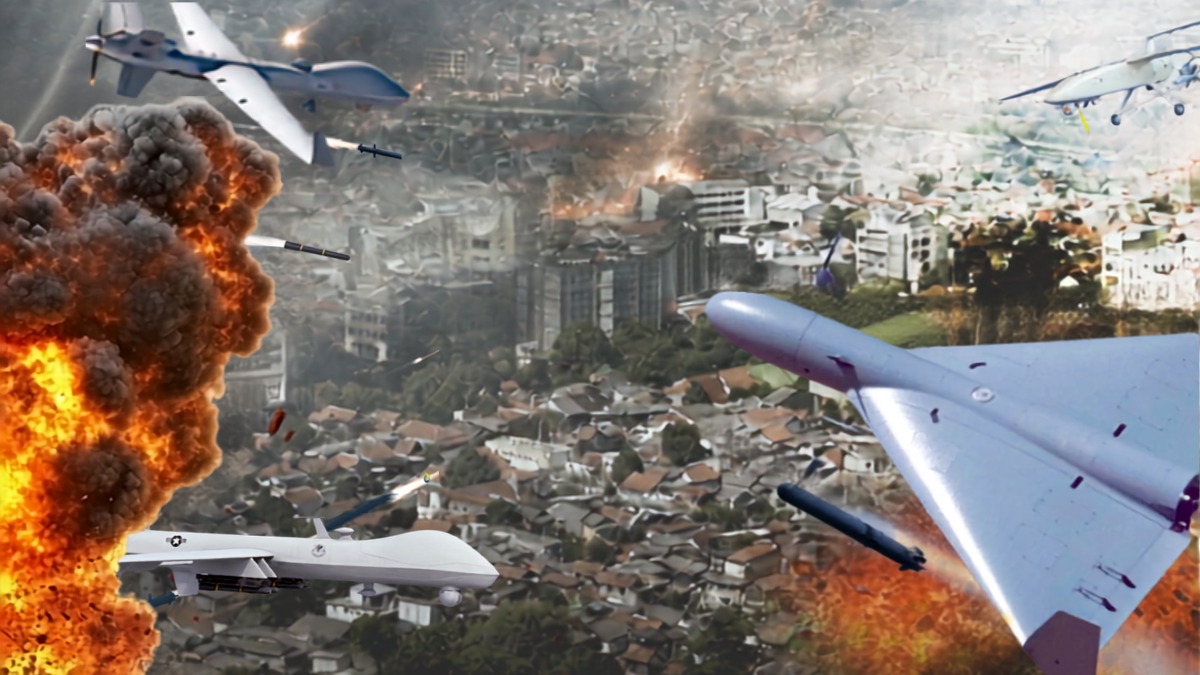
Drones are now central to modern warfare, from surveillance to precision strikes (Infographics: Media India Group/Hitesh Mehta)
Drones have emerged as the defining image of modern warfare, as seen in all the recent conflicts, be it Ukraine-Russia, Iran versus United States and Israel or closer home the India-Pakistan conflict last year.
Alongside conventional platforms, drones have become a core instrument of surveillance, precision attack, electronic warfare and battlefield coordination.
Though Indian drones may not yet be as advanced as some seen in all the three conflicts mentioned above, they are no longer being treated as experimental assets, instead they are becoming central to strike planning and battlefield awareness.

Smit Shah
According to Smit Shah, President of Drone Federation India, which clubs together all drone manufacturers in the country, India’s combat drone capability has improved steadily over the past decade, particularly in Intelligence, Surveillance and Reconnaissance (ISR) missions.
“Leading countries like the US, Israel and China still maintain a clear edge in autonomy, swarm warfare and large-scale operational deployment. India’s focus is shifting from platform acquisition to building sovereign capability across the full value chain, including software systems, communication networks and mission payloads, ” Shah tells Biz@India.
Alvin Anthony, Co-Founder and CEO of NextLeap Aeronautics, a Bengaluru-based Unmanned Aerial Vehicle (UAV) and defence technology start-up, believes the future of military drones will be defined by operational adaptability rather than platform specifications alone.
“The focus is shifting from standalone platforms to mission-driven systems that can adapt to changing operational requirements. Future UAVs will need to combine autonomy. endurance, payload flexibility and reliable communications while remaining deployable in complex environments,” Anthony tells Biz@India.
Danish Ghori, Co-founder of Airbots Aerospace, a Mumbai-based drone manufacturing startup, says the next phase of drone development will be driven by intelligent systems rather than hardware alone.
“Modern UAVs are evolving into intelligent platforms capable of autonomous navigation, advanced sensing and real-time analytics. Technologies such as AI-enabled detection, secure communications and mission-specific autonomy will be critical in determining the effectiveness of future defence and surveillance operations,” Ghori tells Biz@India.
Operation Sindoor: India’s first drone-intensive conflict
On the night of May 7, 2025, India launched Operation Sindoor in response to the Pahalgam terror attack that killed 26 civilians. Within minutes, Indian forces struck nine terror infrastructure sites across Pakistan and Pakistan-occupied Kashmir (PoK).
This marked India’s most significant cross-border military action since 1971, but with a defining difference with unmanned systems were at the centre of execution.
India deployed Israeli-origin Harop loitering munitions, Heron Mk-2 surveillance drones and SkyStriker systems manufactured through an India-Israel joint venture. Pakistan’s response, with a mix of drones, artillery and air attacks, escalated the conflict further.
Where India struggled: Electronic warfare and swarm pressure
Despite tactical success, Operation Sindoor exposed structural weaknesses in India’s drone ecosystem. The most critical vulnerability was electronic warfare. Pakistani forces reportedly deployed extensive GPS jamming and spoofing, which significantly degraded the performance of several Indian unmanned systems.
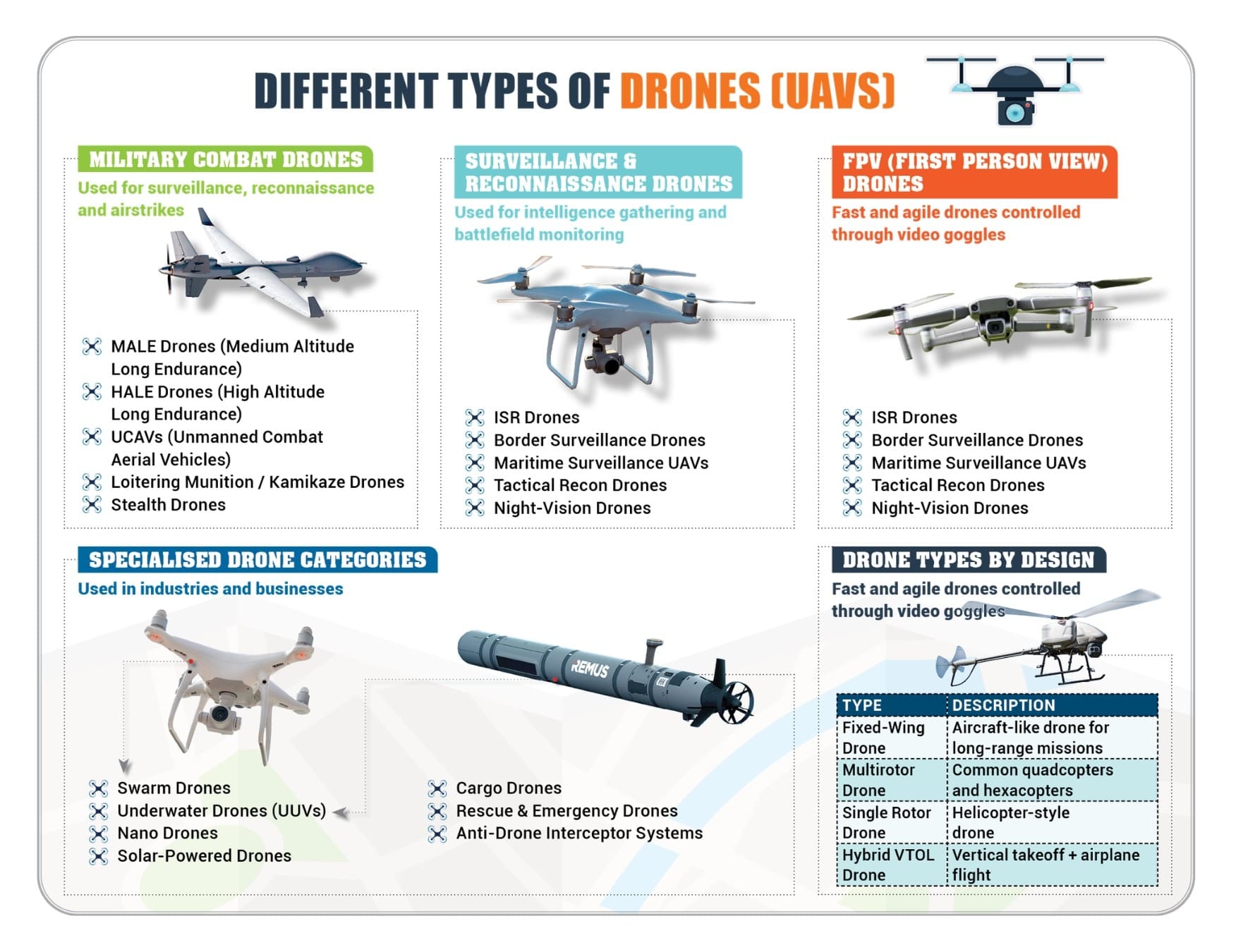
Military drones are evolving across combat, surveillance, swarm and specialised roles
A second challenge was swarm saturation. Pakistan’s use of large numbers of low-cost drones created radar clutter and forced Indian defences to respond to multiple simultaneous targets. This exposed the lack of a mature counter-swarm doctrine.
According to Ashutosh Baheti, Chief Executive Officer of Paras Anti-Drone Technologies, recent conflicts have demonstrated that effective defence against drones increasingly requires a layered approach rather than reliance on a single technology.

Ashutosh Baheti
“Modern counter-UAS solutions increasingly require a combination of RF detection, tracking, identification, monitoring and neutralisation capabilities working together as an integrated architecture. Effective protection can no longer depend on a single technology,” Baheti tells Biz@India.
He adds that drone threats are evolving far more rapidly than traditional security systems.
“Counter-drone technologies must be designed with continuous upgradeability and adaptability in mind. The ability to rapidly incorporate new threat intelligence and respond to evolving operating methods is becoming just as important as the underlying hardware itself,” he says.
The third weakness was technological dependence. Key subsystems such as navigation modules, encryption layers and communication links remain reliant on foreign suppliers. This creates operational risk in high-intensity conflict where supply chains and software access can be disrupted.
Finally, India’s indigenous drone ecosystem, while expanding rapidly, showed inconsistent battlefield resilience. Several systems failed under sustained electronic attack conditions, highlighting the gap between development testing and combat reality.
Ghori says that recent conflicts have fundamentally changed expectations from unmanned systems.
Also Read: Next-gen armour: Protecting soldiers for modern battilefield
“The conflicts in Ukraine and the Middle East have shown that drones can no longer operate as isolated platforms. Success increasingly depends on real-time intelligence, adaptability and the ability to function reliably in contested environments. Future battlefield solutions will require scalable systems that can rapidly integrate sensing, communication and decision-support capabilities,” he says.
Shah also points out that India’s progress is uneven across the ecosystem.
“While some manufacturers are achieving high indigenous value addition, others still depend heavily on imported components. The industry is steadily localising critical systems such as flight controllers, communication stacks and mission software, but advanced sensors and semiconductors remain a constraint,” Shah says.
India’s drone position today
India’s drone capability today reflects a clear split between imported operational strength and a still-maturing indigenous base. On the operational side, the armed forces rely heavily on proven foreign systems, particularly from Israel and the United States.
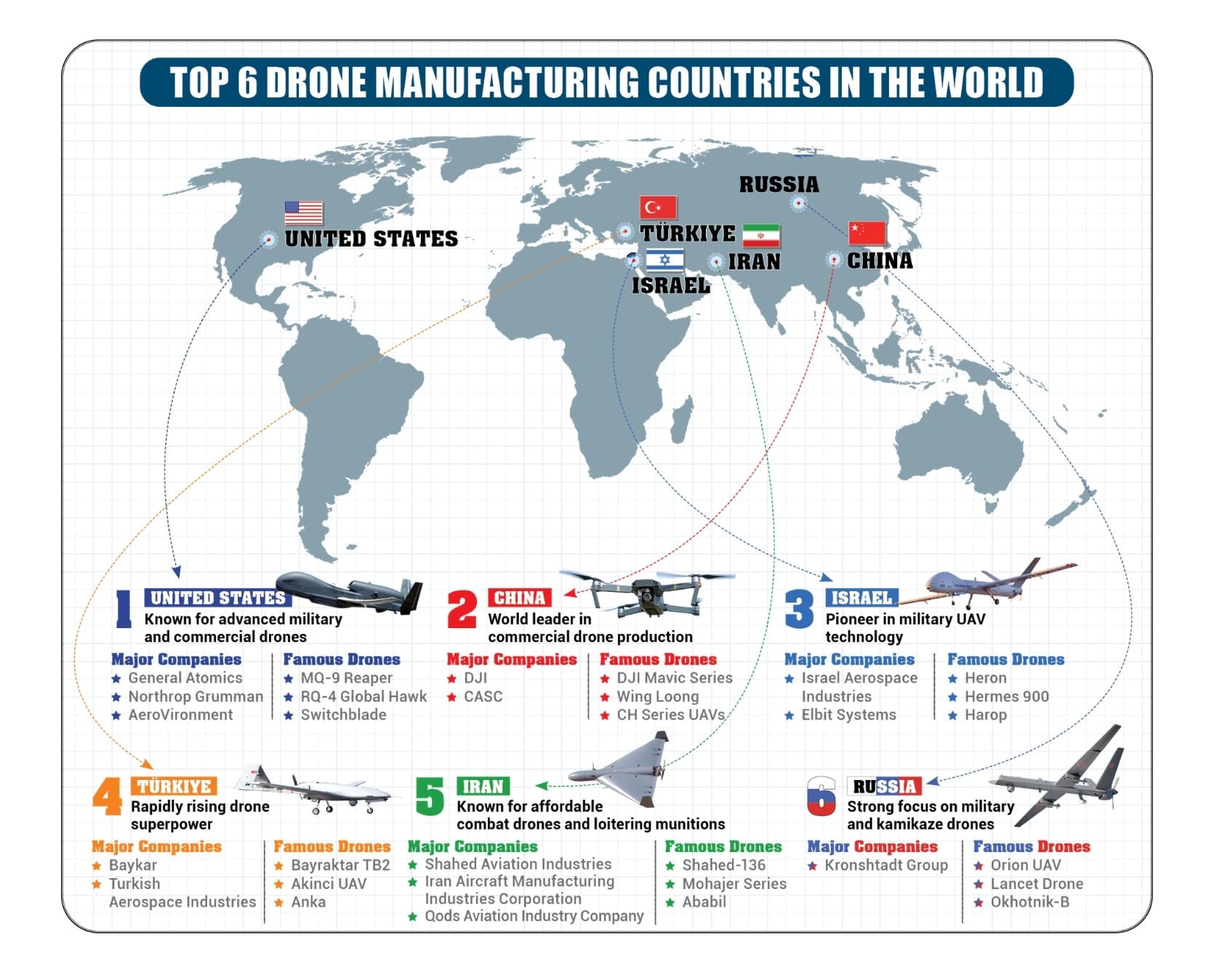
The US, China, Israel, Türkiye, Iran and Russia are leading global drone development
At the same time, indigenous development is steadily expanding but remains in transition. Tapas-BH-201 developed by Defence Research and Development Organisation (DRDO), the primary defence R&D organisation in the country, is aimed at medium-altitude surveillance roles, while Hindustan Aeronautics Limited (HAL), and private manufacturers are building Medium Altitude Long Endurance (MALE)-class and tactical UAV systems.
Baheti says that India is also emerging as a credible exporter of counter-drone technologies.
“The successful commercialisation and international adoption of our Chimera counter-UAS technology demonstrated that counter-drone solutions developed in India can compete successfully in global markets. It established confidence in indigenous anti-drone technologies among international customers facing increasingly complex drone threats,” he says.
According to Akshay Mahla, a UAV software research engineer, the next phase of drone evolution will be driven by multi-drone coordination, computer vision and low-cost FPV systems that are already reshaping battlefield outcomes.
He notes that India is preparing a defence drone procurement programme worth over USD 2 billion, with strong emphasis on domestic suppliers.
“Today, cheap drones, satellites and AI-assisted reconnaissance mean almost any movement can be detected and targetted. The battlefield cycle has also accelerated, with new drone designs and countermeasures emerging in weeks rather than years,” Mahla tells Biz@India.
Also Read: Paras Anti-Drone expands global footprint as demand for CUAS solutions grows
Anthony says that next challenge for India lies in scaling indigenous capabilities across the entire ecosystem.
“India has already demonstrated strong capabilities in UAV design and manufacturing. The next phase will depend on strengthening domestic supply chains, localising critical technologies and building scalable production capacity. Countries that control their technology stack will have a significant strategic advantage in future conflicts,” he adds.
Mahla also highlights a shift toward swarm autonomy, where future drone groups will be able to share information, divide tasks, reassign missions and continue operating even when individual units are lost. “Instead of one expensive aircraft, you get hundreds of inexpensive cooperative systems. The challenge is no longer building drones, but building the intelligence that coordinates them,” Mahla says.
Looking ahead, Baheti says future battlefield security will depend as much on anti-drone capabilities as offensive drone technologies.
“Our objective is not simply to neutralise today’s drone threats. It is to build counter-UAS technologies that can continue evolving alongside the threats they are designed to address. That is where we believe the future of anti-drone technology lies,” he says.
Ghori adds that autonomous and networked systems to have the greatest impact on future battlefields.
“AI-enabled autonomy, advanced surveillance systems, secure communication networks and cooperative unmanned operations will de ne the next generation of warfare. The foundations for those capabilities are being built today through advances in intelligent sensing, data analytics and autonomous mission execution,” he says. The foundations for those capabilities are being built today through advances in intelligent sensing, data analytics and autonomous mission execution,” he says.
In coming years, warfare will be increasingly shaped by AI-enabled, autonomous drones capable of operating in swarms and contested environments. For India, the priority will be to strengthen indigenous technologies, electronic warfare resilience and large scale drone production to achieve greater self-reliance and maintain a competitive edge on future battlefields.