
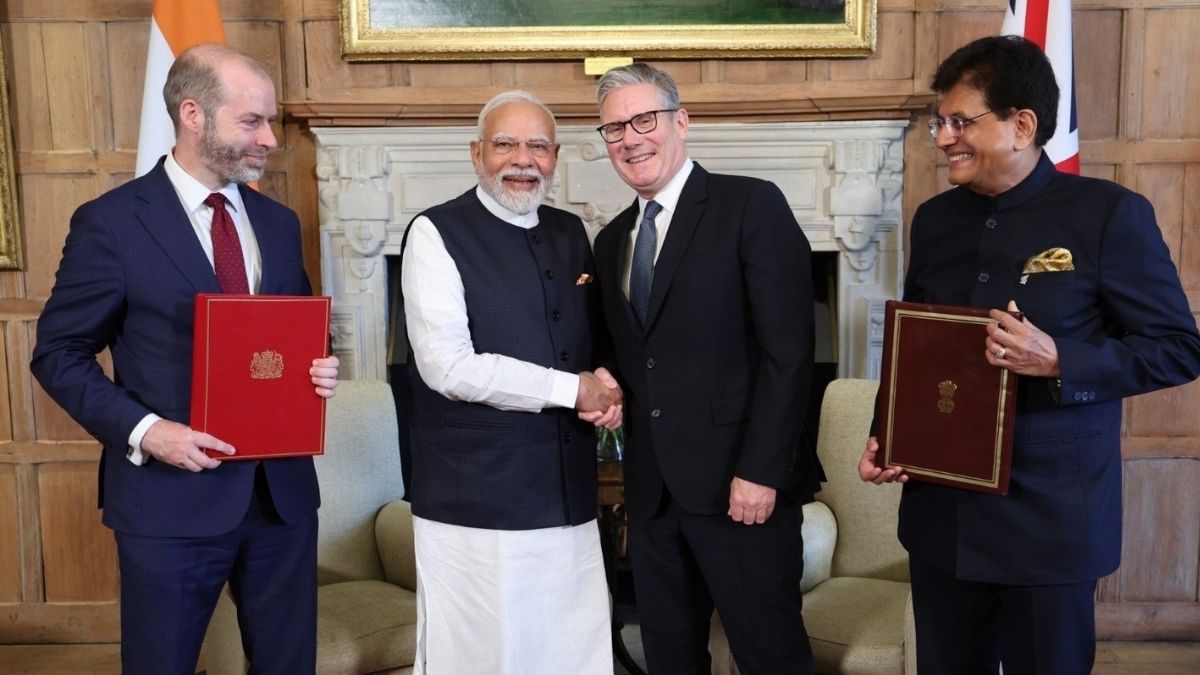
British Prime Minister Kier Starmer with his Indian counterpart Narendra Modi at the signing of the UK India FTA (Photo: PIB)
The world of a stable, rules-based trade policy as we knew no longer exists. In recent years, the global economic landscape has been marked by intense trade tensions, tariff wars, and shifting alliances. Amid this turbulence and uncertainty, India has been able to overcome economic challenges and managed to navigate the storm with a smart, strategic approach, through Free Trade Agreements (FTAs) and larger economic integration with trading partners. In this unpredictable trade environment, the India–United Kingdom Comprehensive Economic and Trade Agreement (CETA), also referred to as the India–UK Free Trade Agreement, comes into force from July 15.
The trade agreement will lift the uncertainty that currently affects Indian exports to the UK and is likely to increase exports of Indian goods to the UK by 9 pc on average solely because of policy predictability, which comes in addition to the trade gains arising from the various policy changes in the agreement.
Also Read: EU-India FTA: Redefining India’s trade policy for new global era
The negotiations between the two governments were initiated in January 2022 and following three years of negotiations it was signed last year. This FTA is forecast to boost Indian GDP by USD 6.8 billion, the U.K.’s GDP by USD 6 billion and increase the annual bilateral trade by USD 34 billion in the long run. The FTA will also double bilateral trade to USD 120 billion by 2030.

The UK-India Free Trade Agreement (FTA) eliminates tariffs of up to 12 pc on imports of Indian textiles and clothing
This historic trade agreement signifies a major shift in Britain’s economic policy and reflects the evolving global trade landscape shaped by India’s rise as a global economic power. The FTA also represents a key development in the changing landscape of globalisation, particularly amid shifting geopolitical dynamics and the rise of bilateral trade agreements.
As India’s first comprehensive trade agreement with a major European partner and Britain’s most significant post-Brexit trade initiative, the FTA is strategically significant and economically lucrative. As the agreement comes into force, this also marks a paradigm shift in India’s bilateral relations with Britain, bringing the the world’s fifth and sixth-largest economies closer together. The agreement is largely viewed as a win-win that transforms the UK-India relationship from a historical post-colonial dynamic to a modern, dynamic, strategic and economic partnership.
The agreement is coming into force in a strange and unpredictable political environment in Britian. In the last 10 years, Britain has seen seven Prime Ministers, and soon there shall be a new prime minister. Labour Leader and former Mayor of Manchester Andy Burnham is on track to replace the incumbent Keir Starmer, who resigned last month under growing controversy over his handling of affairs, notably Starmer’s turning a blind eye to his close ally Peter Mandelson in the Jeffrey Epstein sex scandal.
Allegations that Starmer was aware of the alleged role of Mandelson, former Labour Minister, former Ambassador of the UK to the United States and former European Trade Commissioner, in helping Epstein spread his influence in the UK for over a decade. Starmer’s unceremonious exit comes barely two years after he led the Labour Party to an historic win, bagging 411 of 650 seats in the British Parliament.
Also Read: India’s expanding trade horizons: Major FTAs in 5 years
The unprecedented “revolving door” at 10 Downing Street, the official residence of the British PM, reflects the lingering fallout of Brexit, deep economic challenges, and mounting public dissatisfaction over political system. Despite the domestic troubles that his party is in, it is hoped that when Burnham takes office, he will place the UK-India trade and economic relations as one of his top bilateral trade priorities.
When the Great Britain and India started the free trade negotiations in 2022 many political pundits, economic thinkers and trade strategists said it would never be done, but UK and India FTA defied all expectations and kept pushing for a deal, opening a fresh chapter in India-U.K. trade relations, and one must not underestimate its significance.

The agreement provides zero-duty access for nearly 99 pc of Indian exports, significantly improving the price competitiveness of Indian jewellery
While the European Union and India Free Trade Agreement, negotiations of which concluded early this year, is called “Mother of all deals” the U.K.-India Free Trade Agreement, because of its ambitious target, can be called as the ‘gold standard of modern trade deals’. It is true that while EU-India FTA offers institutionalised predictability, Brussels moves slowly, often frustratingly so, but, once commitments are embedded in legal text, they tend to endure, the agreement with UK, will be a political litmus test for British bureaucracy in the unfolding political turmoil.
India’s flurry of recent trade deals represent a monumental triumph in global trade diplomacy, shifting the nation from a historically protectionist stance to one of assertive global integration. By aggressively expanding its economic footprint, India is successfully balancing domestic interests with massive international market access. In this respect, the India-EU Trade Agreement, India-EFTA Trade and Economic Partnership Agreement (TEPA), and the India-UK Comprehensive Economic and Trade Agreement (CETA) marks historic turning points. These agreements highlight India’s highly refined geo-economic toolkit. By skilfully leveraging its vast consumer market and skilled labour force, India has managed to negotiate reciprocal market access while rigorously protecting sensitive sectors like agriculture and domestic manufacturing.
Why this deal matters
This FTA matters a lot for India as the it will help India access UK market through eliminating or drastically lowering tariffs on Indian exports, including textiles, apparel, leather, footwear, gems, and jewellery, Indian exporters will gain a distinct competitive edge in the UK. It will be a boost to services and mobility as the deal relaxes visa rules for professionals and facilitates mutual recognition of qualifications in key sectors like IT, accounting, and architecture. In the field of investment and technology transfer, it will provide stronger intellectual property certainty, encouraging British firms to invest in India’s technology, pharmaceutical, and R&D sectors. The pact will help India solidify its position as an economic powerhouse.
The UK and India are two major economies with deep commercial, cultural and people-to-people links. This agreement will give businesses greater confidence to trade, invest and collaborate across a fast-growing economic corridor.

FTA will open streamlined visa pathways for highly skilled professionals
Double Contributions Convention – bonanza for Indian Diaspora
One of the most important aspects of the FTA is that UK has also agreed to extend the benefits under the Double Contributions Convention (DCC) for UK nationals moving to India to work and continue to build entitlement to a UK State Pension from 36 months to 60 months. They will continue to pay National Insurance Contributions during that period, without also having to pay social security contributions in India. As this is on reciprocal basis, it is also valid for Indian professionals working in the UK and will be applicable to highly skilled professionals on pre-existing visa routes. This is in line with the arrangements the UK holds with other countries such as Korea, Japan, and Canada. This will be achieved through the UK-India Double Contributions Convention Agreement.
Also Read: Lessons for EU from India-UK Free Trade Agreement
India has signed and operationalised bilateral Social Security Agreements (SSAs) with 15 European countries, and UK will be the 16th. These treaties protect expatriates from dual social security taxation, allow for the export of pensions, and permit the totalisation of contribution periods to qualify for benefits
FTAs and the Rise of India as a Global Economic Power
India’s ascent as a global economic power has positioned it at the centre of international trade diplomacy, with FTAs serving as a principal instrument of this transformation. As the world’s most populous nation and the fifth-largest economy by nominal GDP, India’s influence in global commerce has grown markedly, with FTAs underpinning much of this progress.
The agreement also represents the latest step by the UK and India to strengthen their relationship, building on the Technology Security Initiative, and the UK-India Comprehensive Strategic Partnership, which centres the relationship on mutual economic growth, technological innovation, and collaboration on global challenges including climate change.
India, with its rapidly growing economy and expanding middle class, presents a significant opportunity for the UK to diversify its trade partnerships and reduce reliance on traditional markets. Nevertheless, the FTA introduces a distinct set of challenges for the broader South Asian region.
CETA in the global uncertainty
India’s economy remains a pillar of global resilience amid ongoing geopolitical tensions, elevated crude oil prices, and shifting trade policies. Despite these external pressures, robust domestic consumption, infrastructure investments, and service sector growth keep the nation among the world’s fastest-growing major economies. While advanced economies battle to stabilize growth, India continues to project strong structural and macroeconomic indicators. Navigating this uncertain climate presents distinct challenges, but the country maintains important safeguards.
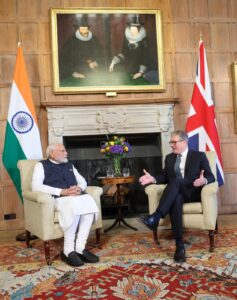
This historic trade agreement signifies a major shift in Britain’s economic policy and reflects the evolving global trade landscape
However, there is no denial that India’s economy is facing growing challenges amid global geopolitical tensions, currency volatility, and rising energy costs. The weakening of the Indian Rupee, combined with increasing crude oil prices and disruptions in global supply chains, has raised concerns among policymakers and investors alike. As India imports a significant portion of its crude oil requirements, any increase in global oil prices directly impacts inflation, transportation costs, and overall economic growth. The recent tensions in the Gulf region have further intensified these concerns, putting additional pressure on the Rupee and widening the country’s trade deficit.
Yet, for both economies, this agreement acts as a de-risking mechanism, building resilient supply chains away from over-concentrated regions and counterbalancing broader global trade instability. Successfully bringing into action, a major bilateral trade deal in the current climate signals immense commitment of both governments to business growth.
Also Read: From paper to ports: IMEC Corridor faces reality test
Beginning with implementation and utilisation, in order to deliver fully, businesses need to be able to take advantage of all aspects of the deal, and this is not always easy. For example, the automotive sector has been widely identified as one that stands to benefit from the agreement when it comes into force. The deal reduces tariffs from up to 110 pc to 10 pc in a phased way, ultimately including electric and hybrid vehicles. However, the rules of origin requirements which stipulate the proportion of different types of vehicles that need to be made and assembled in the UK are more stringent than in other similar FTAs agreed by the UK, particularly for non-passenger car vehicles. How significant this turns out to be will only be known as businesses start to utilise the agreement.
How FTA can be beneficial can be seen in the recent steel import policy by UK and EU. The EU and UK aim to combat “global over-capacity” by curbing the influx of “state-subsidised foreign steel” using these measures. As new synchronised steel trade measures by the UK and EU came into effect on July 1, India preserved its competitive advantage in both markets.
New Delhi’s free trade agreements with both trading partners have enabled it to make relative gains. The EU and UK aim to combat “global over-capacity” by curbing the influx of “state-subsidised foreign steel” using these measures. Both expect that the steps could give rise to fair competition and utilisation of their domestic capacities. The UK’s duty-free steel quotas for India have been pegged at the highest level among its trade partners barring the EU after recent negotiations that also cleared the path for implementation of CETA between the two countries.
(Sunil Prasad is the Secretary General of Brussels based Europe India Chamber of Commerce. The views expressed here do not necessarily reflect those of Media India Group.)
