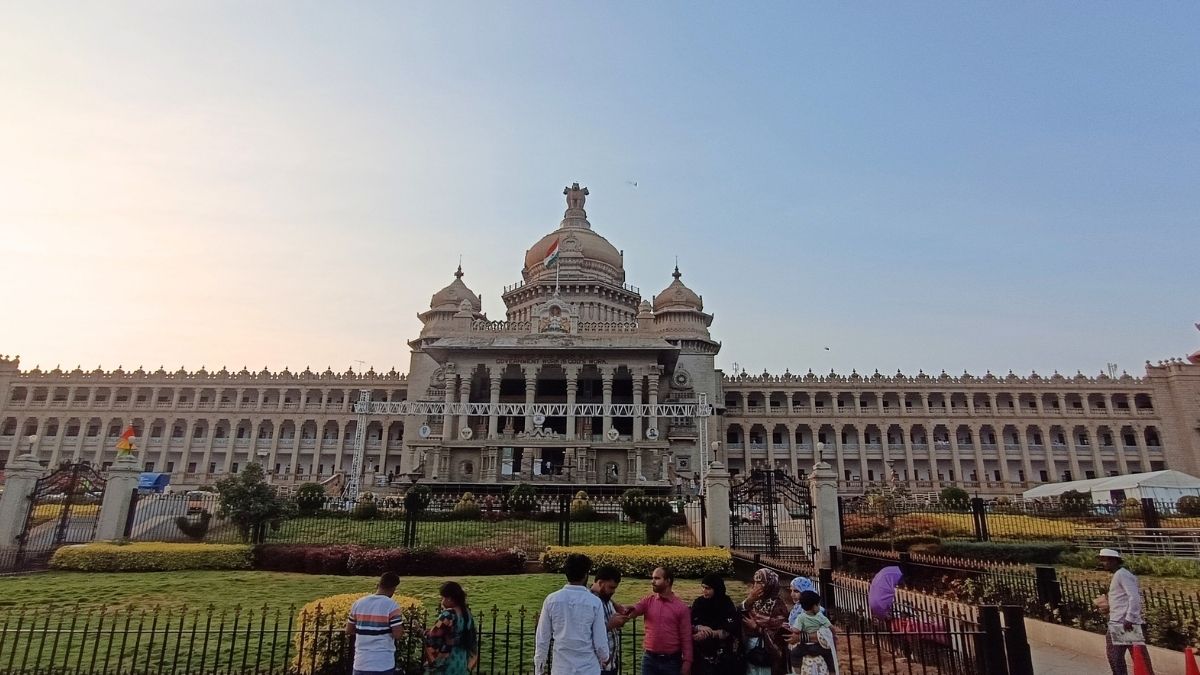
Permission requirements for protests are not new to Karnataka (Photo: MIG)
A proposed bill to make it mandatory for organisers of protests on government property and public spaces to take prior permission, has sparked a series of protests in the state.
The bill seeks to tighten rules governing public gatherings, clearing legislation that requires prior permission for rallies, protests, meetings and other events on government property. Violations could attract jail terms and fines, raising questions over dissent, public order and the constitutional right to peaceful assembly.
The opposition Bharatiya Janata Party (BJP) has accused the Congress government of targetting the Rashtriya Swayamsevak Sangh, a far-right wing organisation and parent of the BJP, while the government says the measure is aimed at preventing unauthorised use of public property. The bill will be discussed in the ongoing Monsoon Session.
The Karnataka Cabinet cleared the Karnataka Regulation of Use of Government Premises and Public Property Bill, on August 13. It requires any private individual, organisation, association or society to seek written permission before using government land, buildings, roads, parks, playgrounds or water bodies for processions, meetings, assemblies, functions, celebrations and training programmes.
Also Read: A defining moment for Hindutva politics
The application must go to the deputy commissioner, superintendent of police or another authorised officer at least seven days before the event. Officials can refuse permission citing public order or traffic disruption. Marriages, funerals and small, unorganised gatherings for education or recreation are exempt. Events with more than ten participants require clearance.
Violation counts as trespass. A first offence can bring up to three years in jail and a fine of INR 500,000. A repeat offence rises to five years and INR 1 million if the violation continues after conviction, an additional fine of INR 5,000 a day applies. The bill also allows arrest without a warrant.
Home Minister Priyank Kharge, who piloted the bill through the Home Department, says it will run alongside existing laws such as the Karnataka Police Act, 1963, the Karnataka Parks, Play-fields and Open Spaces Act, 1985, and the Bharatiya Nagarik Suraksha Sanhita, 2023. He frames the objective as protection of public assets from unauthorised occupation.
“Why is everyone thinking this is to curtail or curb any particular institution, association, organisation, society, club, union, syndicate or NGO? Beats me,” Kharge said after the Cabinet meeting.
That denial has not settled the matter. Kharge has, since 2025, pushed the RSS to register formally and disclose its finances, and wrote an open letter to it in June. The dispute traces back to October 2025, when a proposed RSS march in Kharge’s own constituency, Chitapur in Kalaburagi, was halted over law and order concerns. The Cabinet had drafted a similar bill then, with a two-year jail term for a first offence and three years for repeat violations. It was shelved for lack of inter-departmental consultation, and the government issued an order instead, dated October 18, 2025. The Karnataka High Court stayed that order on grounds including violation of fundamental rights. The 2026 bill gives the same restrictions the force of a full statute.
Also Read: Despite nationwide protests, government pushes through Transgender Bill
BJP state president B Y Vijayendra has accused the government of targeting the RSS. BJP MP Tejasvi Surya called the move unconstitutional, saying the right to form associations is protected under the Constitution and upheld by several High Courts. Kharge has hit back, calling BJP’s objections a case of “Priyank-phobia.”
The bill is not Karnataka’s only such move this year. In December 2025, the Assembly passed the Karnataka Hate Speech and Hate Crimes (Prevention) Bill, carrying a jail term of one to seven years and a fine of INR 50,000, rising to two to 10 years and INR 100,000 for repeat offences. The BJP opposed that bill too, calling it an attack on free speech.
Permission requirements for protests are not new to Karnataka. In 2019, police in Mangaluru detained 38 activists for protesting against the Citizenship Amendment Act without permission. In 2022, Congress leaders, including then-Leader of Opposition Siddaramaiah and D K Shivakumar, were booked for a march against the ED’s questioning of Rahul Gandhi, held despite restrictive orders. Siddaramaiah, who later became Chief Minister, later moved the Supreme Court to quash those proceedings. In October 2025, Karnataka Rashtra Samithi workers were booked for protesting at Freedom Park after their permission request was denied since two other protests were already cleared for that date.
“What we are witnessing in Karnataka is a slow accumulation of permission regimes, each justified on its own narrow terms, but together they change the default position of the citizen from someone who can assemble freely to someone who must ask the state’s leave every time. The seven-day notice period combined with a three-to-five-year jail term is disproportionate to the stated goal of protecting parks and playgrounds. If the concern were really about damage to public property, existing laws on that already cover it. What this bill actually regulates is assembly itself, and that touches Article 19 of the Constitution,” Tariq Qadri, Political Analyst and Senior Associate at NBMC Analytics, a political intelligence, data science, and governance consulting firm tells Media India Group.
Also Read : Karnataka assembly passes anti-superstition bill
His point goes to the core of why the permission rule invites scrutiny. Public order concerns can already be addressed under provisions of the Bharatiya Nagarik Suraksha Sanhita that let district magistrates restrict gatherings when a specific threat is identified. A blanket seven-day notice requirement for any gathering of more than 10 people, backed by a three-year jail term, does not target a specific threat; it targets the act of assembling itself, before any disruption occurs.
Karnataka’s own record shows how such rules get applied unevenly. Rallies by ruling parties have gone ahead on post-facto court orders and administrative discretion, while opposition parties and smaller groups have faced refusals, arrests and prosecution for proceeding without clearance. A system built on the discretion of a deputy commissioner or police officer, with no fixed criteria for refusal beyond broad terms like public order, leaves room for selective enforcement no matter which party is in power.
The bill was expected to be tabled in the recently-concluded Monsoon Session of the Karnataka legislature. However, the government chose not to introduce the bill, perhaps due to the rising opposition. Whenever the bill is introduced, it remains to be seen if it will pass as drafted, or is diluted after the same court and political scrutiny that stalled its 2025 predecessor. That alone will determine whether Karnataka ends up with a genuine framework for protecting public property, or another statute testing the limits of the right to assemble.