
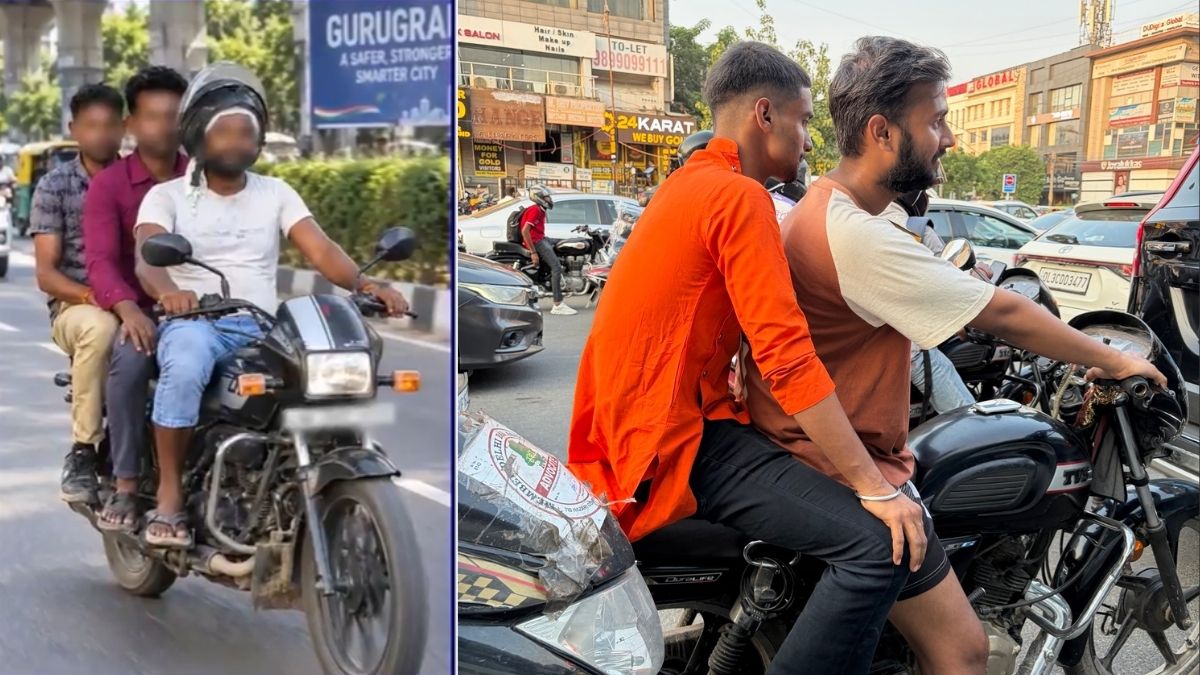
Triple riding and lack of helmet use remain common road-safety concerns among two-wheeler riders (Photo: Gurugram Traffic Police)
On September 13, 2026, Delhi-based biker Shivani Chauhan, known as Sia, was allegedly chased and rammed by a car while riding on Gurugram’s Golf Course Road. The incident, that was captured on her helmet camera and also of a fellow biker, went viral. In a police complaint, Chauhan said that the car had been following her group before hitting her motorcycle and fleeing.
Police later arrested two men and added charges including attempt to murder, rash driving, endangering life and stalking. Due to the high profile that the case had gained on social media, the police said that a five-member Special Investigation Team (SIT) had been formed to investigate the incident, as the accused has denied deliberately hitting Chauhan.
Though not directly related to the above incident, it has put the spotlight on the safety of two-wheeler riders on Indian roads. Of the 183,382 deaths recorded on Indian roads in 513,563 accidents, two-wheeler riders accounted for 46.2 pc of all road fatalities, while pedestrians accounted for another 20.6 pc. The figures do not establish that riders were responsible for the accidents and the deaths, but they do underline the vulnerability of people on two-wheelers and the consequences of unsafe road behaviour by them or by other road users.
Speeding, helmets and wrong-side riding remain major concerns
Over-speeding remains one of the biggest reported causes of road crashes. Government data presented by Union Road Transport and Highways Minister Nitin Gadkari in a written reply to the Lok Sabha on July 30, 2026, showed that over-speeding caused 82,124 accidents in 2025, while wrong-side driving and lane indiscipline accounted for another 4,089 accidents.
Helmet compliance remains another major concern. Gadkari said 54,132 people died in 2025 because they were not wearing helmets, highlighting the consequences of one of the most basic road-safety requirements.
Gurugram offers a particularly stark picture of repeated violations. Traffic police issued more than 203,000 challans for wrong-side driving in 2025, while around 110,000 speeding cases were recorded. Police also issued 390,000 challans for riding without helmets and 450,000 cases involving triple riding or pillion violations.
Also Read: Rising road rage cases in India: A deadly consequence of frustration & neglect
For Inderjeet Gautam, producer at Mehrotra Productions, a studio that produces video advertisements and digital content for brands, who regularly rides a bike, risky riding is often driven by ‘the adrenaline that comes with it’ or what he describes as ‘the bad habit of ignorance’.
“Riders can become accustomed to ignoring safety rules, particularly when they do not immediately see the consequences of their behaviour,” Gautam tells Media India Group.
Aayush Mehta, another regular bike rider, says convenience and overconfidence can also push riders towards violations.
“Sometimes I break traffic rules because I am in a hurry or there is heavy traffic. For example, I might speed when the road is relatively empty or cross a signal when I think there is no traffic around,” Mehta tells Media India Group.
“Sometimes riders also avoid helmets for short distances because they feel it is unnecessary. We know the risks, but convenience and overconfidence can make us take those risks,” Mehta adds.
The problem has continued in 2026. Just in a week-long enforcement drive, from January 12 and 18, the traffic police in Gurugram issued 1,855 challans for wrong-side driving, despite warnings that serious cases could lead to criminal cases against them. The same enforcement drive recorded 830 helmet violations and 332 drunk-driving cases.
Adhiraj Rana, who regularly drives his car in Vrindavan, Uttar Pradesh says he has often seen riders flouting traffic rules on the road.
“They do not check the rear-view mirrors when they are overtaking someone. Speeding, weaving, wrong-side riding, sudden lane changes and signal jumping, all these categories are dangerous. Most of them do not wear helmets. They do not care about their life and they do not care about others. To just look cool, they do all these things,” Rana tells Media India Group.
A case reported on September 17 further illustrated the problem. Gurugram Police impounded a motorcycle after finding 113 pending challans worth INR 1.07 million. The rider was stopped for riding without a helmet and could not produce the required documents. Most of the pending challans reportedly involved helmet, traffic violations as well absence of documents related to insurance and emissions.
Rana says he recently experienced the consequences of such behaviour himself. “I was driving a car at 25-30 kmph and one of the riders was coming from the wrong side, talking on the phone and not wearing a helmet. He nearly hit my car,” he says.
The question, therefore, is not simply whether riders know the rules. Research into young two-wheeler riders in India has linked risky riding with attitudes towards dangerous behaviour, social norms, perceived approval from peers and previous riding behaviour.
Also Read: Repeated fatal truck accidents in US put spotlight on Indian drivers
Gautam also points to the influence of social media and peer behaviour, particularly among younger riders.
“A lot when kids see this kind of content they think it is cool and they must try it. When elders respond by simply warning or scolding them, it can sometimes become an incentive for young riders to prove them wrong rather than understand the risks,” he adds.
Mehta similarly believes social media and friends can make risky riding appear attractive.
“When we see people doing wheelies, high-speed riding or other stunts on Instagram and YouTube, it can make risky riding look exciting or impressive. Friends can also encourage someone to ride faster or show off,” he says.
Social media has added another dimension. Police in several cities have arrested riders after viral videos showed them carrying out wheelies, overtaking dangerously and other stunts apparently performed for online content. Such cases suggest that peer approval and the pursuit of online attention can become additional incentives for risky riding.
But riders also point to problems beyond individual behaviour.
“The biggest problems that I face as a rider are damaged roads, especially the water-clogged roads with potholes, careless drivers of cars, trucks, autos and e-rickshaws,” Gautam says.
Mehta also says road conditions and the behaviour of other motorists affect two-wheeler safety. “
“For me, the biggest problems are traffic congestion, poor road conditions, potholes and cars not giving enough space to two-wheelers,” he says.
Sudden lane changes without indicators and wrong-side driving by other vehicles, he adds, can also be dangerous for bikers.
Rana also says lane discipline needs attention by both riders and other drivers. “Riders should ride in the most left lane. They ride their bikes in the overtaking lane at a speed of 40-50 kmph, while the overtaking lane has a speed limit of 80 kmph. Riders don’t make way for other vehicles to overtake them,” he says.
For pedestrians, the consequences can be particularly serious. Driving on wrong side, jumping traffic signals, speeding through intersections and riding through spaces meant for pedestrians can turn routine journeys into dangerous encounters.
Pappu Yadav, a pedestrian who regularly uses roads and footpaths, says pedestrians and people who spend time on the roads often face the consequences of unsafe riding.
“Pedestrians and people who spend time on the roads face the most challenges. Often riders bring their vehicles onto the footpath, which can lead to accidents. It is also not ethical, as footpaths are meant for pedestrians,” Yadav tells Media India Group.
Another pedestrian, Ram Singh points to the difficulty pedestrians face while crossing roads.
“A major problem is that some riders do not slow down near crossings. They suddenly come from behind or try to overtake from the side, which makes it difficult for pedestrians to judge when it is safe to cross. Older people and children are especially vulnerable in such situations,” Singh tells Media India Group.
He says two-wheelers using footpaths leave pedestrians with less space to move safely, increasing the risk of collisions and injuries.
Not every accident involving a motorcycle is caused by the rider, just as not every violation results in a crash. But the repeated enforcement data shows that unsafe riding remains widespread.
Also Read: Poor road infrastructure
Rana believes clearer road rules and better segregation could help reduce conflicts between two-wheelers and other vehicles.
“There should be a separate lane for riders and strict rules for riders and drivers,” he says.
He also argues that vehicles travelling at a constant speed should avoid the overtaking lane so that faster vehicles and emergency vehicles such as ambulances, fire trucks and police vehicles can pass safely.
Inderjeet believes that changing this behaviour requires more than punishment.
“Only proper education with calm and not nagging can change a rider’s behaviour towards riding more safely,” he says.
He also says witnessing an accident changed his own riding behaviour, making him more aware and safety-conscious.
The Gurugram hit-and-run has highlighted how vulnerable bikers can be when another road user behaves recklessly. At the same time, India’s road-safety challenge also requires scrutiny of riders who treat wearing helmets, following traffic rules and road discipline as optional.
