
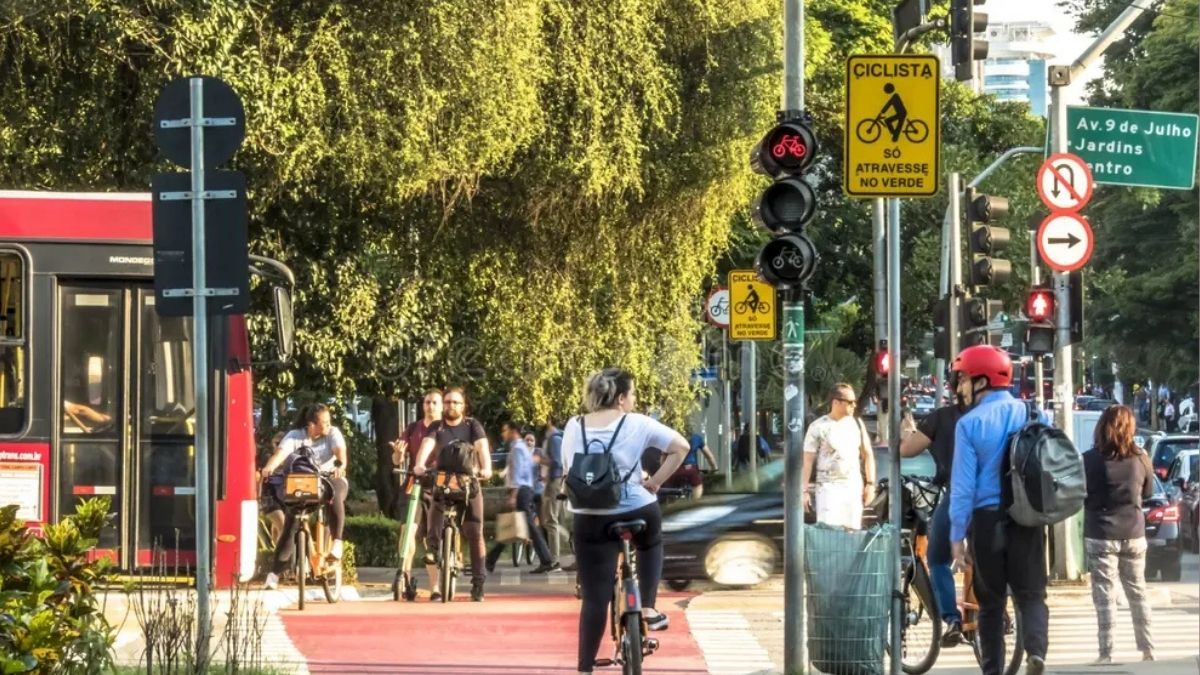
Report also calls for greater investment in walking, cycling and shared transport (Photo: International Transport Forum)
More than 70 pc of the global population is expected to live in urban areas by 2060, putting further pressure on transport systems as cities expand and travel demand increases, according to a report by the International Transport Forum (ITF) at the OECD.
The report estimates that, if current trends continue, urban vehicle-kilometres travelled could increase by 69 pc between 2025 and 2060 from 15 trillion to 25 trillion vehicle-kilometres. Passenger-kilometres travelled are expected to rise by 81 pc over the same period. The increase is linked to higher incomes, greater use of private vehicles and longer journeys as cities expand.
The growth will not be evenly distributed. The ITF expects travel demand to increase significantly in sub-Saharan Africa and Southeast Asia, driven by urbanisation and economic growth. Demand is expected to remain relatively stable in Europe, the US, Canada, Australia and New Zealand, as well as higher-income East Asian markets such as China, Japan and South Korea.
The report says rising urban travel could increase congestion, affecting labour productivity, while also adding environmental and road-safety pressures. Private vehicle travel generally produces more negative externalities per passenger-kilometre than other forms of transport.
Also Read: Hi-tech transport
Against this backdrop, the ITF is calling for a greater focus on urban travel demand management (TDM). The approach aims to reduce or redistribute travel demand across space and time while allowing residents to access the activities and services they need. It includes integrating land-use and transport planning, improving walking, cycling and shared transport, and introducing vehicle-access policies.
The report says that cities should move away from a traditional “predict-and-provide” model, where governments forecast rising demand and build infrastructure to accommodate it. Instead, it recommends a “decide-and-provide” approach, where authorities establish a vision for urban mobility and use existing infrastructure more efficiently while limiting negative impacts.
The ITF also recommends taking a systems approach, with coordination between different levels of government and better sequencing of policies. This is intended to prevent individual measures from producing unintended effects and to improve public support.
Land-use planning is another central part of the report. The ITF recommends compact and mixed-use development, accessibility-oriented planning and transit-oriented development to reduce the need for long-distance travel and strengthen the case for public transport, walking and cycling infrastructure.
The report also calls for greater investment in walking, cycling and shared transport. Public transport fare integration, fare caps, concessions for low-income users and open payment systems can reduce barriers to multimodal travel. Better pedestrian and cycling infrastructure can also make these modes viable for complete journeys rather than only short trips.
Where appropriate, cities can also use vehicle-access restrictions and pricing mechanisms, including low-traffic neighbourhoods, priority lanes, low-emission zones, parking charges and road pricing. The ITF says the effectiveness of these measures depends on local socioeconomic conditions and the availability of alternative transport options.
Pricing can also provide funding for transport. The report notes that some demand-management measures can generate revenue that can be used to support public transport and other complementary investments. Revenue can also be redirected to address the distributional effects of such policies.
Also Read: Civil society meets before BRICS 2016 in India
The report stresses that fairness needs to be considered from the beginning. For example, the London Congestion Charge initially created a greater financial burden for some low-income households, particularly those living in areas with limited public transport. London subsequently directed part of the revenue towards public transport and introduced measures to offset costs for some affected groups.
The ITF also recommends stronger monitoring and evaluation. Cities should establish clear objectives, collect baseline data and assess travel patterns before and after interventions. Data from travel surveys and mobile devices can be used to measure changes in mobility behaviour.
Public communication is another part of the proposed approach. The report says governments need to explain the benefits of demand-management measures, address misinformation and engage civil society and academia to build public support.
The report also notes that changing technology and social behaviour will affect future urban mobility. Teleworking, electric vehicles, automated vehicles, ageing populations and new mobility services are already changing how people travel and need to be considered in future planning.
For rapidly growing cities, particularly in developing economies, the ITF says demand management could help prevent cities from becoming locked into transport patterns that are costly, inefficient and environmentally harmful.
