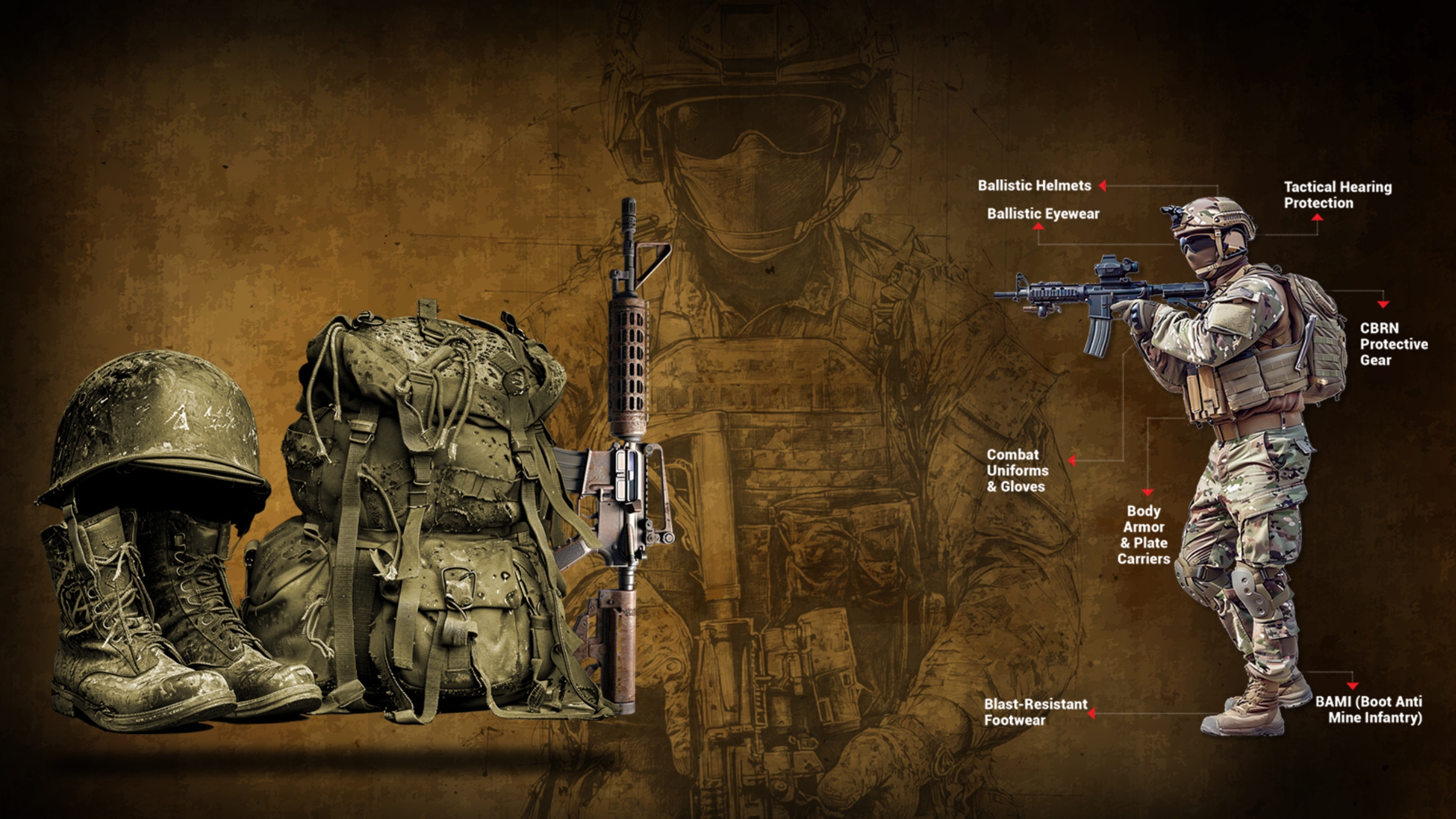
Soldier equipment and tactical gear displayed with a fully equipped modern infantry soldier ( Infographics: Media India Group/Chhanda Roy)
The image of a modern soldier is defined not only by the assault weapons he carries, but also by the defensive gear for protection that he wears. Ballistic helmets, bullet-resistant jackets, protective eyewear, combat boots and specialised gear against chemical, biological and explosive threats have become as essential as guns and magazines.
As battlefields become more lethal with armour-piercing rounds, drones and fragmentation weapons, personal protective equipment is increasingly determining a soldier’s ability to survive, fight and return home safely.
India has made significant progress in manufacturing personal protective equipment, with domestic companies producing bullet-resistant jackets, ballistic helmets, hard armour plates, anti-mine boots, ballistic shields and Nuclear, Biological, Chemical (NBC) protection systems. Modern designs are becoming lighter, more comfortable and capable of protecting soldiers against not only bullets but also shrapnel, blast fragments and emerging drone threats.
However, while the country can manufacture most finished protection systems, it still relies on imports for several critical materials used in advanced armour, including aramid fibres, Ultra-High-Molecular-Weight Polyethylene (UHMWPE) fibres and specialised ceramics. As battlefield threats evolve, the next challenge will be strengthening indigenous capabilities in these high-performance materials while developing the next generation of soldier protection technologies.
According to Mukesh Sharma, Founder and Proprietor of New Delhi-based defence equipment manufacturer RK & Sons, India has made significant progress in producing finished personal protective equipment but remains dependent on imports for certain advanced ballistic materials.
“Historically, India relied heavily on imported ballistic materials. While certain advanced fibres and specialised technical textiles are still sourced internationally, domestic capabilities are steadily expanding. Government initiatives encouraging indigenous manufacturing are expected to accelerate investments in high-performance fibres, advanced composites and next-generation protective materials,” Sharma tells Biz@India.
While India has developed strong manufacturing capabilities in finished protective equipment, Sharma notes that the industry is still building domestic capacity in certain advanced materials.
Also Read: Forces face moral dilemma over Artificial Intelligence in defence
From patka to next-generation armour
The evolution of personal protective equipment can be seen in the transition from the Indian Army’s bulletproof patka or protective headgear, introduced in the 1990s, to modern ballistic helmets capable of providing protection against assault-rifle threats while offering improved comfort and mobility.
Similarly, earlier bullet-resistant jackets were often heavy and provided protection mainly to the chest and back. Today’s jackets use advanced ballistic fibres and ceramic plates to stop higher-calibre rounds while reducing weight and extending protection to vulnerable areas such as the neck, shoulders and groin.
The latest generation of equipment is also designed for threats that were less prominent in the past. For example, manufacturers are developing rifle-rated helmets capable of stopping AK-47 and NATO-standard ammunition, while body armour systems increasingly focus on protection against shrapnel and drone-dropped explosive fragments, lessons drawn from recent conflicts such as the Russia-Ukraine war.
A handful of Indian companies have emerged as key players in the personal protection equipment sector. Firms such as MKU, SMPP and Indian Armour manufacture a wide range of ballistic helmets, bullet-resistant jackets, armour plates and specialised protection systems for military, paramilitary and law-enforcement agencies.
Several of these companies now meet international standards and supply equipment to customers across Europe, Asia, the Middle East and the Americas, reflecting the growing maturity of India’s soldier protection ecosystem.
Also Read: MKU partners with Indonesian Republikorp to expand defence manufacturing
Building self-reliance in soldier protection
Personal safety equipment has emerged as one of the strongest pillars of India’s defence manufacturing ecosystem. Indian companies today manufacture a wide range of protection systems for military, paramilitary and law-enforcement agencies.
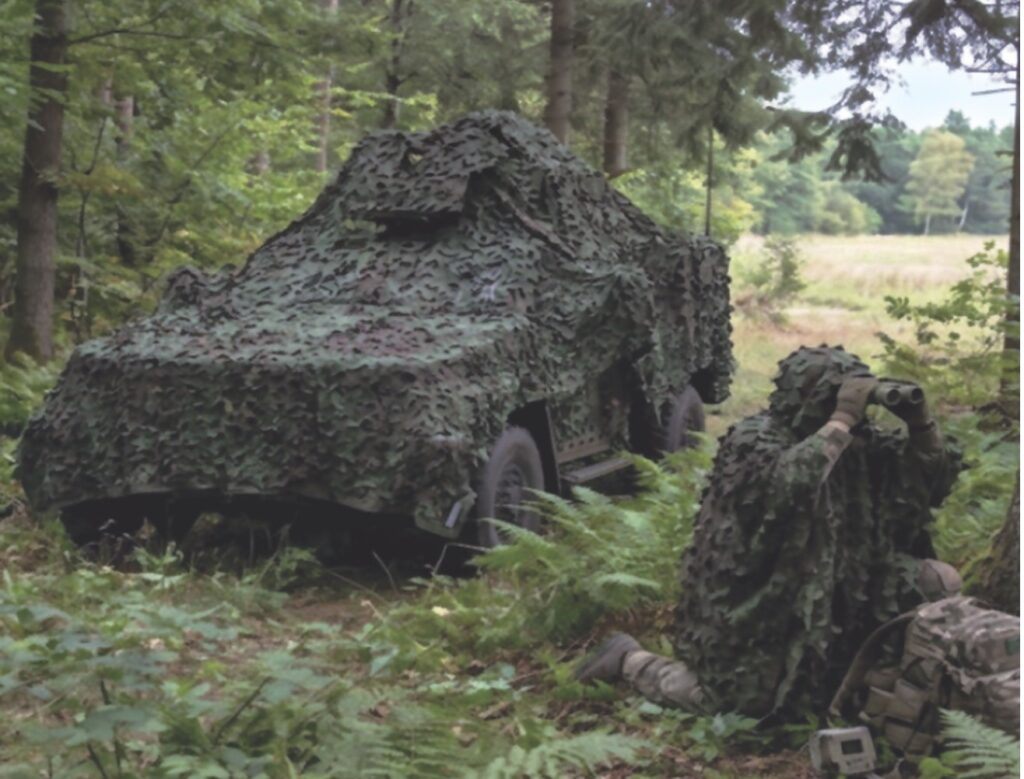
Camouflaged military vehicle and soldier concealed in woodland terrain.
The country’s ballistic protection portfolio includes bullet-resistant jackets, ballistic helmets, hard armour plates, bullet-resistant shields, tactical vests, ballistic blankets, vehicle armour kits, bomb disposal suits and specialised NBC protective equipment. Many of these products are now manufactured domestically and supplied to both Indian security forces and overseas customers.
One of the most significant milestones was the introduction of IS 17051:2018, India’s first dedicated standard for bullet-resistant jackets. Developed by the Bureau of Indian Standards (BIS), the standard prescribes minimum performance requirements and testing procedures for jackets used by defence forces, paramilitary organisations and police agencies. Prior to its introduction in 2019, Indian procurement largely relied on foreign standards such as the United States National Institute of Justice (NIJ) specifications.
Recent conflicts have highlighted the growing importance of personal protection systems in modern warfare. According to Sharma, soldier survivability increasingly depends on the quality of protection systems available to frontline personnel.
“India today possesses the capability to design, manufacture and integrate a wide spectrum of personal protective equipment, including ballistic helmets, bullet-resistant jackets, anti-mine footwear and tactical protective systems,” Sharma adds.
He says products such as NIJ-compliant ballistic helmets, lightweight bullet-resistant jackets and advanced anti-mine boots showcase India’s growing capabilities, with manufacturers focussing on lighter designs, improved ergonomics and enhanced soldier mobility without compromising protection.
Also Read: Global conflicts bring challenges & opportunities for Indian defence industry
Preparing for new battlefield threats

Karan Gupta
Recent conflicts, including the Russia-Ukraine war and Operation Sindoor, have reshaped requirements for personal protection equipment. According to Karan Gupta, Vice President of MKU, the threat to soldiers is increasingly coming from drone attacks, explosions and shrapnel rather than direct gunfire.
“As modern warfare evolves, forces are looking for greater body coverage, including protection for the neck, shoulders and thighs, in addition to the chest and back,” Gupta tells Biz@India.
He says manufacturers are also focussing on next-generation protection technologies.
“Our latest innovation has been in rifle-rated helmets capable of stopping threats such as AK-47 rounds and NATO-standard ammunition. Beyond stopping bullets, we are also working to reduce trauma and secondary injuries to provide better protection for soldiers,” says Gupta.
India has also marked significant progress in NBC protection systems. After more than three decades of research, the Defence Research and Development Establishment (DRDE) finalised indigenous standards for NBC protective equipment. The programme covers five categories which includes individual protective equipment, collective protection systems, medical protection equipment, detection equipment and decontamination systems.
Gupta adds that manufacturers are now developing rifle-rated helmets and working on reducing trauma from secondary impacts caused by blasts and fragments.

Ashish Kansal
Ashish Kansal, CEO and Director of SMPP, a New Delhi-based manufacturer of advanced defence equipment, says evolving geopolitical realities and changing battlefield dynamics are driving demand for more advanced and integrated defence solutions.
“As geopolitical landscapes shift, the necessity for robust, reliable, and technologically advanced defence ecosystems becomes very critical. From state-of-the-art ballistic protection that ensures absolute soldier survivability and weapon platforms protection, to high-precision 155 mm artillery ammunition engineered for maximum battlefield efficacy, our manufacturing capabilities are driven by uncompromising quality. We bridge traditional firepower with modern tactical necessity, ensuring that our Forces are equipped with the absolute best in class,” Kansal tells Biz@India.
The development has reduced India’s dependence on American and European standards in a strategically important area of defence preparedness and strengthened domestic capabilities in chemical and biological protection.
Also Read: BEL targets stronger export growth through Eurosatory participation
Emergence of India as a major exporter
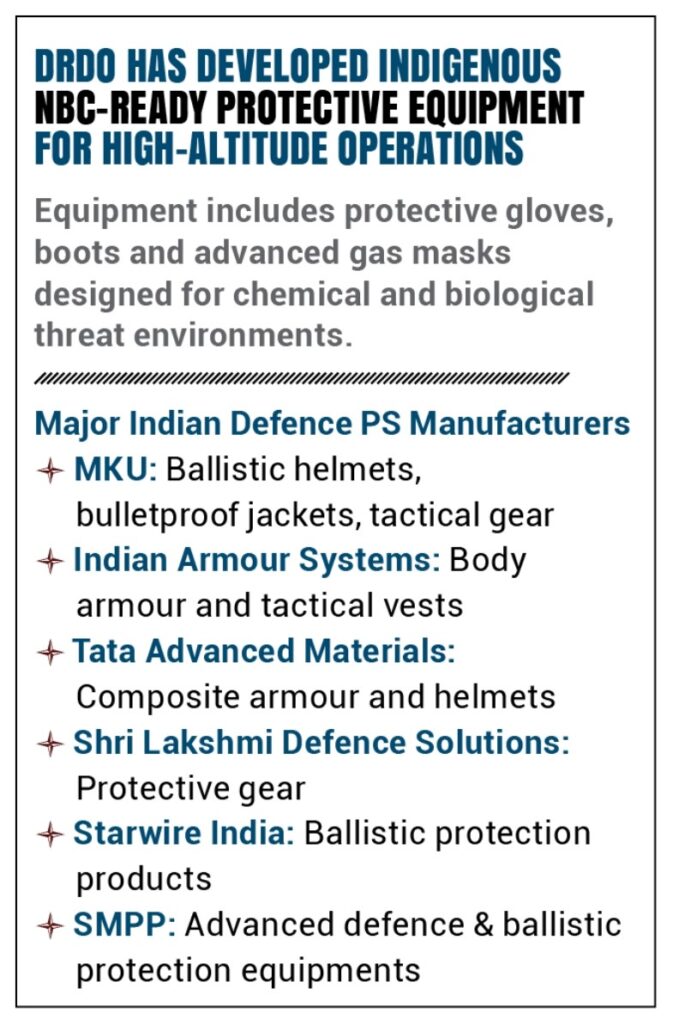
Major Indian defence manufacturers
India’s growing expertise in personal protective equipment is increasingly reflected in exports. According to Volza, a global trade intelligence firm based in United States, India ranks third globally in bulletproof product exports, with the United Arab Emirates, Qatar and Singapore among its key markets. Indian-made bullet-resistant jackets and ballistic helmets are also supplied to countries including the United States, Germany, Australia, Vietnam, Indonesia and Israel.
According to Gupta, growing trust in Indian defence products is helping companies expand internationally. “Countries increasingly see India as a trusted partner. That combination of technology, quality and reliability is creating new opportunities for Indian defence exports,” he says.
“Indian manufacturers have consistently demonstrated the ability to deliver products meeting international standards at highly competitive costs. Increased government support for defence exports has helped Indian companies gain access to international markets through policy reforms, export facilitation and participation in global defence exhibitions,” says Sharma.
Among Indian manufacturers, MKU has established one of the largest international footprints. The company secured a multi-year contract in 2025 to supply more than 200,000 advanced ballistic helmets to an undisclosed Southeast Asian nation. It has also supplied ballistic plates and body armour systems to governments in Germany, Spain, Norway, Sweden and Estonia.
Also Read: Agniveer: One rank, one uniform, three paths
The next frontier in soldier protection
India’s personal safety equipment sector demonstrates how the country’s defence manufacturing ecosystem has evolved beyond licensed production and assembly. Through indigenous standards, domestic innovation and growing export competitiveness, India has built a globally recognised industry capable of protecting soldiers at home and supplying security forces abroad.
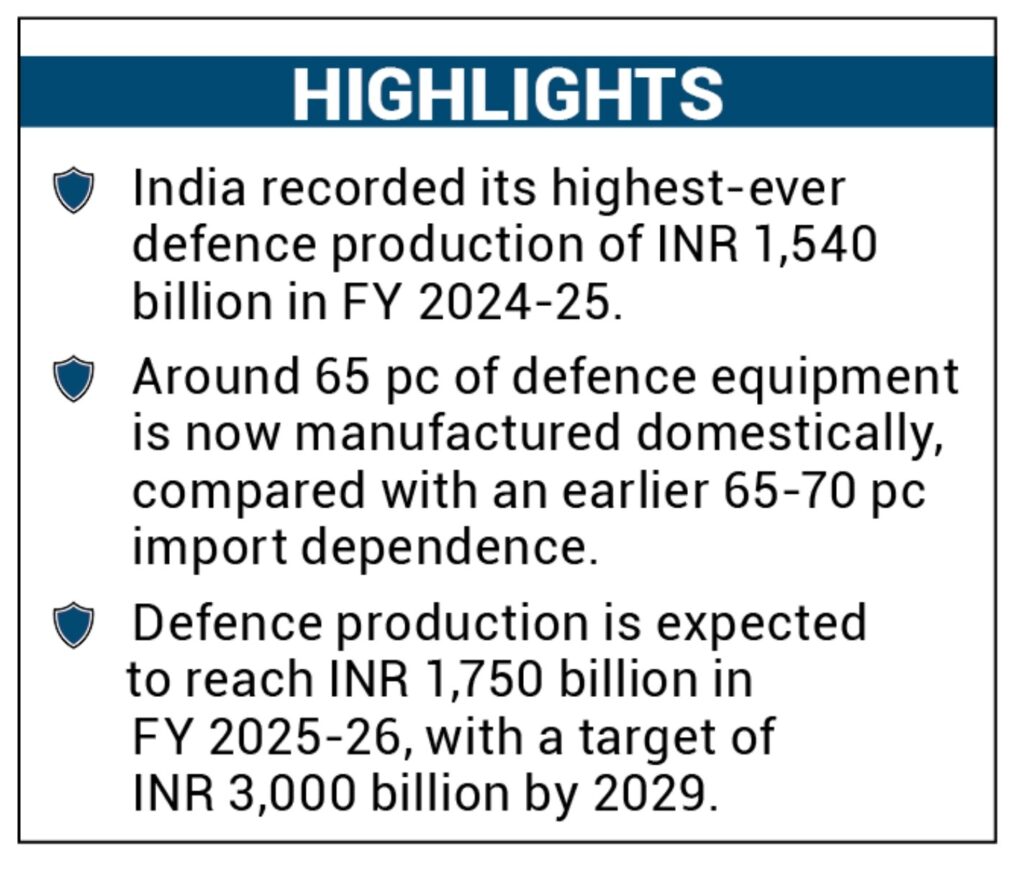
India’s defence production hits a record high
As battlefield threats evolve, manufacturers are integrating new technologies into personal protective equipment. The focus is shifting towards lighter ballistic materials, rifle-rated helmets, enhanced fragmentation protection and modular armour systems that can be tailored to specific missions.
Companies are also investing in trauma-reduction technologies, wider body coverage and protection against threats posed by drones and explosive fragments. According to industry experts, future innovations will increasingly combine advanced materials, smart design and greater mobility to improve soldier survivability on the battlefield.
“The future of warfare, we have positioned ourselves at the vanguard of autonomous technology and digital defence. Our advanced aerial drone platforms offer unprecedented reconnaissance and precision strike capabilities, while our sophisticated counter-drone systems provide a seamless, multi-layered shield against evolving airborne threats. In SMPP, we remain committed to safeguarding the nation and empowering our armed forces by delivering comprehensive package of cutting-edge defence solutions,” adds Kansal.
The industry is also increasing investments in research and development to address emerging battlefield threats. Gupta says MKU spends roughly 7-8 pc of its revenue on Research and Development, up from about 5 pc a few years ago, with a growing focus on advanced protection systems and counter-drone technologies.
India’s soldier protection industry has evolved from basic gear to advanced, globally competitive systems. Going ahead, progress will centre on stronger R&D, improved domestic production of critical materials and steady innovation in new protection technologies. This will help deepen self-reliance while also strengthening India’s position in the global defence supply chain.