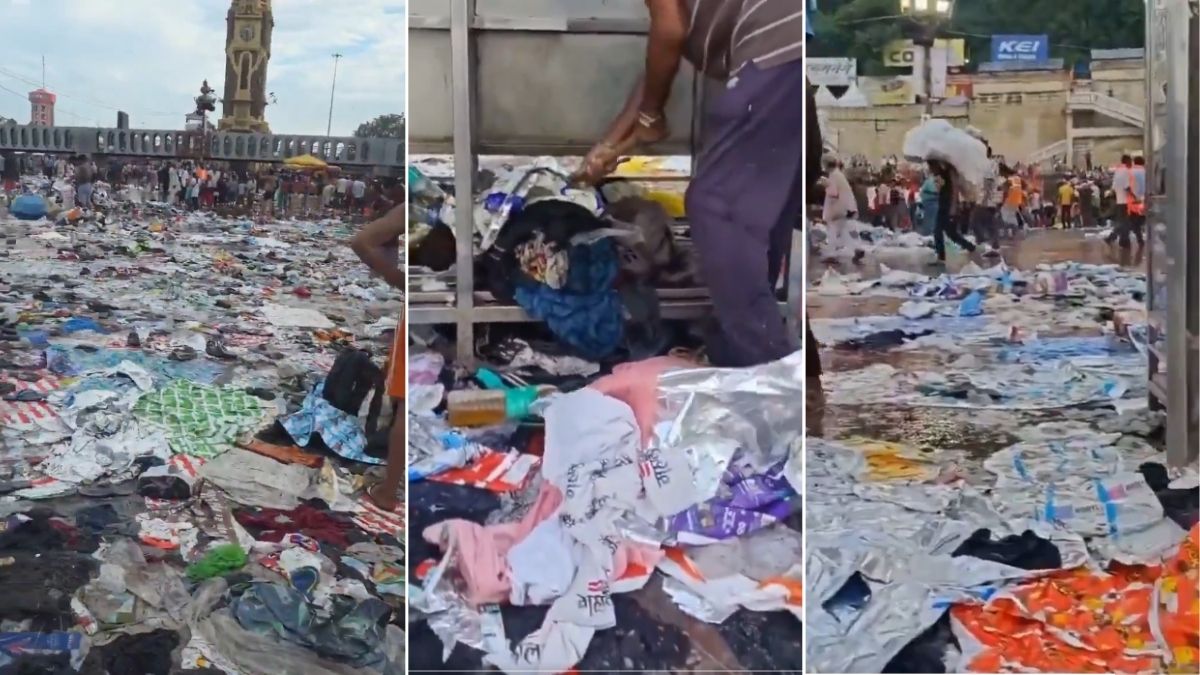
At Har Ki Pauri, one of Haridwar's most prominent bathing ghats, waste was seen scattered across the area after the yatra (Photo: Deb_livnletliv/X)
The annual Kanwar Yatra that concluded last week in Haridwar left behind approximately 7,000 metric tonnes of waste. Nearly 2,000 metric tonnes were generated during the final two days alone, when around 10 million devotees arrived in the city, taking the total number of pilgrims during the Yatra to nearly 48 million.
After the pilgrims had left, sanitation workers of Haridwar Municipal Corporation collected around 7,000 metric tonnes of garbage in a 24-hour clean-up operation. A subsequent municipal estimate put the collected quantity at approximately 8,000 metric tonnes from Ganga ghats and fair sites across the city. The waste included plastic sheets, discarded clothes, bottles, Kanwar structures and other material.
At Har Ki Pauri, one of Haridwar’s most prominent bathing ghats, waste was seen scattered across the area. Among the sanitation concerns reported from the site were bottles filled with urine found in changing rooms, adding another dimension to the hygiene problems left behind after the pilgrimage. The aftermath also affected some local businesses, with reports of rooms rented to Kanwar pilgrims being left filled with garbage and some properties suffering damage.
The sheer volume of waste was many times higher than Haridwar’s normal daily waste generation. The city normally generates around 200-300 tonnes of municipal waste a day, making 7,000 tonnes equivalent to roughly 23-35 days of normal waste generation.

Ganesh Channa
Ganesh Channa, Founder and President of the World Environment Council, a non-profit organisation based in New Delhi, says the scale of the pilgrimage makes waste management particularly difficult, but argues that religious traditions cannot be separated from environmental responsibility.
“We are following our cultures and religions, but we are not caring enough about the environment and even our traditions. With such a huge population, it becomes difficult to control every individual, and many people are also not aware of how to protect the environment,” Channa tells Media India Group.
The municipal corporation deployed around 1,000 additional outsourced workers and more than 80 vehicles as part of a mega cleanliness drive from August 12 to 18. The teams were assigned sanitation, garbage collection, transportation and disposal work. Drones were used to monitor sanitation along major Kanwar routes and crowded areas, while the civic body also tested solar-powered sensor dustbins.
Also Read: Sawan Shivratri: Celebrating Shiva beyond Kashi and Kedarnath
Several prominent locations, including Subhash Ghat, Nai Ghat, Alaknanda Ghat and Vishnu Ghat, were cleaned, with around 95 pc of work at these locations reported to have been completed during the initial phase. Municipal Commissioner Nandan Kumar said sanitation work would continue after the Yatra because the scale of the pilgrimage meant clearing the city’s ghats and public spaces could not be completed immediately.
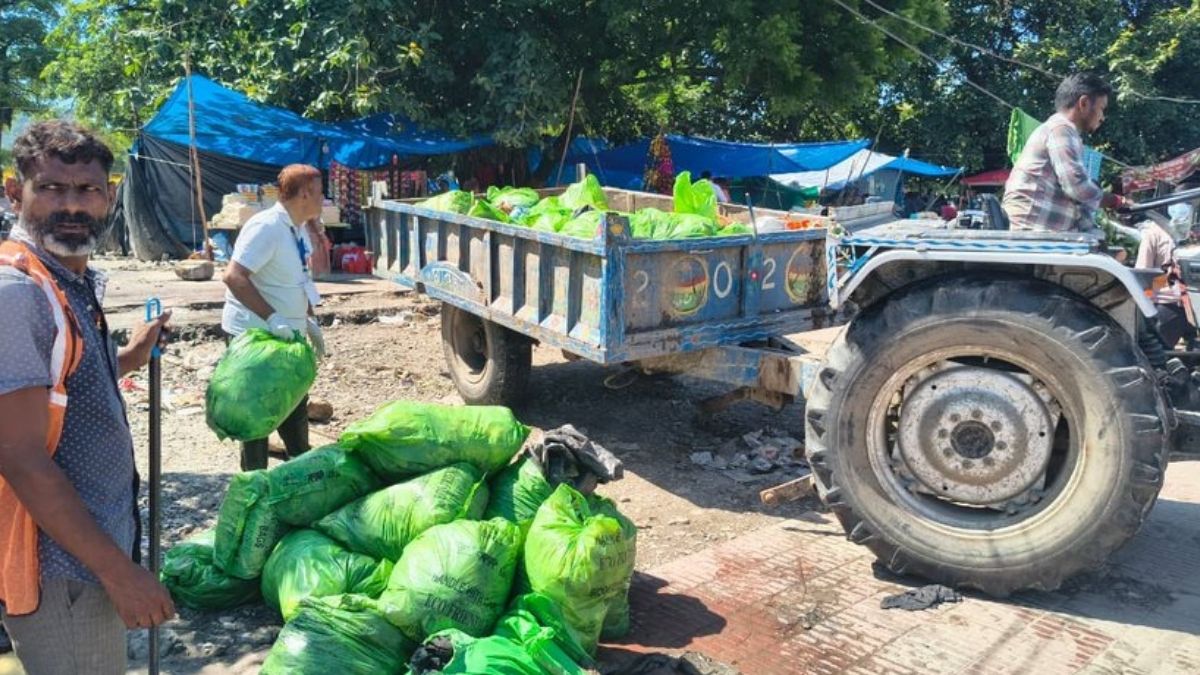
After the pilgrims had left, sanitation workers of Haridwar Municipal Corporation collected around 7,000 metric tonnes of garbage at Har ki Pauri (Photo: Nagar Nigam Haridwar)
But the problem is not new. Har Ki Pauri has witnessed sharp increases in solid waste during major religious gatherings for decades. A peer-reviewed study published in The Environmentalist examined waste generation around Har Ki Pauri during the 2004 Ardh-Kumbh and found that the initial amount of solid waste recorded on January 30 was 775 kg. On the main bathing day on May 4, it rose to 4,550 kg, almost six times the initial amount.
Over nine days of observations, researchers collected 23,865 kg of solid waste from the Har Ki Pauri area. Waste generation fell sharply after the main bathing day but still remained 14.9 pc above the initial level during the following week.
The 2026 figure cannot be directly compared with the 2004 study because the observation periods, scale of the gatherings and collection methods were different. However, both demonstrate the same pattern: large concentrations of pilgrims create sudden and substantial waste spikes around Har Ki Pauri.
The problem has repeatedly emerged during previous Kanwar Yatras as well.
In 2022, the fortnight-long Kanwar Yatra reportedly left approximately 30,000 metric tonnes of garbage in Haridwar. Shoes, slippers, plastic mattresses and clothes were among the waste scattered across the city, particularly around the ghats. The quantity was estimated to be equivalent to about five months of Haridwar’s normal waste generation.
In 2023, another Kanwar Yatra left around 27,810-30,000 metric tonnes of waste after more than 40 million pilgrims visited the city. At least 50 pc of the waste was identified as plastic by the Haridwar municipal commissioner. Garbage was spread across Ganga ghats, markets, parking lots and roads along the 42-km Kanwar route from Har Ki Pauri.
The 2023 aftermath also highlighted the scale of the sanitation challenge. An environmental organisation estimated that open defecation could have contributed up to 10,000 tonnes of faecal waste to the Ganga, while sewage-treatment infrastructure was reported to have come under pressure during the pilgrimage. The 10,000-tonne figure was an expert estimate rather than an official measurement and should therefore be treated accordingly.
The recurring nature of plastic pollution around Har Ki Pauri is also documented.
The National Green Tribunal (NGT) also recorded that plastic and other waste was being thrown directly into the Ganga and that drains carrying sewage to treatment plants were being choked by plastic and municipal waste. It noted that waste deposited along the riverbank could enter the Ganga during the rainy season, posing a serious pollution risk.
In 2019, despite the NGT’s ban on non-biodegradable plastic bags in Haridwar and Rishikesh, polythene continued to be used extensively in Haridwar’s Kanwar market.
Also Read: Increasing cyclones and garbage deposits, a nod towards extreme climate change
The issue is therefore not simply about one year’s clean-up failure. It points to a recurring mismatch between the scale of religious gatherings and the city’s ability to manage their environmental and sanitation consequences.
For Haridwar, the problem is particularly serious because the waste is generated around one of India’s most important pilgrimage sites and immediately beside the Ganga. The discovery of urine-filled bottles in changing rooms is also a reminder that the challenge extends beyond solid waste to basic sanitation, hygiene and the availability and use of adequate facilities for millions of temporary visitors.
Channa says the problem should be viewed as part of a larger failure to provide adequate waste and sanitation infrastructure for large pilgrim crowds.
“If so many people are coming, there should be proper dumping stations and collection points everywhere. Today almost everyone carries a water bottle. If a person is travelling from Mumbai to Delhi, they may use five or six bottles in a day. Imagine how much plastic is generated when millions of people are travelling or gathering at one place. The same thing happened at Haridwar,” he says.
Channa adds that the presence of urine-filled bottles and other discarded material around the Ganga therefore reflects a broader sanitation problem rather than an isolated incident. The solution requires facilities to be put in place before pilgrimages begin, including adequate garbage collection centres at points where pilgrims congregate.
At the reported 7,000-tonne level, the 2026 waste corresponds to around 146 grams per pilgrim, based on 48 million visitors. If the municipal figure of 8,000 tonnes is used, the equivalent is around 167 grams per pilgrim. These are calculated averages, not official estimates of individual waste generation, but they illustrate the cumulative impact of a pilgrimage involving tens of millions of people.
The comparison with the 2004 Ardh-Kumbh is also revealing. Researchers recorded 23.9 tonnes over nine observation days around Har Ki Pauri, while today’s clean-up operations are dealing with thousands of tonnes across a much larger pilgrimage footprint. The figures are not directly comparable, but the recurring waste spikes show that mass religious gatherings have posed a waste-management challenge at the site for more than two decades.
The central issue, therefore, is not whether Haridwar can clean up after the Kanwar Yatra. Authorities have demonstrated that they can mobilise workers, vehicles and technology for emergency clean-up operations. The larger question is whether the city can prevent such quantities of waste and sanitation waste from accumulating around the Ganga in the first place.
Also Read: Ever-growing garbage hills of Delhi
Channa points to Maharashtra’s Pandharpur Wari as an example of how large pilgrimages can manage waste through better preparation and organised collection. He says the annual pilgrimage attracts around 1 million devotees, yet waste-management arrangements, collection systems and facilities are put in place along the route.
“Before any festival, the government and organisations should create awareness and prepare garbage collection centres everywhere,” he says.
According to Channa, awareness must begin before pilgrims arrive rather than after waste has accumulated. “Awareness is very important. Without awareness we cannot implement anything,” he says, adding that governments and NGOs should work together to educate pilgrims and establish collection infrastructure before major religious events.
Channa, who has personally visited Har Ki Pauri, says he was struck by another practice, pilgrims leaving their clothes behind after bathing.
“I was shocked to see that people take a bath and then leave their clothes on the stairs. Some people believe that after taking a bath they should leave their clothes there and not take them back. But if they do not want those clothes, they can carry them away, dispose of them properly or donate them. There should be proper collection points for clothes,” he says.
“These are traditions that need to change. Religion and tradition are important, but they should not become a reason to damage the environment. We need to find a way to follow the tradition while also protecting the place,” he adds.
With religious tourism continuing to grow, Haridwar’s waste crisis is becoming a test of whether India’s major pilgrimage destinations can accommodate massive visitor numbers without overwhelming the ecosystems that make them sacred.
Channa says the focus needs to shift from cleaning up waste to preventing it from being generated or discarded improperly in the first place. “The first step is awareness, but awareness alone is not enough. There must be facilities available for people to follow what they are being told. If you ask people not to throw plastic but there is no collection point nearby, the system will fail,” he says.