
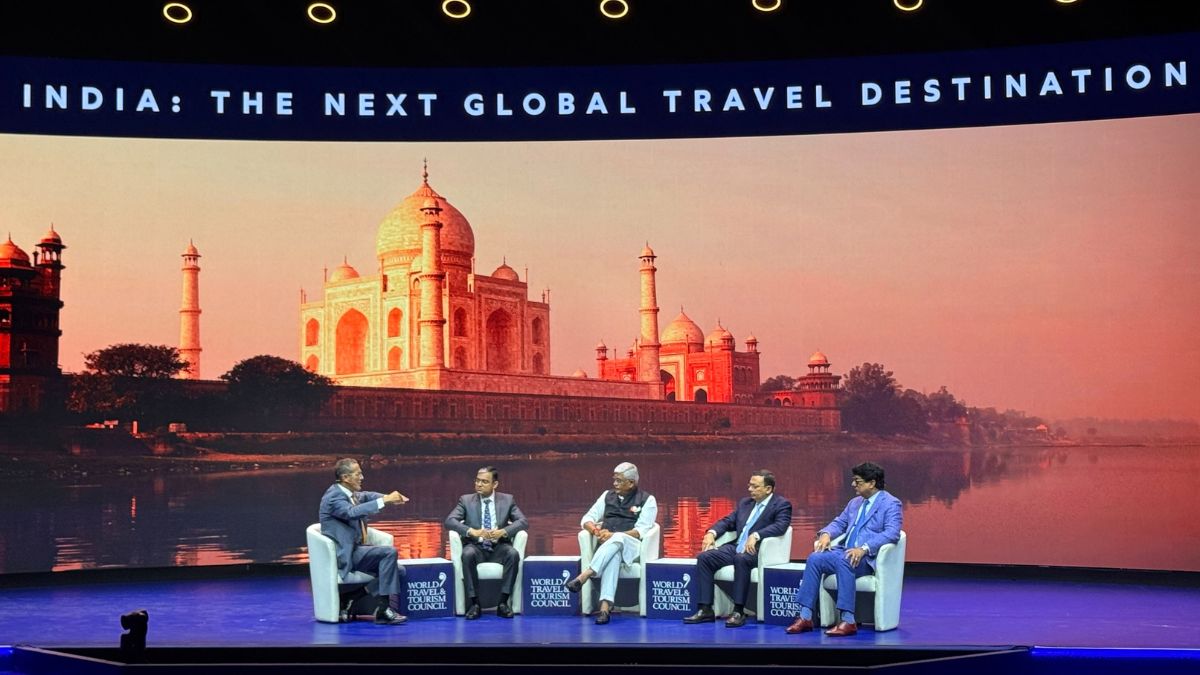
Indian Tourism Minister Gajendra Singh Shekhawat with Gaurav Bhatnagar, Puneet Chhatwal and Zubin Karkaria at the WTTC Global Summit in Malta (Photo: India and You)
To promote destination India worldwide and to attain a sizeable multi-fold growth in foreign tourist arrivals in the country, the Indian government is working hand in hand with various stakeholders in the domestic travel and tourism industry, said Gajendra Singh Shekhawat, the Union Minister of Tourism, while addressing a panel discussion in Malta on Thursday.
Shekhawat is visiting the Mediterranean country to participate in the ongoing 26th Global Summit of the World Travel and Tourism Council (WTTC), a leading global organisation of the travel and tourism industry.
Shekhawat was addressing the session, India: The Next Global Travel Destination, which also included key Indian tourism and hospitality stakeholders including Gaurav Bhatnagar, Co-founder, TBO.com, one of the largest distributors of tourism products globally, Puneet Chhatwal, CEO, IHCL, the largest hospitality firm in India and Zubin Karkaria, Founder & CEO, VFS Global.
Shekhawat said that the government has undertaken a slew of measures including boosting connectivity, easing visas and especially developing tourism infrastructure like roads, airports and railway lines to ease travel all over the country.
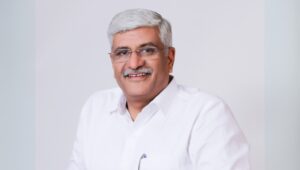
Gajendra Singh Shekhawat
“India is the future on the tourism map of the world. To unleash the potential which any country has for tourism, the first and foremost requirement is the experiences to share that we have in abundance and everybody is aware about that, about the diversity of India, about the millenia-old civilisation of India, about the culture of India. The second thing is connectivity. That was a big challenge for India, that was, not now. It has been addressed and we are continuously doing that. For 177 countries, we have e-Visa protocol and over 80 pc of visas for India come from online visa system, e-Visa system. And of those 80 pc, 94 pc are being treated, delivered, catered and delivered within 72 hours. But we have some compulsions, some compulsions on security, which is also a concern. We cannot leverage tourism at the cost of our security,” Shekhawat said.
He added that the government was working closely with all stakeholders, including the hospitality industry, the airlines, the tour operators and the people of the country to ensure that tourism industry continues to develop rapidly.
Also Read: Shekhwat calls for private investment, new destinations at Assocham National Tourism Conclave
“From the level where we are as on date, from here to the target which we have taken for ourselves, our Prime Minister has taken that from 5.6 pc contribution of tourism economy to 10 pc contribution to GDP, or from 9.2 million international arrivals in a year to 100 million, which we have targetted for ourselves by 2047 and we will be achieving it. And to achieve that target, I think that there are four ‘P’ principles required. The first is political will, which I have said that Prime Minister has set a target. The second is public spending. The government is spending heavily on infrastructure development. And the third thing is partnership. Here, all the stakeholders will have to come together like the industry, the government, the agencies and organisations. And the fourth P is people’s participation. Because tourism, it requires that also. So, we are working on all four ‘P’ verticals,” he added.
Chhatwal said that India faced a unique challenge of building enough supply to meet the burgeoning demand in all sorts of tourism products, including hotel rooms.
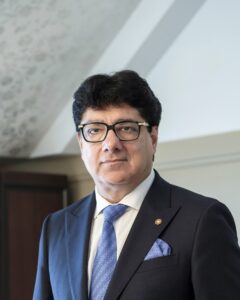
Puneet Chhatwal
“India is a supply problem. It is under-supplied in everything for the demand that exists. So, we need more branded rooms, we need more highways, we need more airports, we need more talent, we need more… and we need all that in an accelerated fashion. So what is supposed to be normally done in 10 years, we need to do it in three years. And at the same time, increase the capacity by five times. So that is what is needed for 1.4 billion people. It is not easy to, you know, manage that across a very large landscape that India represents,’’ Chhatwal said.
“As a country, it took us 75 years post-independence to get to 200,000 branded rooms. And the next 100,000 are coming in the following 5 years. So that means 50 pc increase in supply in five years, and maybe getting to half a million by 2030, which is not good enough. So, what we have today is equal to the branded supply of Singapore and Dubai put together. But it is coming. And when it comes to our own company, Indian Hotels Company, which is very big for a company which is 123 years old, as a company, it took us 115 years to get to our 100 hotels. Today we are 675, having added over 500 in the last five years,” Chhatwal added.
On the potential demand around the world, for travel to India, Bhatnagar of TBO said that the demand for travel to India was coming from various segments of travellers.
“I think it is quite heterogeneous. It generally falls into three buckets. India is very popular among the young, a lot of kids, graduating from college, doing a gap year, and that is a very, very long-tail of mass tourism that comes to India, and I think they are great carriers of stories and adventure back. Then we have the other end of the spectrum, which is the luxury traveller. And there we really excel, because the level of hospitality that India is able to offer is genuinely unparalleled. And then the middle segment is the business traveller, the MICE traveller, people who are coming in because they are attending a destination wedding in India, because wedding is a big thing,” said Bhatnagar.

Gaurav Bhatnagar
He added that the luxury travel segment was the most profitable and the market has consistently moved upwards towards luxury. “The luxury traveller is always the most profitable, because the per capita spend by a luxury traveller is so much more. But it is like a funnel. You start as a backpacker coming to India, eventually you will come for business, eventually you will come back as a luxury traveller,” Bhatnagar added.
On the issue of easing visas, Karkaria of VFS Global, the world’s largest visa services firm, says that the process for visas for India has eased tremendously over the years.
“I think we have already done a lot if you look at the e-Visa system, you know, which is now for most of the nationalities, it is working extremely well. People don’t need to go to a visa application centre or to the embassy. You just apply online, and if you find it sometimes difficult to apply online, there are a lot of aggregators who help you to do that enrollment. I think it has already been smoothened. And if I look at, when I started with the visa centres for the Indian government in 2008 to now, we don’t have many people coming in physically for the visas, they apply online and they are travelling. So I think we are far ahead,’’ said Karkaria.
Also Read: 84 pc Indians interested in culture-led domestic tourism: Skyscanner
He added that even though for most of the travellers it was a seamless process, the issue of security was also important and hence people should fill up the forms carefully and errors could delay the whole process.
“You have to understand that apart from making things seamless, frictionless, there is also the security angle. So if you have filled something wrong in your form, say your passport number doesn’t match what your actual passport is, or when your form mentions dates of travel that are not consistent with your booking dates, then automatically, you know, you have a delay. Because the process is not the issue, it’s what documentation you submit that is an issue,’’ Karkaria added.
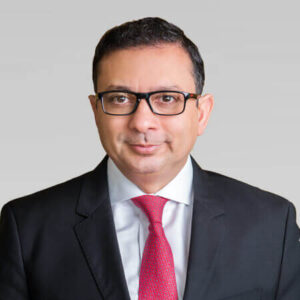
Zubin Karkaria
He added that there was also a significant rise in demand from students around the world for travel to India. “There are a lot of international students for different reasons are looking at India as a destination to go and study. And this is something that I have been speaking to the Education Minister over the last one year, and we may start something called ‘Study in India’ as a product soon, where we will encourage students from around the world who feel that they are not able to either afford or get a visa to another country where they wanted to go and study, but India has got the best institutes, technical, engineering, and there is a huge opportunity today for India to attract students. Once the student comes in, the parents come in, the student becomes the ambassador of the country, and then his friends come in, and that is another area that we should look at,” said Karkaria.
