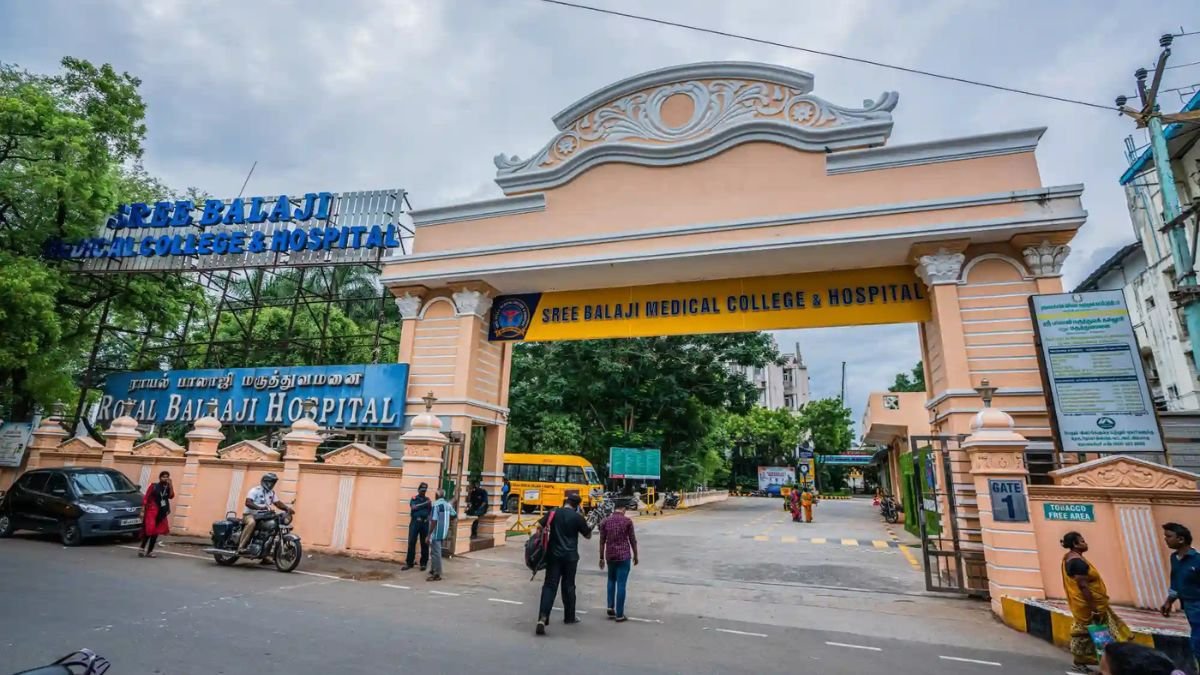
Sree Balaji Medical College and Hospital, Chennai, currently has 77 vacant MBBS seats after the special stray vacancy round of NEET UG 2026 counselling
More than 400 MBBS seats remained vacant across India even after the Medical Counselling Committee (MCC) conducted a special stray vacancy round of NEET UG 2026 counselling, highlighting the gap between demand for medical education and students’ ability to afford available seats.
Of the 948 vacant seats included in the special round seat matrix, only 537 were allotted, leaving 411 unfilled, according to figures reported by the media. This compares with around 60–70 seats reportedly remaining vacant after the counselling process in the previous year.
The vacancies come despite nearly 2 million candidates appearing for NEET UG 2026 to compete for approximately 140,000 MBBS seats. The difference between the number of aspirants and available seats, where over 14 candidates compete for every seat, makes the unfilled positions significant, particularly when students continue to compete for admission to government medical colleges.
Also Read: 30-day NEET protest erupts in violence after police use tear gas and batons
A Health Ministry official, quoted by media reports, acknowledged that an additional counselling round had failed to fill all the available seats.
“The Supreme Court had directed us to conduct four rounds of counselling, but we conducted a fifth round as well. Despite that, more than 400 seats remain without allotments,” the official was cited.
The official also identified increasing fees at private medical colleges as a possible reason for the vacancies.
“In many institutions, fees that were around INR 1.5 million have increased to INR 2.5–3 million. Government medical college seats and those in reputed private institutions are getting filled. Vacancies are concentrated in some private colleges. These institutions need to review their fee structures and the quality of education and infrastructure they offer. If fees remain this high, increasing the number of seats will serve little purpose, as students can’t afford them,” the official said.
The increase in annual fees puts private medical education beyond the financial capacity of many families. It also raises a question about whether qualifying for a national medical entrance examination translates into a realistic opportunity to pursue a medical degree.
Rudrendu Sharma, an Educationist based in Delhi, his assessment of the situation points to the contradiction between the large number of medical aspirants and the inability to fill available seats.
“The contradiction is clear, as millions of students compete for medical admissions, yet hundreds of seats remain vacant because the students who qualify cannot necessarily afford them. This is not merely an admission problem; it reflects a deeper failure to align educational opportunities with the financial realities of Indian families,” Sharma tells Media India Group.
Also Read: Doctors’ stir over NEET PG courses picks pace after police clash
The distribution of vacant seats indicates that the problem is concentrated in particular regions and institutions rather than reflecting a lack of interest in medical education.
Before the special round, Tamil Nadu accounted for 688 of the 946 vacant seats, followed by Puducherry with 187. Together, they accounted for 875 vacancies. Karnataka had 25 and Maharashtra 13, while the remaining 33 were distributed across 15 other states and Union Territories.
Of the 946 vacancies, 920 were in deemed universities. The remaining seats included 22 under the 15 pc All India Quota, two under the open-seat quota and one each under the Delhi University and NRI quotas. The vacancy list also included a seat at AIIMS Madurai and one at Government Stanley Medical College in Chennai.
Annual tuition fees at several deemed universities in Tamil Nadu and Puducherry ranged from INR 2.3 million to INR 3.5 million, according to media reports.
The concentration of vacancies in institutions charging these fees has brought the financial barriers to private medical education into focus. While the number of available seats may have increased, the cost of accepting them remains a constraint for candidates who do not have access to substantial family savings or financial support.
Senior Educationist P B Prince Gajendra Babu, General Secretary of the State Platform for Common School System, Tamil Nadu, told a news agency that students with higher NEET scores but limited financial resources were unable to pursue admission to expensive private institutions.
“The lesser scorer who is financially sound applies and secures the seat,” he was quoted as saying and that the system was allowing financial capacity to influence access to medical education more than examination performance.
Babu also called for private medical institutions unable to reduce fees and fill their seats to be closed, and urged state governments to establish adequate medical colleges wherever required.
He further criticised the commercialisation of medical education, saying, NEET failed in both its objectives neither ensure merit nor curb commercialisation of medical education.
The affordability debate also extends to how private medical colleges determine their fees and whether the charges reflect the actual cost of providing medical education.
“Medical education cannot become accessible simply by increasing the number of seats. If the cost of studying medicine is beyond the reach of capable students, those seats will remain vacant. The objective should be to ensure that financial circumstances do not determine who gets to become a doctor,” Manisha Trivedi, an Educationist based in Delhi, tells Media India Group.
Also Read: From Paper Leaks to Climate Breakthroughs: Challenges for Gen Z
The issue is also reflected in the concessions offered by private medical colleges to attract candidates. Several institutions in Tamil Nadu and Karnataka reportedly reduced tuition fees or offered discounts to fill vacant seats.
Some colleges in Karnataka reportedly offered concessions of up to 50 pc on management quota fees, bringing the overall cost of certain courses down from approximately INR 12.6 million to INR 6.5 million.
However, such reductions do not necessarily make medical education affordable for families that have to finance the course through savings or loans. The additional costs of accommodation, food, books and other expenses further increase the financial commitment.
Private institutions play a significant role in expanding undergraduate medical education. However, the availability of private seats does not necessarily translate into affordable opportunities. Government medical colleges continue to attract candidates because of their comparatively lower fees, while some private institutions struggle to fill seats despite additional counselling rounds.
The distinction is important because the 411 unallotted seats do not establish that fees were the sole reason candidates did not accept admission. College location, institutional reputation, infrastructure, academic facilities and individual preferences may also influence decisions.
Nevertheless, the concentration of vacancies in high-fee deemed universities, along with the concerns raised by the Health Ministry official and educationists, points to affordability as an important factor requiring attention.
For students who qualify NEET but cannot meet the financial requirements of private institutions, an available seat may not represent a viable admission opportunity.