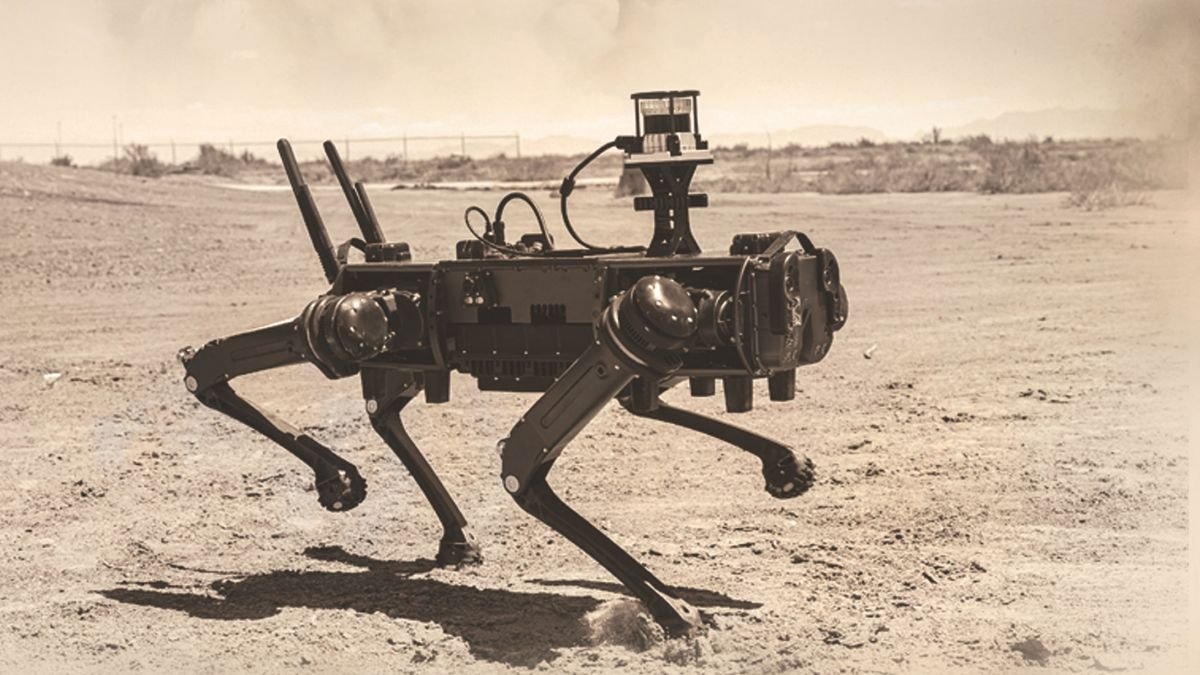
Quadruped robotic platforms represent another area of military robotics development, with potential applications in surveillance and operations
In the last few conflicts around the world, drones or Unmanned Aerial Vehicles (UAVs) have captured the headlines and the imagination of all, from military generals and political leaders to the ordinary person. Their success has been in inflicting great damage on enemy forces, at the fraction of the cost of deploying an aircraft or firing a missile for the same end and in keeping the soldiers safe and away from any threats.
But unmanned vehicles have not just taken to the skies, they are also making a significant difference in many battles on the ground as Unmanned Ground Vehicles (UGVs) are increasingly being deployed in wars. A notable example is their use by both Russia and Ukraine in their four-yearlong conflict, which has emerged as world’s largest testing ground for military robotics, demonstrating how unmanned systems can reduce risks to personnel while sustaining operations in highly contested environments.
From bomb disposal to battlefield combat systems
Military UGVs were originally developed for specialised roles such as bomb disposal and mine clearance. Early systems relied entirely on remote operators and were intended to keep soldiers away from explosive threats. Advances in artificial intelligence, communications, sensors and navigation technologies have significantly expanded their capabilities. Today’s UGVs can conduct surveillance, reconnaissance, logistics support, casualty evacuation and electronic warfare missions. Many are also capable of carrying remote weapon stations, anti-tank guided missiles, machine guns and other combat payloads.
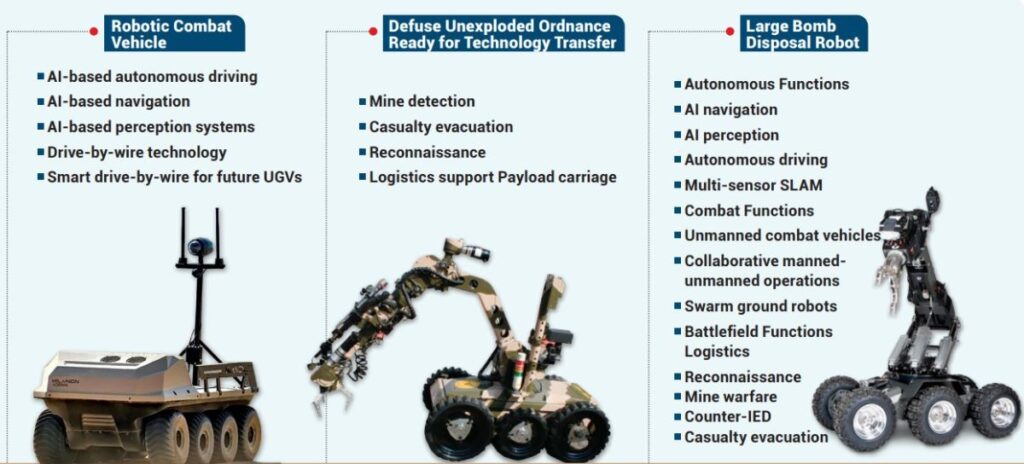
Indian defence robotics research is expanding across combat, bomb disposal and autonomous ground systems (Infographics: Media India Group/Hitesh Mehta)
An important concept driving future development is Manned-Unmanned Teaming (MUM-T), under which soldiers and robotic systems operate together, where UGVs perform dangerous or repetitive tasks while soldiers maintain control over critical decisions.

Shrey Mehta
According to Shrey Mehta, CEO and Founder of Svaayatt Systems, an Indian defence-tech startup based in Vadodara, Gujarat, AI and autonomy will increasingly define the next generation of military robotics.
“The battlefield of the future will rely on coordinated networks of autonomous aerial and ground systems operating alongside soldiers. Key priorities for armed forces will include autonomous reconnaissance and surveillance, unmanned logistics and casualty evacuation, remote weapon deployment and manned-unmanned teaming,” Mehta tells Biz@India.
Major General Prabdeep Singh Behl (Retd), a retired career military officer, cautions against overestimating current capabilities.

Prabdeep Singh
“Current use in the Ukraine war has initiated a new dimension into land warfare. It may conserve manpower by reducing casualties, but efficacy remains limited. It must be supported by infantry for physical capture of ground,” Singh tells Biz@India.
The next stage of development of UGVs is expected to involve greater autonomy. Future platforms are likely to continue missions even if communications are disrupted, coordinate with other unmanned systems and allow a single operator to supervise multiple vehicles simultaneously.
Ukraine: The world’s biggest UGV battlefield
No conflict has accelerated UGV development more rapidly than the Russia-Ukraine war.
Ukraine planned to produce more than 15,000 UGVs during 2025, compared with approximately 2,000 units produced in 2024. By early 2026, the Ukrainian Ministry of Defence reported nearly 24,500 UGV missions during the first three months of the year alone, with over 9,000 missions conducted in March.
The number of military units operating UGVs reportedly increased from 67 in November 2025 to 167 by March. Ukraine has also announced plans to contract 25,000 additional UGVs in the first half of the year as part of a broader effort to shift frontline logistics away from soldiers and towards robotic systems.
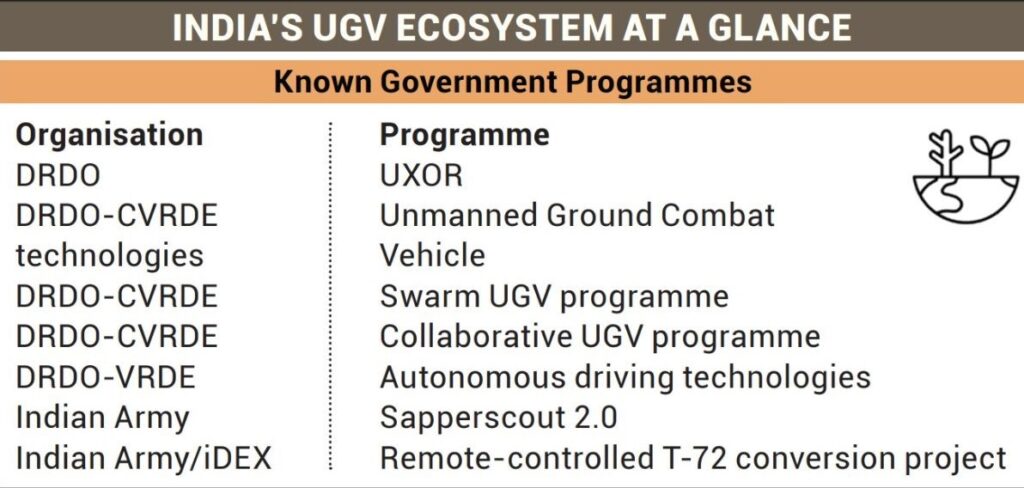
India’s unmanned ground vehicle ecosystem includes programmes led by DRDO, the Indian Army and other defence research organisations
Also Read: From boots to BrahMos: Indian defence exports rise up value chain
Russia, too, has expanded the use of robotic ground systems, which delivered more than 12,000 tonnes of cargo during 2025, with deployment expected to increase further in 2026.
Singh says that such deployments still face operational limits. “Robotic warriors or dogs will remain symbolic until mass production is resorted to and they are tried and tested in actual battlefield conditions under various terrains,” he adds.
He says that despite their success in Ukraine-Russia conflict, their use cannot be entirely replicated elsewhere, notably India. “Different terrains as found on our borders do not make such initiatives practical in our context,” adds Singh.
But Mehta says that unmanned systems are no longer supplementary battlefield assets but are becoming integral to military operations.
“Recent conflicts have demonstrated that survivability through unmanned deployment significantly reduces personnel risk, while autonomous reconnaissance provides persistent situational awareness. Ground robots are increasingly being used for logistics resupply in contested environments, and AI-enabled target detection is improving mission effectiveness,” says Mehta.
Global leaders in military robotics
The United States and Europe remain at the forefront of military UGV development. In the US, current efforts focus heavily on logistics support and casualty evacuation. The Army is testing systems such as the Hunter Wolf UGV, including armed variants fitted with remotely operated weapon stations carrying .50-calibre machine guns.
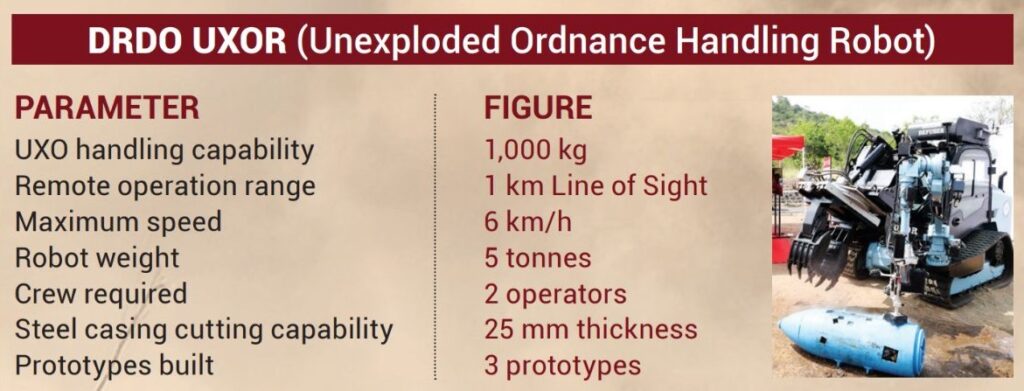
DRDO’s UXOR robot is designed to handle unexploded ordnance
Europe has emerged as a major centre of innovation. Estonia-based Milrem Robotics has developed the THeMIS platform, widely regarded as one of the most successful military UGVs currently in service. The platform has been adopted by more than 16 countries and has seen operational use in Ukraine for logistics and casualty evacuation missions.
Similarly, German weapons manufacturer, Rheinmetall’s Mission Master family has secured multiple international contracts and demonstrated the growing acceptance of robotic ground systems across NATO militaries.
India’s UGV journey gathers momentum
India’s own journey in military robotics began much earlier than many realise. One of the country’s earliest UGV programmes was Mission Unmanned Tracked (MUNTRA) platform by Defence Research and Development Organisation (DRDO). Based on the Russian Boyevaya Mashina Pekhoty (BMP)-2 infantry combat vehicle, MUNTRA was developed in surveillance, mine-detection and Nuclear-Biological-Chemical reconnaissance variants. The programme represented India’s first major effort to field military unmanned ground systems.
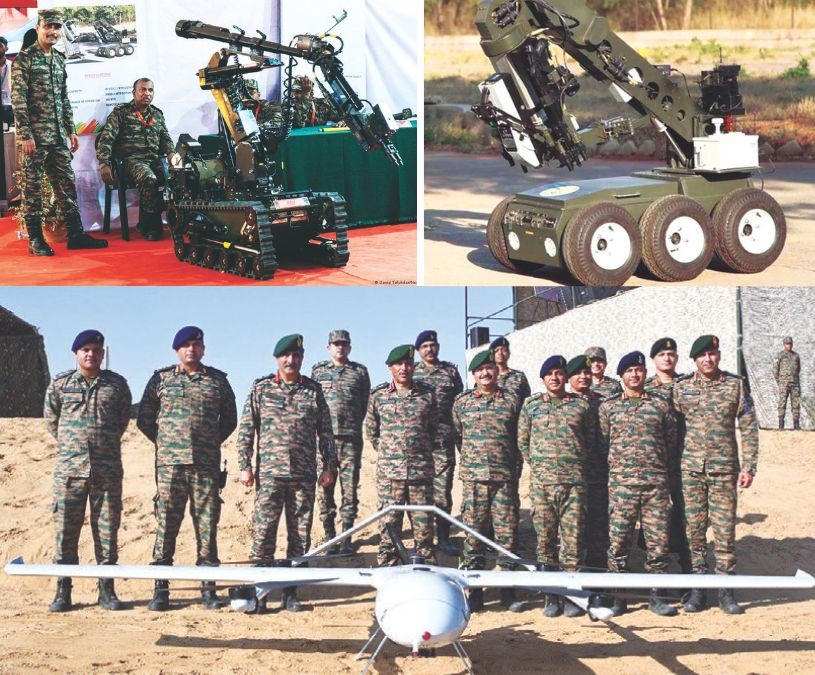
The Indian Army is exploring unmanned ground systems to support reconnaissance, surveillance and other high-risk military operations
Another important indigenous development was Daksh developed in 2005 by DRDO, a remotely operated vehicle designed for bomb disposal and hazardous operations. The platform has been inducted by several security agencies and remains one of India’s most successful robotic systems.
A major milestone came in December 2025 when the Indian Army unveiled the Sapper Scout RP Ver 2.0 at Inno-Yoddha 2025 in New Delhi. Developed by Major Rajprasad RS of the 7 Engineer Regiment of the Indian Army, the platform is described as India’s first fully indigenous multi-utility UGV developed internally by the Army. Designed to support MUM-T operations, it can undertake reconnaissance, surveillance, mine detection, casualty evacuation and logistics missions.
Singh highlights India’s operational advantage in niche applications.
Also Read: Forces face moral dilemma over Artificial Intelligence in defence
“We have been using UGVs effectively for IED neutralisation in Kashmir and Sri Lanka operations and these systems have been developed indigenously by the Army. However over reliance may prove counterproductive. Unmanned armoured vehicles can be used as decoys or for ghosting the enemy,” according to Singh.
Building an indigenous UGV ecosystem
India’s UGV ecosystem is increasingly being driven by a combination of DRDO, established defence manufacturers and emerging startups.
Among the most significant developments was the unveiling of the Vikram VT-21 Advanced Armoured Platform and 30mm Unmanned Turret by DRDO and Tata Advanced Systems, a member of the Tata Group, in April this year.
The UGV is available in tracked and wheeled variants. The platform offers Standardisation Agreement (STANAG) Level 4 and Level 5 protection, amphibious capability and high mobility across challenging terrain.
Tata Advanced Systems has unveiled a dedicated tracked UGV with a payload capacity of up to 1,000 kg, a hybrid-electric propulsion system and the ability to undertake logistics, reconnaissance, mine detection and combat support missions.
Gridbots Technologies, based in Ahmedabad, Gujarat, has emerged as another important player through its Zeus Hitman combat UGV. The platform has completed high-altitude trials and incorporates Level-5 autonomous operation capabilities. Equipped with the AWS Katana weapon station, it can integrate machine guns and anti-tank guided missiles while providing real-time target tracking and engagement capabilities.
Svaayatt Systems has also entered the sector with its SGV-500 Scorpion, a UGV currently under trial with Ministry of Defence. Designed as a modular combat, the platform can accommodate machine guns, grenade launchers, electronic warfare systems, jammers and remote weapon stations. The company says it has demonstrated the platform to the Indian Army and is positioning it for future military induction.
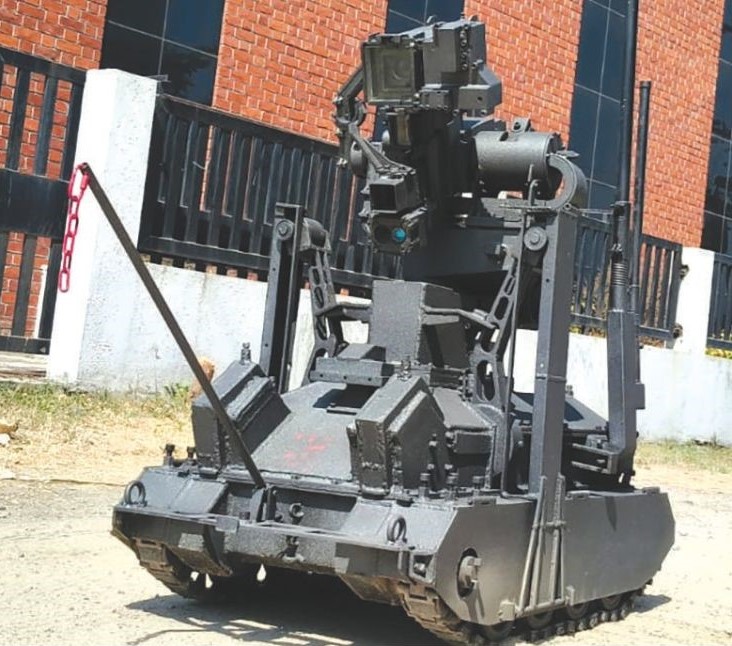
A tracked unmanned ground vehicle designed to undertake hazardous military operations, including bomb disposal and reconnaissance
It is also developing the heavier SGV-1000 platform, intended for higher payload capacities, enhanced autonomy and future integration of medium machine guns and anti-tank guided weapon systems.
“Our objective is to create robotic platforms that can operate effectively in complex and contested environments while minimising operator workload,” Mehta says.
In parallel, CSIR-Central Mechanical Engineering Research Institute (CMERI), a government research organisation based in Durgapur, West Bengal, continues to conduct research on multipurpose UGV technologies aimed at strengthening indigenous robotics capabilities.
Self-reliance and the road ahead
Unlike most other defence technologies, India has not depended heavily on imported UGVs. Most current efforts are centred on indigenous design and development.
Nevertheless, foreign platforms continue to serve as important benchmarks. Systems such as THeMIS, Mission Master and Hunter Wolf are frequently studied for their operational experience and technological maturity.
Indian players are setting their sights high on the global marketplace. “The combination of operational experience, engineering talent, software expertise and government support places India in a strong position to become a major global supplier of military robotics solutions. Over the next five years, we expect a significant increase in indigenous content across military robotic systems,” adds Mehta.
Despite encouraging progress, challenges remain. Most Indian UGVs are still in the trial, evaluation or limited-induction phase. Production volumes remain small compared with countries actively deploying robotic systems in combat and considerable work remains in areas such as artificial intelligence, autonomous navigation, battlefield networking and human-machine teaming. How fast the country’s defence manufacturers can bridge the gap will determine if India can really stake a claim for leadership of this fast-growing segment.