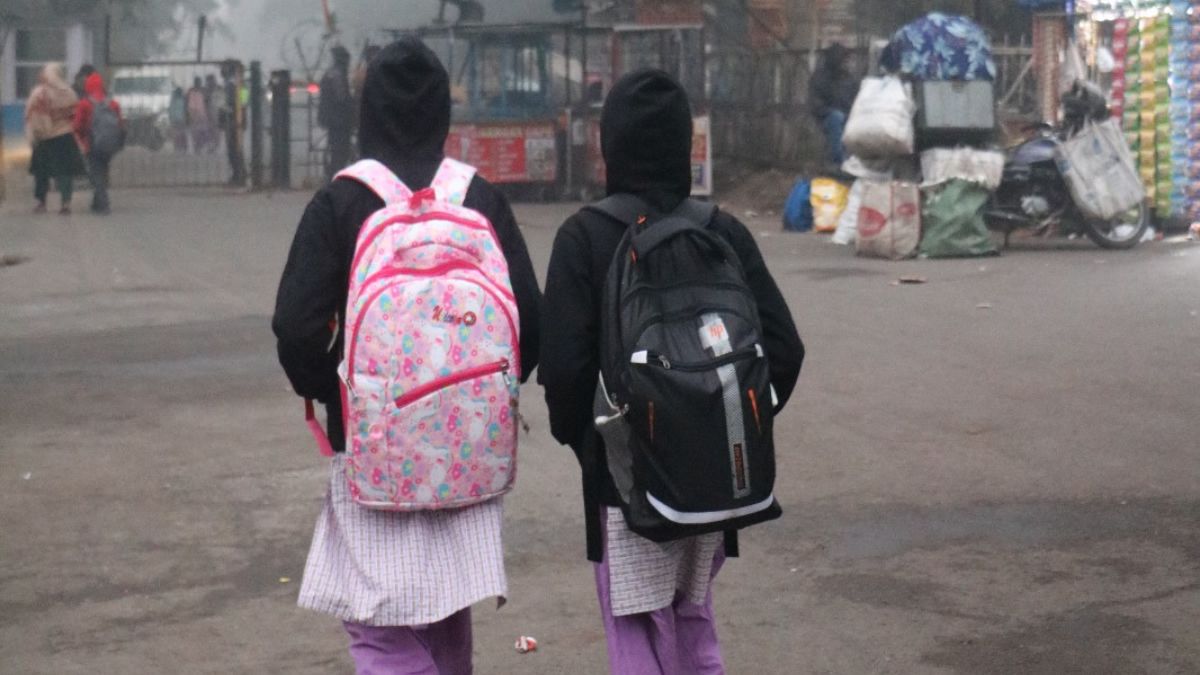
Retention drops by 31.8 percentage points between the middle and secondary stages, marking the steepest decline in school education (Photo: Media India Group/Sunil Yadav)
Even as the Union government claims progress in expanding access to education, its latest school database reveals that retention falls sharply from 83.7 pc at the middle stage to 51.9 pc at the secondary level. The findings from the Ministry of Education’s Unified District Information System for Education (UDISE+) 2025-26 report highlight the growing difficulty of keeping students in school as they move to higher classes, despite total enrolment reaching 247.2 million.
However, the retention figures tell a different story. While 98.5 pc of students are retained at the foundational stage, the rate falls to 91.1 pc at the preparatory stage and 83.7 pc at the middle stage. At the secondary level, it drops sharply to 51.9 pc, meaning nearly half of the original Class 1 cohort does not remain in the education system through Class 12.
“The biggest problem is that we have treated enrolment as the main measure of success, when it should only be the starting point. Getting a child into Class 1 is important, but ensuring that the child reaches Class 12 is equally important,” Kunjal Aanand, educationist at the Central Board of Secondary Education (CBSE), tells Media India Group.
Aanand says that economic pressures are among the major reasons children leave school. “For many families, especially those dependent on daily wages, continuing education comes with an economic cost. A child may be expected to work, support the family business or look after younger siblings.” He adds that household responsibilities, lack of interest, difficulty coping with studies, disability, poor health and early marriage also contribute to students leaving school.
Also Read: India’s shrinking classrooms expose cracks in school education
The biggest fall occurs between middle and secondary education, with retention declining by 31.8 percentage points. Although the rate has improved from 47.2 pc in 2024-25, the large gap shows that keeping students in school becomes more difficult as they move to higher classes.
Explaining this gap, Aanand says, “The secondary stage is where the challenges become much more complicated. At this age, students face a more demanding curriculum, board examination pressure and decisions about their future. If they have not developed strong reading, writing and mathematical skills in earlier classes, they may struggle to cope with the higher-level syllabus.”
He also points to the rising cost of education at this stage, including transport, books, uniforms, examination expenses and private tuition. For girls, household responsibilities, safety concerns, lack of transport and early marriage can create additional barriers. “A school is accessible only when a child can attend it regularly and continue learning there,” he says.
The retention problem comes alongside a steady decline in primary enrolment. According to an analysis of official UDISE+ data by Professor Arun C Mehta, former professor at the National Institute of Educational Planning and Administration (NIEPA), enrolment in Classes 1 to 5 fell from 121.8 million in 2021-22 to 101.9 million in 2025-26, a decline of nearly 20 million students, or around 16 pc.
Aanand cautions against attributing the entire decline to falling birth rates. “A fall in enrolment does not automatically mean that children are dropping out. We must distinguish between the number of children entering school, the number enrolled in a particular year and the number of children who continue through successive classes. These are different indicators,” he says.
He adds that migration, school transfers, school closures and changes in enrolment records may also affect the figures. “The government needs to conduct a more detailed district-level assessment, particularly in areas where enrolment has fallen sharply. It should track whether children are continuing in another school, moving to a different education system or leaving education completely,” he says.
Total enrolment in Classes 1 to 12 also declined from 255.7 million to 232.3 million during the same period. However, the decline slowed in 2025-26, with around 583,000 fewer students compared with a fall of 2.08 million in the previous year.
Interestingly, enrolment in higher classes has increased. The number of students in Classes 9 and 10 rose from 36.9 million in 2023-24 to 38.3 million in 2025-26, while enrolment in Classes 11 and 12 increased from 27.1 million to 28.9 million.
Also Read: Slowdown in Indian economy drives 3.7 million students out of schools in 2023-24
Sharp differences between states
The national figures also hide major differences between states. According to the state-wise analysis of UDISE+ data, Class 1 to Class 12 retention stands at 100 pc in Chandigarh, while Meghalaya records only 18.1 pc. Bihar reports 38.5 pc, Madhya Pradesh 37.3 pc and Uttar Pradesh 44.8 pc.
The gap is also visible in higher secondary enrolment. Kerala records a Gross Enrolment Ratio (GER) of 91.9 pc at the higher secondary level, compared with just 42.1 pc in Bihar. Meghalaya also retains only 45.9 pc of its Class 1 cohort through Class 8, showing that the problem begins much earlier in some states.
An international comparison also highlights the importance of supporting students through the final years of school.
Aanand points to OECD data, saying, “Across countries with available data, an average of 75 pc of students who were expected to graduate in 2024 completed upper secondary education on time. Ireland and Türkiye recorded rates above 85 pc. These systems differ, but the comparison highlights the importance of supporting students through the final years of school, rather than focussing only on getting them enrolled.”
The transition figures further expose the gaps. According to UDISE+ 2025-26, 93.8 pc of students move from primary to upper primary education, but the rate falls to 88.3 pc between upper primary and secondary education and 78.1 pc between secondary and higher secondary education.
On the government’s response, Aanand says that the NEP 2020 has identified broad objectives, but implementation remains the main challenge. “A policy can promise universal access and quality education, but that promise has to translate into functioning schools, teachers in classrooms, affordable transport, academic support and a safe learning environment,” he highlights..
He adds that infrastructure improvements alone cannot guarantee that students complete school.
“When a student stops attending, the school should identify the reason, contact the family and help the child return. We need to know whether the student left because of poverty, poor learning, migration, disability, safety concerns or a lack of interest. Different reasons require different interventions,” Aanand adds.
India’s education challenge is no longer limited to getting children into schools. Despite an overall enrolment of 247.2 million and a pupil-teacher ratio of 24:1, low levels of retaining students through higher classes remains a serious concern. Unless the reasons behind this decline are addressed, the country’s goal of providing universal school education will remain incomplete.