
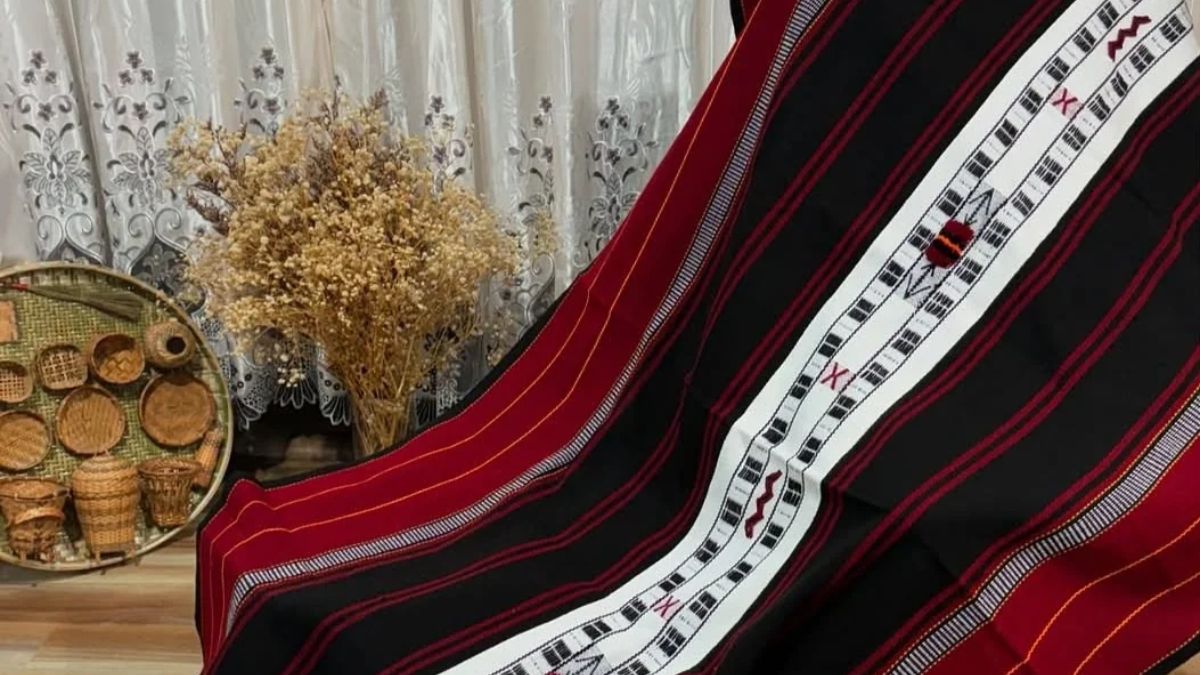
Intricate patterns, bold colours and traditional motifs make Naga shawls a distinctive expression of Nagaland’s rich weaving heritage (Photo: Instagram/RT Puan Collection)
The northeastern state of Nagaland is home to several Naga communities, including the Ao, Angami, Konyak, Lotha, Sumi, Phom and Chakhesang. Though they are all part of the broader Naga group, each tribe has its own traditional clothing, weaving practices and textile designs. This diversity is reflected in their shawls, which differ in patterns, colours and the meanings attached to them.
Patterns reflecting tribal identity and social status
One of the distinctive features of traditional Naga shawls is the meaning associated with their designs. Historically, certain shawls were not worn by everyone. Some were reserved for people who had achieved a particular social position, performed specific ceremonies or demonstrated bravery.
According to the Indira Gandhi National Centre for the Arts (IGNCA), an autonomous arts organisation under the Ministry of Culture, Government of India, based in New Delhi, traditional Naga textile designs vary not only between tribes but also between clans and villages. Common patterns include straight lines, stripes, squares, bands and diamond-shaped designs. Black and white are among the predominant colours, while red and green are also used in different combinations across communities.
The Ao community, for example, has a distinctive traditional shawl known as Tsungkotepsu, also called the warrior’s shawl. Historically, it was associated with men who had taken heads in warfare or performed a feast of merit.
Also Read: Exploring North East India’s music festivals
This was a traditional ceremony through which wealthy individuals demonstrated their prosperity and generosity by organising community feasts and distributing resources.
The shawl features a dark background with a central white band and contrasting red, black and white patterns. Its motifs include figures of mithun, a bull, elephants, tigers, cocks and human heads. According to IGNCA, the mithun represents the wealth of the wearer, while the elephant and tiger symbolise bravery. The human head represents success in head-hunting, while other motifs include traditional weapons associated with warfare, such as spears and daos.
Another Ao garment, Aomelep su, is traditionally worn during festive occasions by wealthy men and the sons and daughters of wealthy families. Dyed dog hair is woven into the fabric at regular intervals, giving it a shaggy appearance. The shawl features alternating red, yellow and black stripes. The Rongsu shawl is another distinctive Ao textile, traditionally associated with men whose fathers and grandfathers had performed feasts of merit and who had also completed the ceremony themselves.
The Phom community also has distinctive textiles connected with social status. One example is Fanet, a cowrie-decorated shawl traditionally associated with men who had taken heads in warfare or performed a feast of merit. Cowrie shells also carry cultural significance in Phom society, where they are associated with marital status. Another Phom textile, henyu, is a red shawl with narrow white horizontal bands. Traditionally associated with wealthy men, it has in recent years been adopted as the community’s national cloth and can be worn without the earlier social restrictions.
Other Naga communities also have distinctive shawls associated with their customs and social practices. Among the Angamis, two traditional garments are Loramhoushu, a white cloth with red and black bands, and lohe, a black cloth with red and yellow bands. The community also has a special garment called phichu-pfe, traditionally worn by priests.
Also Read: Moatsu: A celebration of harvest, memory and community identity
The Lotha community has shawls associated with the number of social gennas, or traditional ceremonies, performed by the wearer. The ordinary Sutam shawl, a white cloth with broad dark blue horizontal stripes, was worn by boys and men who had not performed these ceremonies. Other garments, including phangrhup and ethasu, were associated with different stages of ceremonial achievement.
Among the Konyaks, the meyni shawl, made with alternating broad black and red bands, was traditionally associated with village chiefs and elders. Another garment, nye-myon, was worn by village elders during important meetings and conferences. These examples illustrate how textile designs and the right to wear particular garments were connected to social position and community traditions.
These examples show that Naga shawls have historically reflected the customs, achievements and social organisation of individual communities. Their designs are not simply decorative elements but are connected to the traditions through which communities expressed their identity and recognised social achievements.
Women keep traditional weaving practices alive
The distinctive patterns of Naga shawls are closely connected to the weaving skills passed down through generations. Women have traditionally played an important role in preserving these practices.
The traditional loin loom is widely used in Nagaland for making textiles. It is a backstrap weaving device in which one end of the warp is attached to a fixed support and the other is secured around the weaver’s waist. The weaver maintains tension through a strap around her back, allowing the threads to be arranged and woven into cloth.
According to IGNCA, Naga women use yarn made from locally available fibres, including short-staple cotton, wild jute, bark and nettle, as well as some silk and wool. The weaving process involves arranging coloured threads in the warp and weft to create different patterns and motifs.
Also Read: Exploring Assam through culinary celebration of Bihu
Many Naga shawls are woven in three separate pieces, which are later stitched together to form a complete garment. The central strip generally carries more elaborate designs than the two outer sections. The Lotha shawl is an exception, as it is traditionally woven in nine parts before being stitched together.
The process is time-consuming and requires considerable skill. According to IGNCA, an expert weaver may take around 10 hours to complete a plain strip, while weaving a complete cloth can require approximately 30 hours. The time involved can vary depending on the complexity of the design and the skill of the weaver.
Weaving is also closely connected to the clothing customs of different communities. Shawls and mekhalas, or wraparound garments, have different designs and traditional uses for men and women. The patterns and techniques vary across communities, reflecting their individual cultural practices.
Through this work, women have helped maintain a tradition that goes beyond the production of clothing. Their skills have kept traditional designs alive and ensured that the knowledge associated with these textiles continues to reach younger generations.
The cultural significance of Naga shawls is also visible during festivals, ceremonies and community gatherings. They continue to be worn during traditional dances and celebrations, allowing different communities to display their distinctive clothing and customs.
