
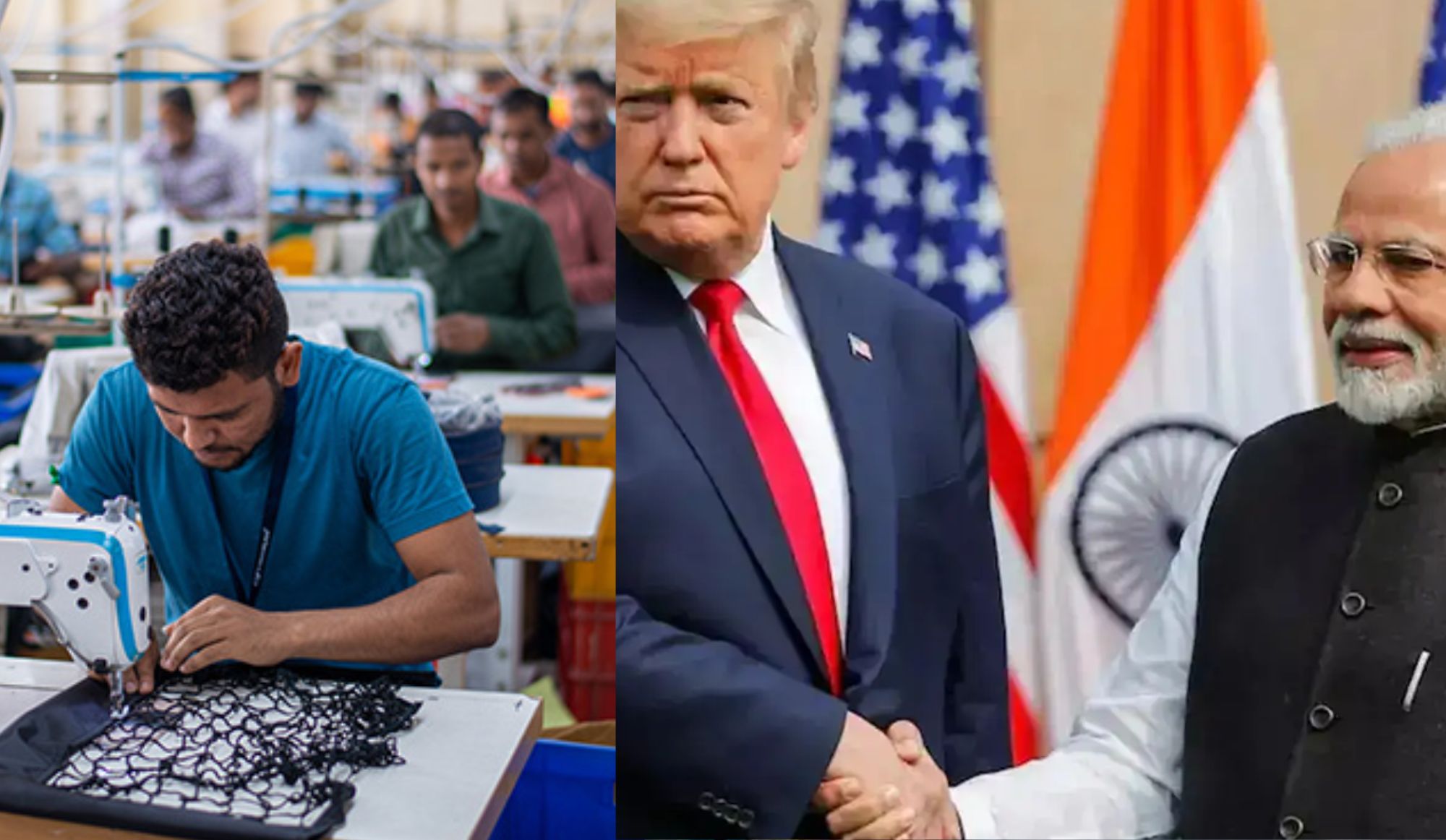
Many experts have expressed concern about the impact of the new tariff regime on Indian economy
It has been a fortnight since India woke up to a shocking trade bombshell when United States President Donald Trump announced a sweeping 25 pc tariff on all Indian exports to the United States. Taking to Truth Social, his own social media platform, Trump unleashed a fiery tirade, labelling India the “tariff king,” condemning its trade barriers as “obnoxious,” and even calling India’s economy “dead.”
This decision has put trade and jobs in India at risk. The possibility of losses was further compounded just a week later, on August 6, when Trump imposed an additional 25 pc tariff on Indian goods, pushing the total to 50 pc. The escalation also came with threats of further, unspecified penalties linked to India’s ongoing purchases of Russian crude oil, which Washington has been targeting aggressively.
Many experts have expressed concern about the impact of the new tariff regime on Indian economy. Vikas Verma, an economist at the Centre for World Trade Organisation Studies in Delhi, believes these steep tariffs will likely cause US importers to cut back on Indian goods, leading to significant business losses and potential job cuts in India.
“In the short term, Indian exports will take a hit as the US importers reduce their orders, leading to business losses and job cuts in India. But if this 50 pc tariff stays in place without a deal, trade dynamics could shift, with competitors stepping in to replace Indian goods. Even if tariffs are lowered later but remain higher than those of other countries, India could still face long-term setbacks. Plus, these high tariffs might undermine India’s goal of attracting more manufacturing investment from US companies,” Verma tells Media India Group.
According to Radha Raghurampatruni, geopolitical analyst and associate professor at GITAM University, Visakhapatnam, while many sectors will be affected by steep tariffs, some such as textiles, jewellery and leather will face the brunt.
“The silver lining for India is that key sectors like semiconductors, copper, and pharmaceuticals, where India supplies nearly half of the US generic medicines, are exempted from these tariffs. However, exports in electronics, auto parts, gems and jewellery, textiles, and leather could still suffer. While the bilateral trade talks were on, India tried to appease Trump by cutting import duties on Harley-Davidson bikes and bourbon whiskey, and by removing the digital services tax that hit US tech giants. But now, to protect domestic demand, India may need monetary measures and might ease fiscal consolidation to boost capital spending. These steps will show India’s commitment to sustaining growth despite the challenges,” Raghurampatruni tells Media India Group.
The Gems and Jewellery Exports Promotion Council (GJEPC) says that the US is the largest market for Indian exports of gems and jewellery, accounting for over USD 10 billion annually. It says that these exports would be hit very hard with 50 pc tariff and has called upon the Indian government to launch an assistance scheme for the industry which is almost entirely driven by thousands of MSMEs, employing millions of people, mainly in Maharashtra and Gujarat. Similarly, textiles and engineering products, too, have an overwhelming share of MSME companies which are unlikely to be able to face the tariffs.
However, India is not alone in facing Trump’s tariff measures. Brazil, previously subject to a 10 pc reciprocal tariff, now faces a 50 pc levy, a move linked to the political turmoil surrounding former President Jair Bolsonaro. Syria and Myanmar have also been affected, with tariffs of 41 pc and 40 pc respectively. Brazil has responded assertively. Brazilian President Luiz Inacio Lula da Silva declared, “No gringo is going to give orders to this President,” rallying support for Brazil’s sovereignty.
Unlike Brazil, which has already taken its case to the World Trade Organisation and threatened reciprocal action, India has adopted a more measured approach, still weighing its options. Indian government has contented itself by issuing statements, calling the tariffs as “unfair, unjustified and unreasonable,” and highlighting that other major economies pursue similar trade with Russia in their national interest.
India restraining from counter tariffs
According to experts, India’s restraint stems from multiple underlying factors. Verma highlights that the Indian government remains hopeful of reaching a trade deal with the US.
“India has not announced any retaliatory tariffs in response to those imposed by the US because the government still hopes to reach a trade deal. It does not want to strain its relationship with the US, which is a crucial strategic partner. India relies on US support to counter China, develop its domestic semiconductor industry, attract more manufacturing, and bring in global companies,” adds Verma.
Echoing this view, Raghurampatruni observes that India is attempting to balance economic interests with broader strategic objectives.
“The 50 pc tariffs imposed on India go beyond a simple trade dispute, they reflect the complex overlap of economic policy and geopolitical strategy. India has chosen to maintain its strategic autonomy while navigating pressures from major powers. It is moving forward by balancing economic interests with its broader strategic goals. The country remains committed to a fair, balanced, and mutually beneficial Bilateral Trade Agreement that prioritises the welfare of farmers, entrepreneurs, MSMEs, and national interests. At the same time, India is actively working to diversify its markets, strengthen domestic resilience, and keep communication channels open with the US, all while firmly defending its core strategic priorities,” adds Raghurampatruni.
The importance of the US as a trading partner adds context to India’s cautious stance. Bilateral trade reached USD 131.84 billion in 2024–25, with India recording a trade surplus of USD 41.18 billion, driven by exports such as drug formulations, telecom equipment, and precious stones, while importing crude oil and coal. Negotiations for a potential trade agreement continue, aimed at further strengthening this key relationship.
Looking at the broader global picture, countries that hurriedly struck deals under Trump’s aggressive trade threats often faced unfavourable terms. The European Union, for instance, agreed to a heavily skewed arrangement, under which while its exports to the US face a 15 pc tariff, it committed to investing USD 600 billion in the US economy and purchasing USD 750 billion in US energy over three years, whereas US exports to the EU enjoy duty-free access.
Experts also suggest that Trump’s steep tariffs on India present both personal and political challenges for the Modi government, especially given Modi’s publicly highlighted rapport with Trump, often portrayed as camaraderie between two right-wing populist leaders.
Hence, this sudden imposition of high tariffs has sparked concern over the future of India-US trade ties. However, Raghurampatruni stresses that India’s current strategy focuses on diversification for now.
“India’s response strategy centres on diversification, deepening trade ties with Japan, South Korea, the EU, and Australia, with the European Free Trade Association deal starting October 1. It is also boosting engagement with groups like ASEAN and BRICS to minimise risks from global supply chain and policy disruptions,” adds Raghurampatruni.
However, India’s measured approach, while prudent, risks being seen as overly restrained and could allow competitors to capture market share. Strategic diplomacy and market diversification remain crucial, and the coming months will test whether India can assert its economic interests effectively without compromising its key strategic partnerships.
