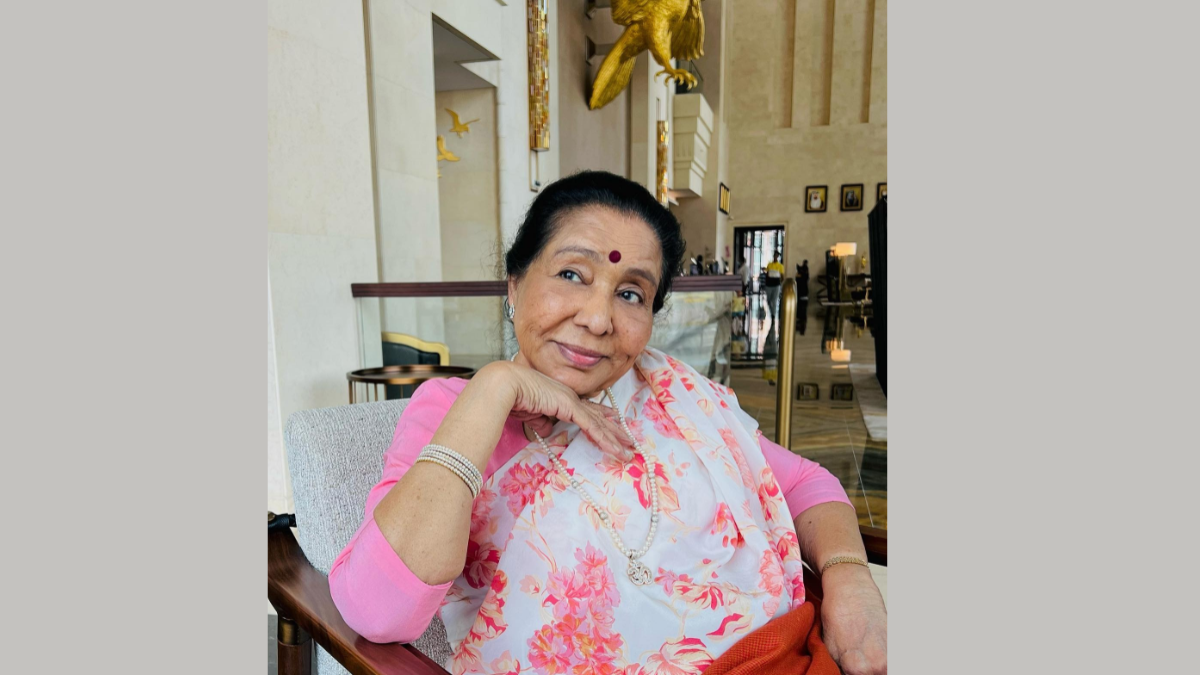
Asha Bhosle's voice was not merely a career making tool, it was a source that energised the emotional life of billions of people
On April 12, the world of music did not just lose a melody, it lost a vibrant ecosystem of a highly-talented singer whose range of tunes and varieties made her popular with almost four generations of humankind.
Asha Bhosle, who once famously, and very aptly, called herself the ‘last Mogul’ of the Indian film industry, has transitioned from the earthly stage to the celestial choir. The emotions behind her self-designated title reflected the time-span dominated by her, which covered almost eight decades, pretty much like her elder sister, lata Mangeshkar, who passed away a couple of years ago.
In a geopolitical landscape often defined by brazen discord and the cacophony of dictating the terms, the death of Asha Bhosle, endearingly called Ashatai (elder sister Asha) reminds us that the true essence of life lies in the abundance of togetherness, lyrical notes of music, the diversity of style of expressions and the harmony of eternal voices. Her voice was not merely a career making tool, it was a source that energised the emotional life of billions of people.
Asha-tai’s greatest gift was her uncanny ability to be part of the society that longed for musical diversity. If her elder sister, the legendary Lata Mangeshkar, represented the pristine, snow-capped purity of the Himalayas, Asha was the sprawling, tropical rainforest, with lucid and bubbling water and lush green mass teeming with life, unpredictable, but fiercely adaptable.
Also Read: When Bollywood songs tell stories beyond just romance
She built a catalogue where songs often followed changing settings rain, night, wind and travel without staying within one form. In Yeh Raatein Yeh Mausam, (These nights, this weather, the riverbank) the movement of night and weather shapes the song’s pace, while O Haseena Zulfon Wali (Oh, beautiful woman with lovely locks hair) carries the rhythm of motion and pursuit, and Piya Tu Ab To Aaja (My Love come now). Songs like Aaiye Meherbaan and In Aankhon Ki Masti,(In the Intoxication of These Eyes) along with Dil Cheez Kya Hai, (What is the heart worth) showed her shift into slower compositions where words and pauses guide the structure.
Her most widely recognised songs span decades and styles, from Dum Maro Dum (Take a Puff) and Chura Liya Hai Tumne Jo Dil Ko (You Have Stolen My Heart) to Rangeela Re (O Colourful One) and Mera Kuch Samaan (Some of My Belongings) and Dil Cheez Kya Hai (What Is the Heart Worth), each marking a shift in sound and recording practice. She also moved across cabaret, classical-based compositions, and popular film music without remaining tied to one format.
Beyond individual songs, the relationship between her artistry and the environment runs as a deeper philosophical thread through her music. Many of her folk-inspired numbers, particularly those rooted in Maharashtra’s cultural traditions, celebrate the earth, the harvest and the changing of seasons with an almost devotional reverence. Her collaborations with composers frequently placed her voice against orchestral landscapes that mimicked rain, wind and birdsong, blurring the boundary between human emotion and the natural environment. Whether she was singing of the lovelorn waiting for monsoon clouds or of the playful joy of a spring afternoon, she brought to these themes an organic authenticity that made listeners feel the soil beneath their feet and the breeze against their skin.
Her repertoire was a masterclass in what one could say ‘defining your own path’, a path that reconciled the tradition with the avant-garde. She could pivot from the soulful, atmospheric ghazals of Umrao Jaan, where music director Khayyam lowered her pitch to discover a haunting, earthy resonance reaching to the summit of the high-octanes of rhythms instigated by R D Burman.
Showing a unique flair for experimentation and diversity, she had also sung songs with several overseas personalities, not all of them professional singers. Perhaps the most outstanding example is her song with former Australian singer Brett Lee.
She had released albums with a number of professional singers from other countries also. These include songs with British singer Boy George, Michael Stipe of American band REM, with British band Code Red and just this year, with another British band Gorillaz.
This wasn’t just versatility; it was a depiction of resilience of voice getting adapted to every climate of cinematic story, from the cabaret to the kirtan or devotional songs, ensuring that the soul of the song remained preserved.
Also Read: Bollywood soundtracks: From melodies to hooks
Her collaboration with Ustad Ali Akbar Khan of the Maihar gharana. clearly depicted that humility was the hallmark of a true singer . Asha-tai, even at 92, was ahead of youth. She launched her own YouTube channel, performed Broadway-style shows in Dubai, and stayed ‘connected’ to the digital pulse without losing her analogue soul and natural talent and intelligence!
I met her for the first time in Paris where I was working for United Nations. I boldly told her that her song, Gun Guna Rahe Hai Bhanvare ( bees are singing) was epitome of nature’s message of living together.’ She smiled. My plans to organise her musical event at UNESCO in Paris did not materialise but her voice and songs remained a culture and heritage of ‘making Indian music internationalised’.
As she sings her way to her final resting place, I hope her departure brings a “ceasefire” to the noise of our times and focusses on ‘songs of bees’ and ‘flowering of buds’. Even though her career spanned over 80 years and her repertoire consists of over 12,000 songs, I would not be alone in wishing, Abhi na jao chhod kar, ke dil abhi bhara nahi (do not leave us, our heart is not yet fulfilled’) !