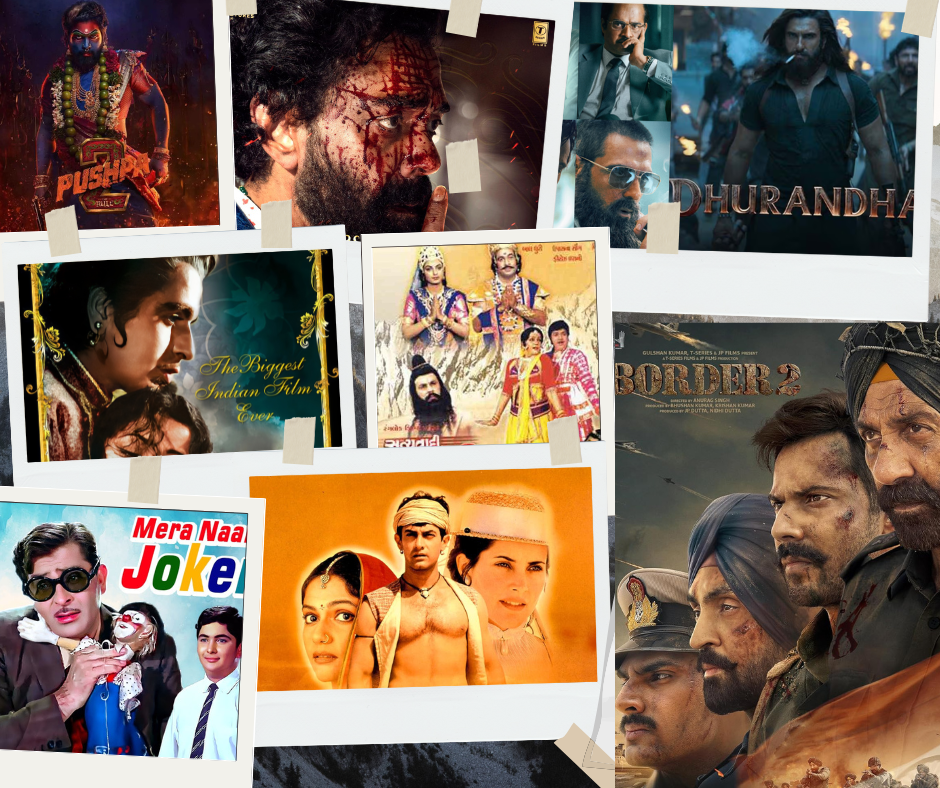
Indian cinema has seen a number of blockbuster films exceed three hours
Indian cinema might be in the middle of one of its most intriguing box‑office moments in years not because films are getting shorter to suit the supposedly shrinking attention spans, but quite the opposite. In an era when two‑hour features and binge‑watched streaming series are often assumed to be the norm, several of the biggest Indian films of recent seasons have been marathon productions, crossing the three‑hour mark and still drawing millions of fans into theatres.
This is not just anecdotal: data from 2025 shows robust box‑office growth alongside these longer runtimes, indicating that audiences are still eager for theatrical spectacle that doesn’t cut corners on scale or ambition.
Also Read: Indian cinema in 2025: Hits, misses & surprises
Recent releases underscore this trend. Animal, clocking in at three hours and 21 minutes, dominated the box office, while Pushpa 2: The Rule ran approximately three hours and 15–20 minutes, drawing unprecedented audiences. Even more striking is Dhurandhar, which stretches for as much as three hours and 34 minutes and has so far grossed over INR 13.33 billion worldwide, confirming that audiences are willing to invest their time when narrative, performances, and spectacle align. Looking ahead, Border 2 is expected to join this unofficial “three-hour club,” signaling filmmakers’ renewed confidence in extended storytelling.
Box-office data from 2025 supports this trend. Fourteen Hindi films grossed over INR 1 billion, up from ten in 2024, showing that audiences are turning out in large numbers even as runtimes expand. Industry experts credit this revival to a combination of high production values, star power, and narratives that can sustain engagement over three hours or more. Indian cinema’s storytelling tradition, with its emphasis on emotional arcs, action, and drama, naturally lends itself to longer films a legacy modern filmmakers are now reinvigorating for contemporary viewers.
This resurgence of the long form film is particularly striking given the widespread assumption that modern audiences have shrinking attention spans. In an age dominated by short-form content, streaming platforms, and binge-watching culture, it might seem counterintuitive that multi-hour theatrical releases are thriving. Yet the success of these recent films shows that Indian audiences still value cinematic immersion, where the scale of the story, depth of characters and spectacle of production create an experience worth dedicating three or more hours to.
Also Read: Cinema’s undying obsession with regional stereotypes
The return of long-form films is not a new phenomenon. Indian cinema has a rich history of epic storytelling, stretching back to the early decades of filmmaking. In the silent era, films like Satyawadi Raja Harishchandra (1917) ran close to two hours, already considerable for the period. As the talkies emerged in the 1930s and 1940s, filmmakers increasingly relied on extended runtimes to accommodate complex narratives, elaborate song sequences, and the moral and emotional arcs audiences had come to expect.
The golden era of Bollywood from the 1950s to the 1980s was marked by films regularly surpassing three hours. Classics like Mughal-e-Azam (1960, 3 hours 55 minutes) set a standard for grandeur, combining intricate storytelling with spectacular production design and music. Epic dramas such as Sangam (1964, nearly four hours) and Mera Naam Joker (1970, over four hours) demonstrated that audiences were willing to invest time in cinematic journeys that were emotionally and visually immersive. Even in regional cinema, films often exceeded three hours, reflecting a cultural appetite for narrative richness and elaborate storytelling.
High-budget spectacles like Lagaan (2001, 3 hours 44 minutes) and LOC: Kargil (2003, 4 hours 15 minutes) continued this tradition into the 21st century, merging commercial appeal with narrative depth. These films showed that length was not a limitation, but an asset, allowing stories to breathe, songs to develop organically and characters to evolve fully.
Despite this long-standing tradition, the early 2000s brought a shift toward more compact storytelling. Multiplex culture incentivised shorter runtimes, as tighter films allowed for more screenings per day, increasing revenue for theaters. Additionally, the rise of digital platforms and streaming services exposed audiences to shorter narratives and episodic formats. Consequently, the average Bollywood feature shrank to two to two-and-a-half hours, prioritising faster pacing and tighter plotlines.
Also Read: Political propaganda turning Indian cinema theatres into battlegrounds
The trend intensified after the pandemic, when digital consumption surged and audience habits shifted further toward bite-sized entertainment. In this context, films exceeding three hours became less common, and filmmakers hesitated to take risks with extended runtimes, fearing attrition and box-office losses.
Yet the box-office success of recent releases suggests a reversal of this trend. Films like Animal, Pushpa 2, and Dhurandhar demonstrate that audiences are willing to engage with longer films when the narrative and spectacle are compelling. The renewed interest in multi-hour films is a blend of tradition and modern commercial strategy. Epic storytelling, visual spectacle, and star-driven projects create an immersive experience that distinguishes theatrical releases from the shorter-form content available on digital platforms.
In terms of scale, the recent films also reflect the pan-Indian approach to filmmaking, aiming to appeal to diverse audiences across languages and regions. Dhurandhar, for instance, combines action, drama and high-end visual effects to cater to a broad demographic, demonstrating that extended runtimes can enhance engagement rather than deter viewers.
Indian cinema has always embraced extremes of duration. Among the longest films ever released is LOC: Kargil (2003, 4 hours 15 minutes), followed closely by Mera Naam Joker (1970, over four hours) and Thavamai Thavamirundhu (original cut 4 hours 35 minutes), which remain benchmarks of epic cinema. Dhurandhar now joins this league as one of the longest, but commercially successful films of the modern era.