
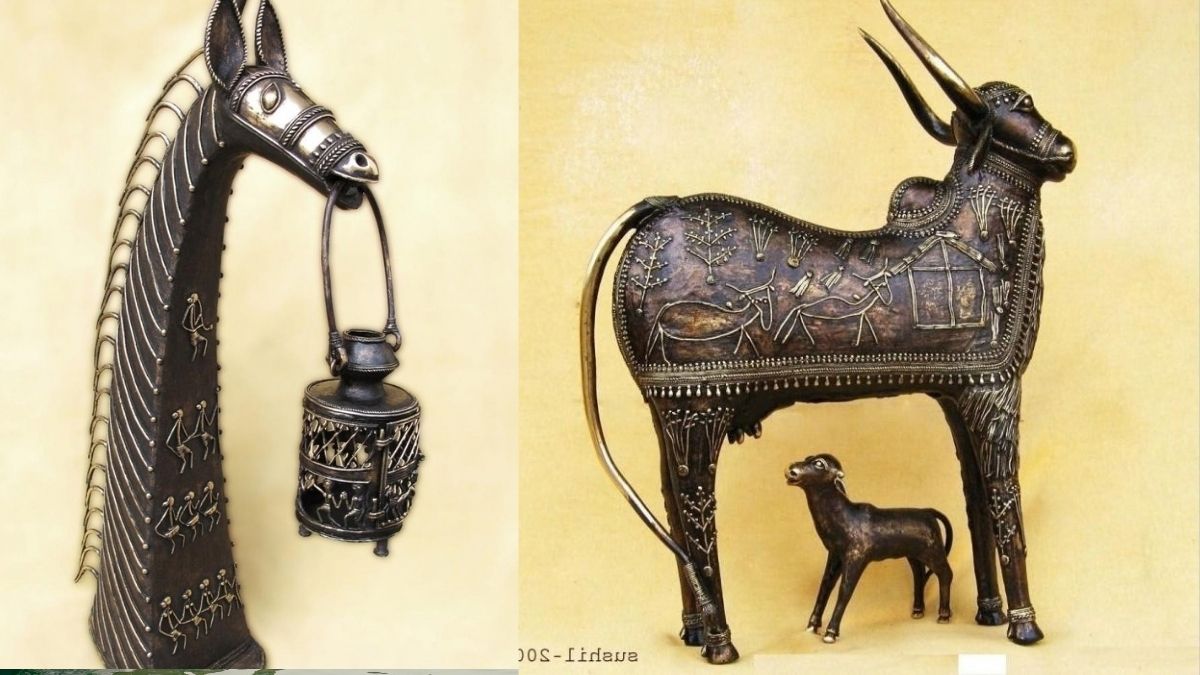
Recognised for intricate textures and handcrafted forms, the metal craft uses the ancient lost-wax casting technique (Photos: Sushil Sakhuja)
In the densely-forested parts of southern Chhattisgarh, at the heart of Bastar district’s rich handicraft tradition is Dhokra, a bell-metal craft that has been one of the most well-known products of this tribal-dominated part of India.
The Bastar–Kondagaon belt, is recognised as an important centre of handicrafts and traditional metalwork and the products made by artisans here are sold across the globe as “Bastar Handicrafts”, while the district itself is also known as Shilp Nagri, or the city of artisans.
Besides bell-metal craft, Bastar is also known for artisanal products made of wrought iron, wood, bamboo and terracotta. Among Bastar’s many traditions, Dhokra holds a distinctive place. Recognised for its intricate textures and handcrafted forms, the metal craft is made using the ancient lost-wax casting technique, with each sculpture shaped from a mould created specifically for the piece.
Also Read: Chapchar Kut: Spring festival of community and culture in Mizoram
A technique passed through generations
For the artisans who practise it, Dhokra is not something that begins with a commercial order. It often begins much earlier, through growing up around the craft and observing older generations at work.
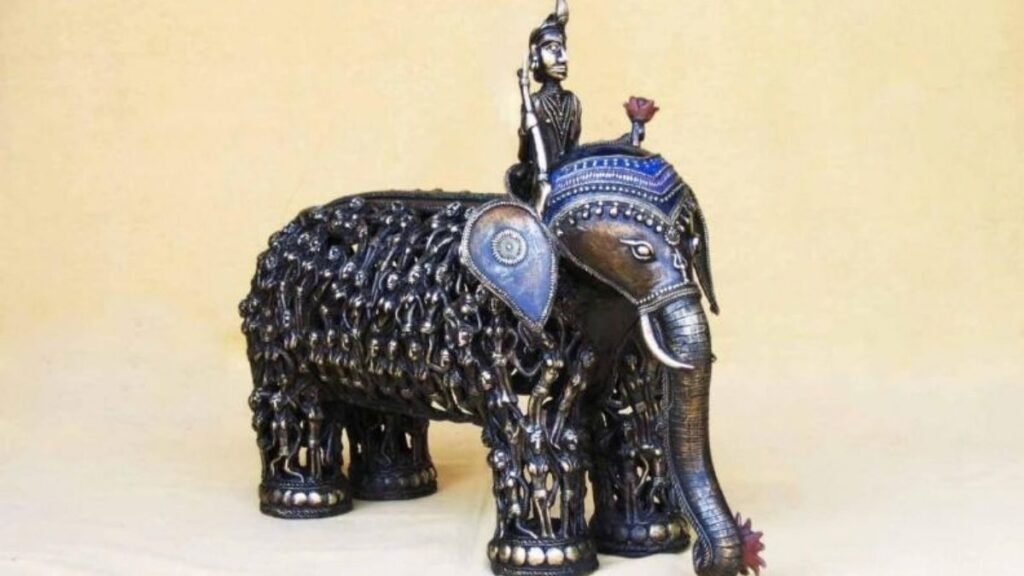
The designs of Dhokra reflect the world in which the artisans live. Human figures, animals, musicians, dancers and representations of tribal life
“I was born in Bastar, in Kondagaon, and grew up in an ordinary family. However, I have been attracted to this craft since childhood. You could say that I started learning this craft from my own generation, and I continue to practise it even today,” Sushil Sakhuja, a sculptor and designer of Dhokra art, from Bastar, tells Media India Group.
Sushil Sakhuja, a self-made artist and a Dhokra art sculptor from Bastar, who has dedicated his work to the traditional arts of tribal communities. Working closely with tribal people, he has explored the rich artistic traditions of Bastar and made bronze his medium of expression. For Sakhuja, however, “art is more of a passion than a business.”
His journey has taken his distinctive Bastar-inspired art beyond India, with his work being showcased in countries and cities including Vietnam, the USA and San Francisco. His international journey reached a notable milestone at the World Sculptors Workshop in Kunming, China, where he received top recognition, bringing attention to his work through the country’s electronic and print media. Through his sculptures, Sakhuja continues to take the artistic traditions of Bastar to audiences across the world.
Also Read: Jaipur artisans preserve 300-year-old lac bangles culture
His experience reflects the generational nature of the craft. Sakhuja says that much of the knowledge involved in Dhokra comes through observation, practice and familiarity with the materials and techniques used by artisans. The continuity of this knowledge is particularly important in a region where handicrafts remain closely connected to community livelihoods.
Process of making Dhokra art
The uniqueness of Dhokra lies in its making. Artisans first shape a clay form, cover it with wax and add fine wax wires to create patterns and details. The wax model is then encased in clay and heated, allowing the wax to melt away and leave a cavity for molten metal. Once cooled, the clay mould is broken open, and the sculpture is cleaned and polished by hand.
The process uses traditional and naturally-occuring materials including beeswax, cow dung, paddy husk and red soil. Since each mould is broken after casting, every Dhokra piece carries subtle variations, giving the handmade craft its distinctive character.
The designs of Dhokra reflect the world in which the artisans live. Human figures, animals, musicians, dancers and representations of tribal life frequently appear in the craft. The surrounding forests and everyday experiences also influence the subjects and forms chosen by artisans.
“In our craft, our colours, our everyday life and our rituals are all reflected. These elements may be similar across different regions, but they are slightly different in each place. By looking at a piece, one can often tell whether it comes from Bastar, Odisha, Jharkhand or another state because each region has its own distinctive visual identity,” Sakhuja explains.
This regional identity is one of the reasons Dhokra works particularly well as a form of cultural storytelling. A sculpture can communicate something about the community that produced it without requiring a written explanation.
From traditional forms to changing tastes
While traditional designs remain central to Dhokra, the craft is also evolving in response to changing preferences of buyers.
“It depends on where the tourists are coming from. Different tourists have different preferences. International tourists generally appreciate the very traditional forms of our craft, although sometimes they also like new designs. Local people, on the other hand, usually prefer small variations because they may have already seen similar pieces many times. They want something slightly different each time for their collection,” he says.
This demand for variation has encouraged artisans to experiment with designs while retaining the traditional process.
The challenge for the artisans is to introduce new forms without losing the visual identity that makes Bastar Dhokra distinctive. For many artisans, innovation therefore happens within the traditional technique rather than by replacing it.
Also Read: Chennai : Cauldron of Culture, Craft and Cuisine
From artisanal workshops to global markets
The growing recognition of Bastar’s handicrafts has created opportunities for Dhokra to travel far beyond its place of origin.
The District Export Action Plan developed by the district administration identifies handicrafts as a major local industry and states that products manufactured there are sold globally under the name ‘Bastar Handicrafts’.
At the state level, Bastar and Kondagaon are counted among the important clusters supporting Chhattisgarh’s metal handicraft sector. Traditional crafts from the region have also developed international markets, with exports to the United States and Europe contributing to livelihoods in the wider craft sector.
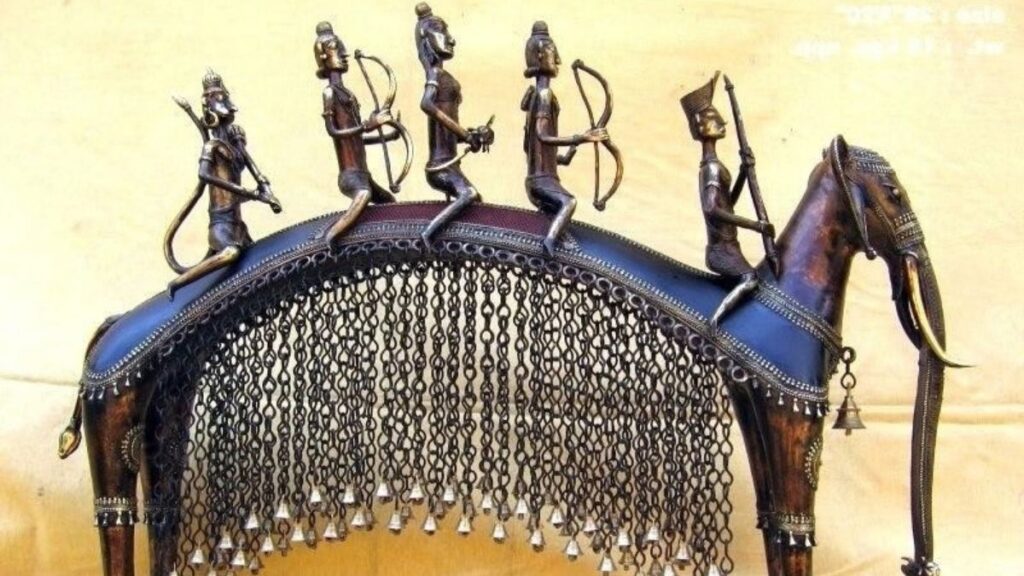
The uniqueness of Dhokra lies in its making. Artisans first shape a clay form, cover it with wax and add fine wax wires to create patterns and details
This gives Dhokra a significance beyond the souvenir market. What begins in an artisan’s workshop in Bastar can eventually find its way into homes and collections far from the region.
Where travellers encounter Dhokra
For visitors, the experience of Dhokra becomes more meaningful when it is encountered alongside the communities that produce it. For a traveller, seeing an artisan shape wax or pour metal can reveal something that a finished object alone cannot: the amount of knowledge, patience and manual skill behind every sculpture.
Bastar’s weekly haats or markets provide an important setting for this. These markets bring together local communities, traders, agricultural products, forest produce and handicrafts, allowing visitors to encounter traditional crafts within their everyday cultural environment.
A culture that is still lived
The wider appeal of Bastar art lies in the fact that its traditions remain closely connected with everyday life.
“For me, the most special thing about Bastar’s culture and traditions is that culture here is not merely something to look at; it is still a part of people’s everyday lives. If a tourist genuinely wants to experience the place and interact with its people, the villages, weekly haats, folk dances, music, devotional singing and local art offer opportunities to see and understand Bastar more closely,” Sakhuja says.
“The real beauty of Bastar lies in its nature, its simple way of life, its sense of community and its old traditions that are still alive today. All of this is what makes Bastar different from other places,” he adds.
That living connection is what gives Dhokra much of its cultural value. The craft is not preserved only as an object from the past; it continues to be made, adapted and sold by artisans today.
For travellers, a Dhokra sculpture can therefore be more than a souvenir brought home from Bastar. It can be a tangible reminder of a place where craft is still part of everyday life from where an ancient technique continues to give Bastar’s cultural identity a form that can travel far beyond its forests.
