
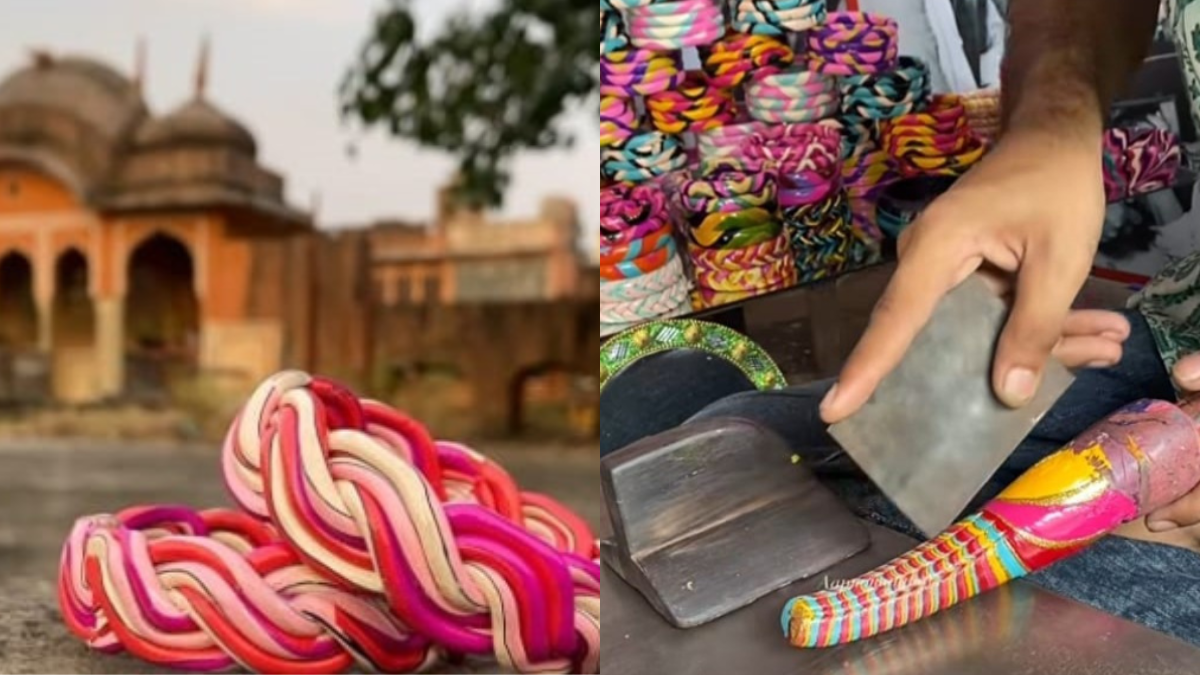
The skill of crafting lac bangles has been passed on from generations (Photo Aapno Maniyar)
For many Indian women, bangles are not merely ornaments but cherished symbols of prosperity, love and happiness. Across India’s diverse states, the intricate art of bangle making continues to flourish through different techniques and exquisite materials.
Despite new trends styles featuring bangles designed from different materials like metal and diamond, Rajasthan’s traditional lac bangles continue to hold a cherished place in households across the country.
Lac is a shiny glossy material which is secreted from the Kerria lacca insect. The material when secreted forms small beads on trees and is later scraped off. This scraped off material is processed and the natural substance lac is extracted from them which is then refined and used for bangle making.
Also Read The colourful cities of Rajasthan
From mythology to modern markets
The art of lac bangle dates back to mythology and royal history dating bac it’s connection to the tales of Lord Shiva and Parvati.
Ancient scriptures narrate the story of Lord Shiva and Parvati’s celestial wedding where the process of lac bangles were undertaken by a group of highly skilled artisans known as the Lakhedas, who crafted bangles as a precious gift for the bride.
In the great Indian epic Mahabharata, lac figures as an important material used in the creation of a grand palace by the Kauravas to eliminate the Pandavas.
But in Jaipur, the craft’s history dates back to 300 years ago when the Pink City’s visionary ruler and founder of Maharaja Sawai Jai Singh II, invited artisans from Uttar Pradesh’s Manoharpur to exhibit the best of their skills. Not only did they impress the ruler, but also made Jaipur their home and t
hree centuries later, the skill continues to flourish today and is practiced by several craftsmen as their major source of livelihood.
Jaipur’s glittering bangle bazaar: Maniharo ka Rasta
In the heart of the city, located in the lively Tripolia Bazar, the bustling Maniharon Ka Rasta lights up with bustling shops of lac bangles where generations-old craftsmanship meets vibrant colour and creativity.
The iconic market is home to the Manihar community, the artisans who have excelled in the skill of lac bangle making.
While the streets here attract both locals and tourists, the Manihar artisans breathe life in the market, and preserve the age-old skills amidst the changing needs and trends of consumers.
Within this market is Nayyer Bangles, a 297-year-old shop, which continues to preserve the culture.
Tahir Hussain, a third-generation artisan working in Nayyer Bangles, has childhood memories of sitting with his family and watching them intricately craft the bangles.
“My family has been practicing the skill for more than 200 years now. I grew up watching the process of bangle making. For me it was a very fantasising process and I always wanted to make lac bangles. After completing my graduation, I returned back to the shop and till today, I have been practicing the skill. In our family, we never had anyone to teach us the process. I learnt the entire process by watching my family members,” Hussain tells Media India Group.
Explaining the process of the bangle making, Hussain boasts that lac bangles are the pride of every Rajasthani bride.
“Raw lac comes in two forms which is the ujla button, a pure form of lac used in the process of colouring and kala button, impure lac used for the base of bangles as it provides strength. To make a lac bangle, a layer of kala button is placed on the stick and is then heated slowly over a coal burnet. It is pressed and rolled over a flat iron plate with the help of a wooden toll which is made of 90 pc wood. After this, a layer of the ujla button is used. This pure form of lac comes in mainly four colours which are yellow, magenta, green and blue. These colours are mixed to form new different colours. The skill of colour making has been passed on from generations to generations. Usually making a bangle takes approximately 15 minutes but if the bangle is being made from scratch it takes one hour. It also depends on the complexity of the designs,” Hussain explains.
While the process of bangle making is an easy one, the work is divided equally among both the male and female members of the family, emphasising the freedom from patriarchal influence.
“The process of crafting the lac bangles is done by both male and females. The craft of making the bangles is usually done by the male family members since they have more sturdy hands. In bangles where we attach beads or stones, the woman joins in. After the bangle is made, it is kept to cool down. The woman then puts in the beads with the help of tweezers,” Hussain adds.
The cost of the average bangles is INR 50, the price can go up to INR 400, depending on the customisation and designs demanded by the customers.
Also Read Kathputli: String puppetry from Rajasthan
As times change, the designs demanded by the consumers have changed and have ranged from the typical designed extra vibrant bangles to more subtle colours.
“The designs of the lac bangles have changed over years. In the early 2000s, there were several Rajasthani soap operas aired and people would come in to buy similar designs to the actress. Later in 2010, there was cold lac which went famous in the market. The main characterstic of lac is the gentle nature and breaking under excessive pressure. When cold lac came into trend, people went on the buy this as it was better in quality, but after sometime, the trend faded out as it was only an adulterated version. If we compare the changes that have come in the trends of lac bangles, people have shifted from sparkling bangles to more subtle designs. Moreover today, people first want to see the entire process of the bangle making and then buy their designs. If you take a look, today Instagram is flooded with reels of the process,” Hussain said.
Business for the artisans booms typically during the wedding season, Diwali and tourist season.
Although the profit margins are very thin, these artisans continue to run their business.
“We usually earn 5 to 10 pc profit when we have bulk orders but it differs on retail orders. There is usually just a margin of INR 20-30. Lac bangle is not made for earning money, it is more about keeping the skill live,” Hussain said,
Aman Hussain is a fourth-generation member practicing the skill at Aapno Maniyar shop, a business that started in 1960. He says he would want the upcoming generation to put efforts into keeping the skill alive and preserving the culture.
Hussain explains on how despite sinking into losses the family did not give up and revamped the business by building their profiles on social media platforms and gaining more recognition than ever.
“Lac is not just used to make bangles, over time people started using the material in furniture, handicrafts and make other jewellery. There was a time when our business of lac was going in losses. We did not want to give up on our business so we started our own social media page on Instagram and Facebook to cope up with the changing trends. After this, we saw a rise in sales as more and more people got to know about us. My only message to people is that lac making is a skill which has been carried in Rajasthan for more than 200 years now and the skill has represented our state. I want more and more people to take this skill forward and pass it on to their future generations,” Hussain tells Media India Group.
With skilled artisans like Tahir Hussain and Aman Hussain keen on preserving the skill and passing it to the coming generations, Rajasthan’s rich heritage will continue to shine, one lac bangle at a time.
