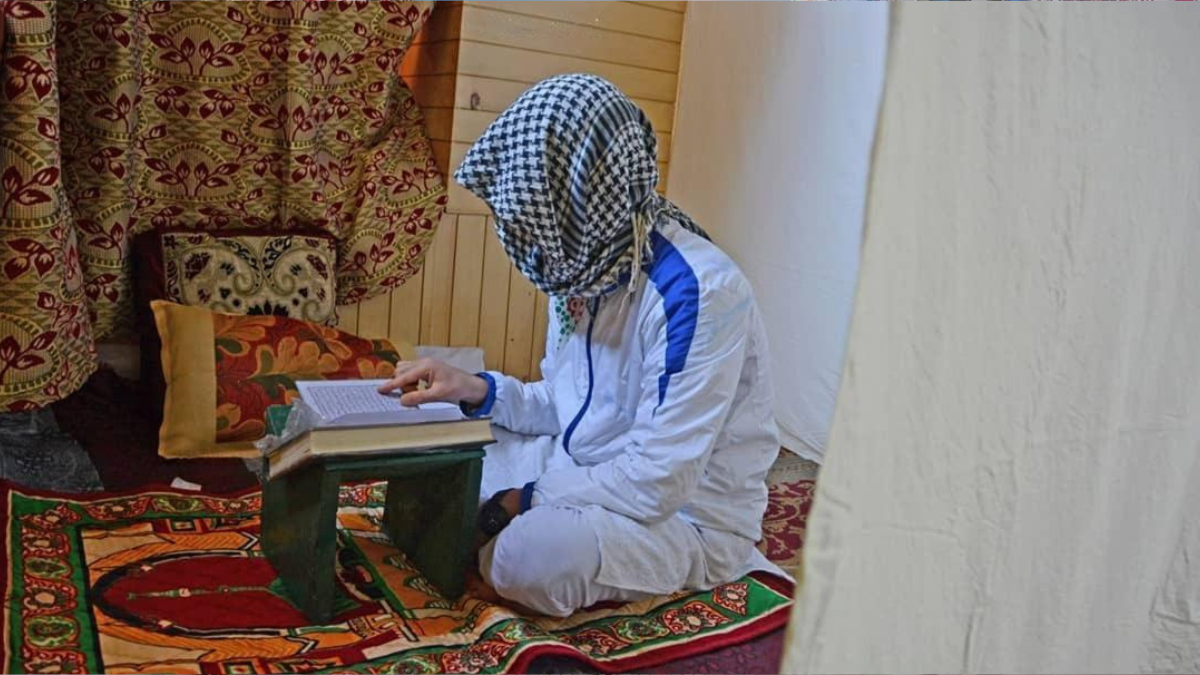
As the holy month of Ramadan enters its final days, many Muslims prepare for a special act of worship known as Iʿtikāf (Photo: Umar Ganie)
The practice goes back to the time of the Prophet Muhammad, who is believed to have regularly observed Iʿtikāf during the last 10 days of Ramadan. Muslims believe these nights are especially important because they include Laylat al-Qadr, or the Night of Power, which is believed to be the night when the Quran was first revealed. Worship during these nights is considered particularly rewarding.
During Iʿtikāf, men usually stay inside mosques while women observe it in a quiet, separate room at home. Once the retreat begins, participants do not leave the mosque or the room except for essential needs. They spend most of their time praying, reading the Quran, making supplications and reflecting on their lives. Meals are simple, and they break their fast and eat within the same space where they worship.
Also Read: Ramadan in Kashmir – Drums at dawn, fasts of faith, nights of devotion
In many parts of Kashmir, the practice of Iʿtikāf is strongly connected with community life. Traditionally, almost every mosque ensures that at least one or more men stay in Iʿtikāf during the last 10 days of Ramadan. Local residents often bring food for sehri and iftar and help with small necessities so that those observing the retreat can remain focussed on worship without worrying about daily needs.
Inside the mosque, life follows a different rhythm. The day is quieter, often spent reading the Quran or resting. Many participants sleep for a few hours during the afternoon to regain energy. The nights, however, are usually filled with prayer.
For Bilal Ahmad, a 34-year-old teacher from Sopore, North Kashmir who has observed Iʿtikāf several times, the experience can be both physically challenging and spiritually uplifting.
“In the beginning it feels difficult because you are used to moving around and talking to people. But after a day or two, your mind becomes calm. During the day we rest a little, sometimes sleep for a short time, but most of the worship happens at night. We stay awake for long hours praying, reading the Quran and making prayer. The mosque becomes like a small world of its own,” Ahmad tells Media India Group.
He says the silence of the night is one of the most powerful parts of the experience. “When everyone around you is praying quietly in the dark hours before dawn, it feels very peaceful. You forget about the outside world,” he adds.
Others preparing for the retreat say the biggest challenge is disconnecting from daily routines.
“For most of the year we are busy with work, phones and responsibilities. For 10 days I want to leave all that behind. I want to focus only on prayer and reading the Quran. I think it helps a person reset spiritually,” Towqeer Shabaan, a 28-year-old student from Malihabad in Lucknow, who plans to observe Iʿtikāf this year, tells Media India Group.
Women who observe Iʿtikāf often prepare a quiet corner or room in their homes where they can pray without interruption. For many, it is a deeply personal experience.
Shazia Bano, a 35-year-old, living in Gaziabad, says she has been planning for the retreat for weeks. “I have arranged a small room in my house where I will stay for the last ten days of Ramadan. My family knows that during that time I will focus only on worship. It is my way of strengthening my relationship with Allah,” Bano tells Media India Group.
Even though participants stay alone or in quiet spaces, the retreat is supported by the wider community. Families take pride in helping those who are observing Iʿtikāf, and mosques often organise simple arrangements for meals and resting areas.
Across the Muslim world, thousands of believers gather in mosques for this practice every year. In Saudi Arabia, for example, the historic Prophet’s Mosque hosts thousands of worshippers during the final days of Ramadan. In 2025, about 4,000 registered participants from around 120 countries stayed in the mosque for Iʿtikāf, while many more also performed the retreat there independently.
Also Read: Ramadan celebrations in different countries
Despite these large gatherings, the essence of Iʿtikāf remains deeply personal. The retreat is not about crowds or numbers, but about the individual’s connection with God.
For those who undertake it, the 10 days can feel both long and short at the same time. Days pass slowly inside the mosque, with little conversation and limited movement. But many participants say the experience passes quickly because their minds are focussed on worship.
Participants also develop a simple daily routine. After the pre-dawn meal and the early morning prayer, many spend hours reading the Quran. Later in the day, some take a short nap to prepare for the long night ahead. After sunset, the mosque becomes more active as people gather for prayers, recitation and special night prayers.
The most intense moments often come in the final nights, when worshippers search for Laylat al-Qadr. Many remain awake until dawn, praying and asking for forgiveness and blessings.
When the moon announcing the end of Ramadan is finally sighted, the retreat comes to an end. On the eve of Eid al-Fitr, those who have spent ten days in seclusion step out of the mosque or their room and return to their families and communities.