
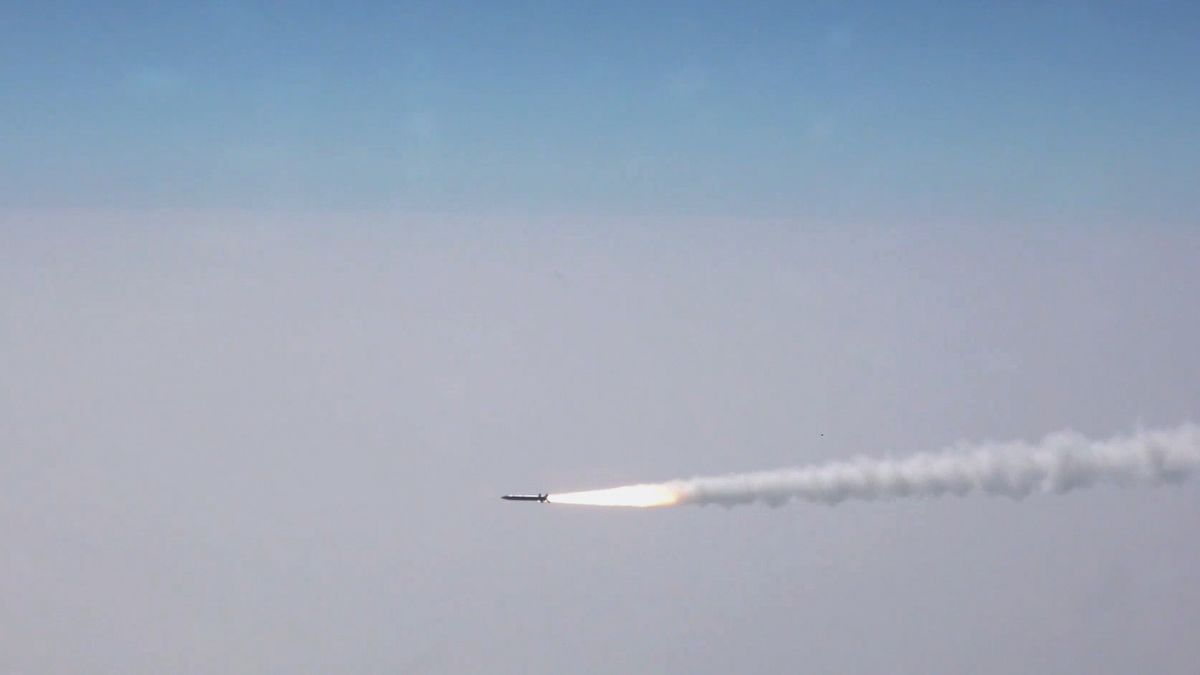
RudraM-II is designed primarily for Suppression of Enemy Air Defences (SEAD) and Destruction of Enemy Air Defences (DEAD) missions (Photo: PIB)
To strengthen India’s long-range precision-strike capabilities, Adani Defence and Aerospace, a production partner for the RudraM-II programme, is working with the Defence Research and Development Organisation (DRDO) to accelerate the missile’s production and secure its clearance for exports. The Indian Air Force (IAF) is expected to place orders for the weapon system, with its induction expected to open opportunities for its eventual availability to international customers.
In a press statement, Adani Defence and Aerospace says that RudraM-II is designed primarily for Suppression of Enemy Air Defences (SEAD) and Destruction of Enemy Air Defences (DEAD) missions. The missile has an estimated range of around 300 kilometres, a maximum speed of Mach 5.5, about 6800 kmph, and a payload capacity of approximately 200 kg, enabling it to engage heavily defended ground targets from stand-off distances.
The statement adds that the Su-30MKI, the backbone of the IAF, is expected to be the initial launch platform, with each aircraft capable of carrying up to five RudraM-II missiles in a single sortie. This would allow the IAF to conduct long-range strikes while keeping its aircraft outside the engagement range of ground-based air defence systems.
Also Read: Indian Army Chief on visit to Czech Republic to strengthen defence ties
The missile features a multi-layered guidance system incorporating an indigenous wide-band passive radio-frequency (RF) seeker. This enables it to detect and engage enemy radar installations even if their operators switch off the radar after detecting an incoming missile. The system can also target ground installations protected by extensive air defence networks.
RudraM-II’s export prospects are expected to benefit from growing international demand for high-speed, long-range stand-off weapons. With its range of approximately 300 km, the missile falls within the range threshold associated with the Missile Technology Control Regime (MTCR), potentially supporting its export prospects, subject to applicable approvals and export-control requirements.
The immediate priority is to accelerate production and validate the missile on additional aircraft platforms, including the Mirage 2000 and Tejas Mk1A, in the coming months. Further integration is envisaged on the Tejas MkII, Rafale and Advanced Medium Combat Aircraft (AMCA) in subsequent phases.
