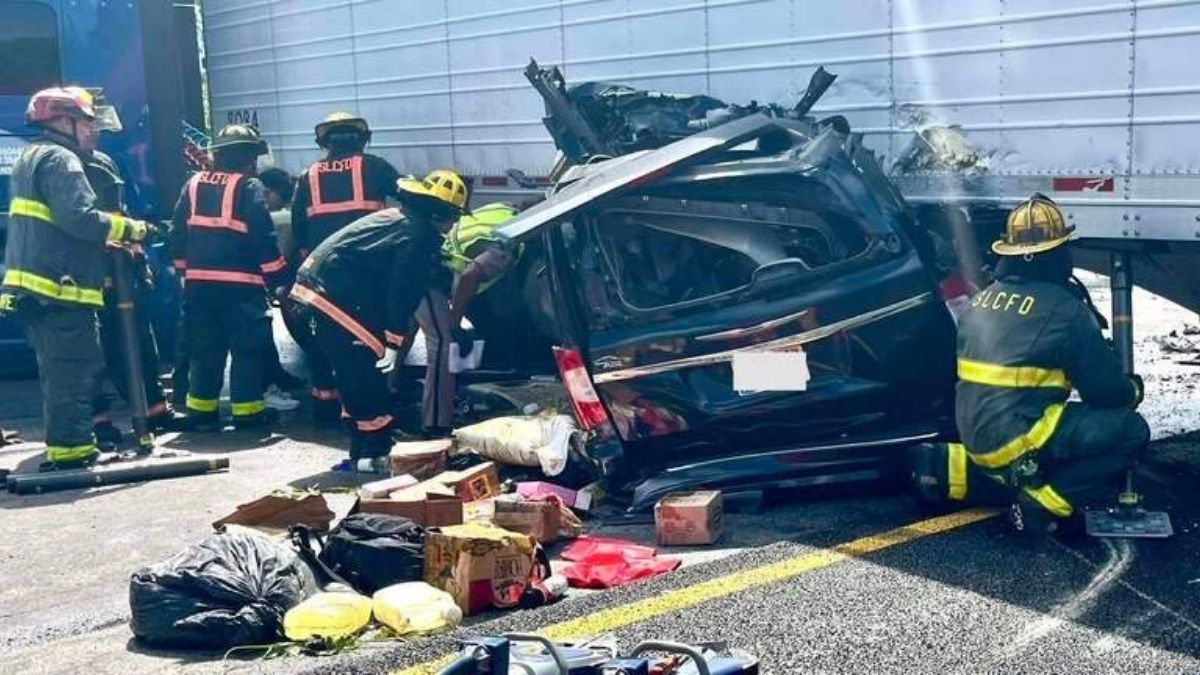
A semi-truck driver caused a fatal crash on the Florida Turnpike, killing three South Floridians, FHP said. The driver faces vehicular homicide charges ( Photo: Lucie County Sheriff's Office )
A United States crackdown on commercial driving licences is putting thousands of foreign truckers at risk, with Indian drivers from Punjab and Haryana among those most affected. More than 28,000 non-citizen commercial driving licences (CDLs) have already been cancelled, largely over English-language and licensing concerns, while federal rules could eventually force about 194,000 non-domiciled CDL holders out of the freight industry.
US authorities have cancelled thousands of licences given to foreign truckers, saying many did not meet English-language rules or came from poorly-run driving schools. The campaign grew after a fatal crash in Florida in August 2025. Officials are now recruiting military veterans to replace these drivers, and the change is hitting Indian, especially Punjabi and Haryanvi, truckers hardest.
Of these, nearly 24,000 to 26,000 were withdrawn because the holders failed English-language proficiency checks, a requirement that has existed for years but was rarely enforced until 2025.
The Federal Motor Carrier Safety Administration (FMCSA) also removed close to 10,000 CDL training schools from its national registry after finding many had issued licences without proper testing. Officials describe these as “CDL mills,” schools accused of pushing unqualified drivers through the system.
Also Read: Indian diaspora caught in crossfire of xenophobia
The cancellations sit within a bigger picture. FMCSA expects around 194,000 non-domiciled CDL holders, licences given to people without permanent US residence, to eventually leave the freight industry under a Final Rule that took effect on March 16. From that date, foreign nationals can only hold a CDL if they carry specific work visas, such as H-2A, H-2B or E-2. The 28,000 revoked so far represent about 14 pc of that total pool.
California, the largest state in the US, has faced the heaviest scrutiny. Transportation Secretary Sean Duffy said 17,000 licences issued there were unlawful, and the state cancelled around 13,000 non-domiciled CDLs in a single day on March 6. The Department of Transportation has also threatened to withhold USD 160 million in federal highway funding from California, along with warnings to New York, Pennsylvania, Minnesota and North Carolina over similar compliance concerns.
The Indian and Punjabi connection
The impact on Indian drivers is significant. According to data from the North American Punjabi Truckers Association, between 130,000 and 150,000 commercial drivers in the United States come from Punjab and Haryana alone. Many arrived over the past two decades, building careers as long-haul drivers or setting up their own transport firms.
The Sikh Coalition, a civil rights group, says roughly a third of California’s truck drivers are Sikh. Legal director Munmeeth Kaur has said that losing a CDL means losing an entire livelihood, and that thousands of drivers were given cancellation notices without a chance to respond or correct errors.
Not every affected driver is undocumented. Many hold valid work permits and were issued licences under rules that later changed. The distinction matters legally: drivers with lawful status have been able to challenge cancellations in court, while undocumented drivers face separate deportation proceedings.
Also Read: Repeated fatal truck accidents in US put spotlight on Indian drivers
The turning point was a crash on Florida’s Turnpike near Fort Pierce on August 12. Prosecutors say Harjinder Singh, a 28-year-old truck driver from India, made an illegal U-turn through an “Official Use Only” crossover, blocking all northbound lanes. A minivan travelling behind could not stop and hit his trailer, killing all three occupants: Herby Dufresne, 30, Rodrigue Dor, 54, and Faniloa Joseph, 37.
Singh had entered the US illegally through Mexico and was later issued a CDL first in Washington state and then in California. He faces three counts of vehicular homicide and three counts of manslaughter, and has pleaded not guilty. A judge denied him bond, ruling he was a flight risk. His trial is ongoing, with hearings continuing through 2026. Even though more than 2.4 million people signed a Change.org petition asking Florida’s governor for leniency; a spokesperson for Governor Ron DeSantis rejected the request, saying criminal actions have consequences in Florida.
Duffy said Singh should never have been issued a licence in the first place, and used the case to press California over its licensing checks.
The Florida crash was not the only incident cited by officials. In October 2025, a semi-truck driven by Jashanpreet Singh, a 21-year-old Indian, crashed into slow-moving traffic on Interstate 10 near Ontario, California, killing three people, including a high school basketball coach and his wife. Singh was charged with gross vehicular manslaughter and driving under the influence, and later pleaded guilty. He was sentenced to four years and eight months in prison.
Federal officials said Singh had crossed the border illegally in 2022 and was released under a Biden-era policy pending an immigration hearing. California state officials disputed this, saying his work authorisation had been approved and extended by federal agencies, which allowed him to legally obtain a licence.
In a separate case, Border Patrol agents at a checkpoint near Blythe, California, arrested a 25-year-old Indian who was found driving with a valid New York-issued CDL despite being in the country illegally. He was detained for processing towards deportation.
The Department of Homeland Security has pointed to these cases as evidence that licensing checks failed. Officials, including DHS Secretary Markwayne Mullin, said too many American lives had been lost in accidents involving unqualified foreign drivers.
To fill the gap left by the cancellations, the administration launched the “Freedom Haulers” campaign, unveiled at the White House with President Donald Trump, Duffy, Veterans Affairs Secretary Douglas Collins and Acting Labour Secretary Keith Sonderling. The programme lets military veterans who have driven heavy vehicles over 2.5 tonnes skip the standard CDL skills test, though they must still pass the written exam.
The Transportation Department says more than 40,000 veterans have already used related waivers to enter trucking, and that average trucker pay is around USD 70,000 a year. Veterans with at least three years of service can also use GI Bill funding for training costs.
Also Read: Indian truck art: Pimped up rides
The crackdown has drawn legal resistance. In California, the Sikh Coalition, the Asian Law Caucus and the Jakara Movement filed a class-action lawsuit on behalf of around 20,000 drivers, saying the state’s cancellation process denied them a fair chance to respond. A California judge later ordered the state to allow qualified drivers to renew their licences, and the state itself found that around 7,000 cancellations had been issued in error.
At the federal level, a case known as Lujan v FMCSA II challenged the Final Rule on behalf of nearly 200,000 lawfully present drivers. In May 2026, the DC Circuit Court of Appeals declined to block the rule while the case continues.
Governor Gavin Newsom’s office has publicly disputed Duffy’s claims about California’s licensing failures, saying the drivers in question were in the country legally and that their documents were approved under federal guidelines. The Sikh Coalition has said it supports genuine safety standards, including English-language ability, but argues that the process used to cancel licences has been unfair and poorly explained.
Industry groups have warned that removing large numbers of experienced drivers so quickly could worsen an existing shortage and disrupt freight movement across the country. For families in Punjab and Haryana who depend on income sent home by relatives driving American trucks, the changes have already begun reshaping plans for the future. Court cases in California and at the federal level are expected to continue through the rest of 2026, and further state-level actions look likely as Washington keeps up pressure on non-compliant states.