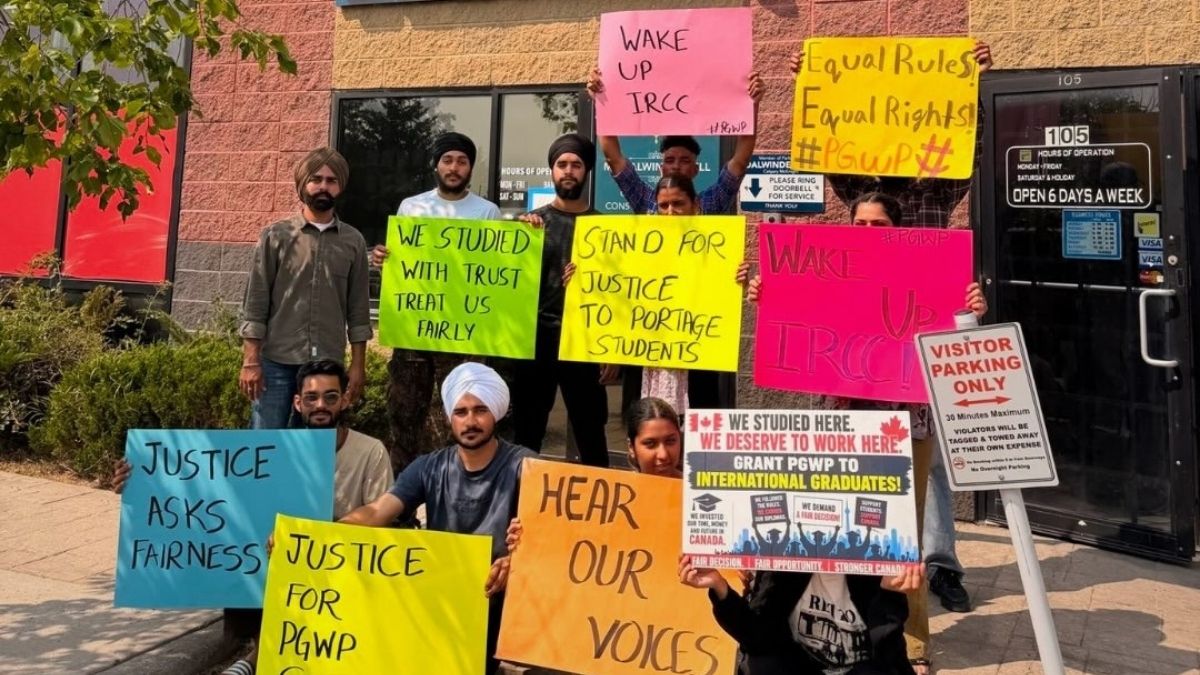
Over 3,323 Indian nationals were removed from Canada in the first half of 2026 (Photo: Naujawan Support Network)
More than 1,000 Indian graduates, most of them from Punjab, have spent weeks protesting outside Portage College campuses in Calgary and Edmonton after their Post-Graduation Work Permit (PGWP) applications, that allowed them to work, were rejected, putting a huge question mark over their future in the country.
The rejection of the permits comes even as 3,323 Indian nationals were removed from Canada in the first half of 2026. The Canadian government ruled that non-credit programmes did not qualify for the permit, a status many graduates say they were told they held when they enrolled.
On June 24, Immigration, Refugees and Citizenship Canada (IRCC) updated its PGWP eligibility page to state that non-credit programmes, apart from certain flight school courses, do not qualify for the permit. IRCC calls this a clarification of an existing rule, not a new policy. Students and Portage College dispute that description.
Also Read: Craft, identity and influence: The rise of Indian diaspora designers
According to figures cited by community organisers, at least 480 graduates have received formal PGWP refusals so far, with the total number of affected individuals estimated at up to 1,500 across Alberta, a state in western Canada. Most of the students in the dispute completed continuing-education, non-credit programmes at Portage College, a public institution headquartered in Lac La Biche with campuses in Calgary and Edmonton.
Students say they paid roughly USD 32,000 in tuition for two-year diploma programmes, in addition to living costs in Canada over that period. Many describe enrolling specifically because they were told, at the time of admission, that the programmes made them eligible for a post-graduation work permit a step most international graduates rely on to gain Canadian work experience before applying for permanent residency.
Portage College spokesperson Andre Delaire said the college’s understanding was that students enrolled in non-credit public-private partnership programmes before May 15, would be eligible to apply for a PGWP, consistent with how IRCC had historically processed such applications. IRCC has said students who began studies before May 2024 are not affected by the June update, a claim that conflicts with what many of the rejected students say happened to their own applications.
Also Read: Truck drivers from Punjab, Haryana hit as US cancels over 28,000 licences
The demonstration, that has continued for weeks at Saddletowne Circle in northeast Calgary, included a hunger strike that began July 24. Alberta Premier Danielle Smith and Prime Minister Mark Carney were asked about the protests on July 29. Carney said he had not been briefed on the demonstrations but that graduates without authorisation to remain in Canada needed to follow the standard process. Smith said Portage College have overstated the pathway to permanent residency and that students whose visas expired without permanent residency status needed to leave the country.
Canada Border Services Agency officers later visited the protest site to check attendees’ immigration status, making it the first time in recent years that the federal border enforcement has conducted status checks directly at an active protest. CBSA confirmed it verified the status of 20 people at the site of which 12 were flagged as possibly inadmissible under the Immigration and Refugee Protection Act and told to report to a CBSA office for a follow-up interview. An immigration lawyer representing some of the students said those individuals could face removal from Canada.
The Calgary dispute is unfolding against a broader rise in enforcement actions involving Indian nationals across Canada. CBSA data show Canada removed 3,323 Indian nationals between January and June 2026, nearly 88 pc of the 3,779 Indians removed during all of 2025, which was itself a record year. India has overtaken Mexico, which recorded 1,573 removals in the same six-month period, to become the top nationality group for removals from Canada, the first time India has held that position since 2020, when 1,424 Indian nationals were removed.
The increase has been steady over several years as 603 Indian nationals were removed in 2021, 786 in 2022, 1,132 in 2023, 2,004 in 2024, and 3,779 in 2025. This year, the six-month total already exceeds every full-year figure from 2021 through 2024. Indian nationals accounted for about 16 pc of Canada’s total removals in 2025; that share rose to more than 31 pc in the first half of 2026.
As of June, 7,669 Indian nationals were listed in Canada’s removals in progress inventory, the largest group among all citizenships in that category. Canada carried out 10,607 total enforced removals in the first half of 2026, compared with 23,160 for all of 2025. CBSA data attributes 8,551 of the first-half removals to non-compliance among refugee claimants, with 1,303 involving non-claimants meaning the increase is not limited to any single visa category, including students.
Also Read: Indian diaspora caught in crossfire of xenophobia
For families in Punjab and other parts of India, the PGWP rejections carry direct financial consequences. Many families borrowed money or sold assets to cover tuition and living costs on the expectation that a graduate would work in Canada after finishing their programme and eventually apply for permanent residency. A rejected work permit, combined with the risk of removal proceedings, can leave a family without the income it had budgeted for and, in some cases, with debt tied to the original investment in the education. The rise in overall removals of Indian nationals adds to concern among prospective students and their families about the reliability of pathways that were, until recently, widely used to move from study to work status in Canada.
IRCC has said it recognises there are questions about the programme requirements but has not announced a reversal of the June 24 update. Some affected students have taken their cases to Federal Court.