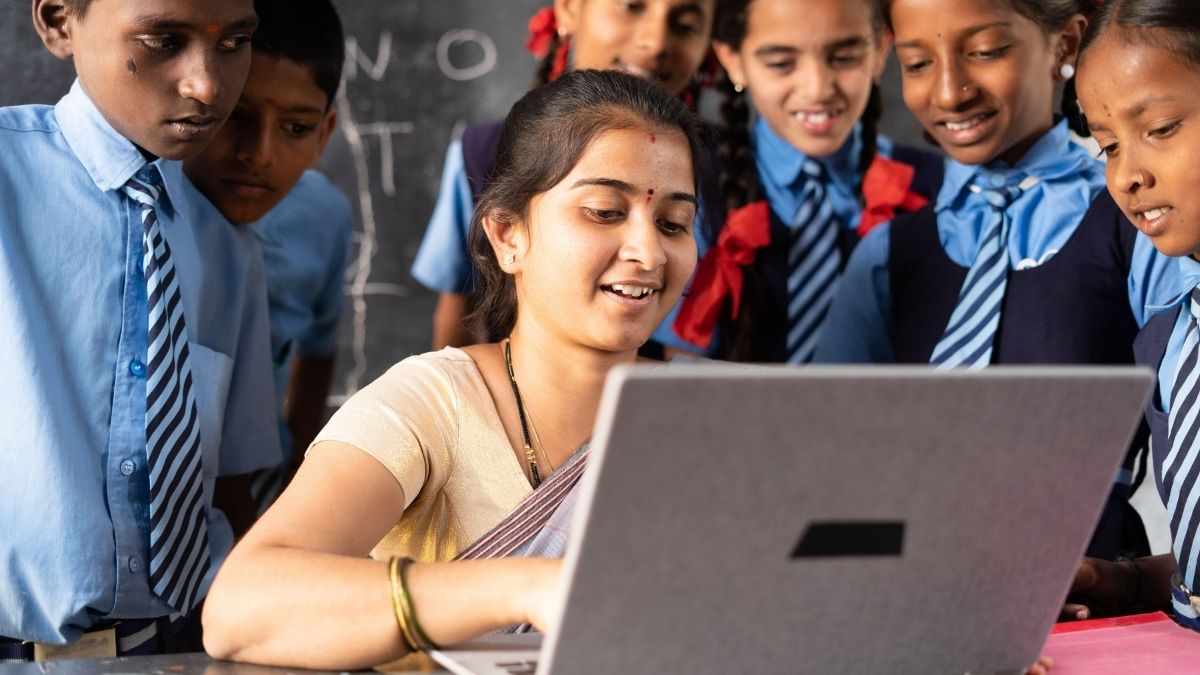
India’s push for tech-driven education highlights the gap between ambition and school-level readiness
Even as India supposedly races to prepare its children for an AI and robotics-driven future, the country’s schools continue to struggle with the basic conditions needed for effective learning, mainly due to the amount allocated for education in Union and State budgets each year, which is pittance compared to the amount needed and more so for the government schools to bridge the technogical gaps with some of the leading private schools, which remain out of the reach of an overwhelming majority of Indian families.
In face of such poor financing, the government’s self-proclaimed ambition to introduce advanced technology in classrooms, including Chhattisgarh’s plans for tribal schools, is fallacious. In reality, most schools in India, face chronic teacher shortages, limited digital access and persistent learning gaps, exposing a widening disconnect between India’s technological ambitions and the realities faced by millions of students.
In Chhattisgarh’s case, the programme builds on the state’s earlier partnership with Magic Bus India Foundation to introduce robotics and AI-based skill education in 800 government schools, initially in Kanker and Kondagaon, with around 1,600 teachers to be trained and 40,000 students targeted.
Also Read: India’s shrinking classrooms expose cracks in school education
The state has also announced an AI Mission with an allocation of INR 5 billion over five years, along with plans for AI awareness programmes and AI and Robotics Clubs in educational institutions.
On paper, the announcements fit neatly into India’s larger ambition of becoming a technology-driven economy. But in reality, they expose an uncomfortable mismatch between what India wants its children to learn and what many schools are currently equipped to teach.
Anil Bansal, an educationist at Udemy, an online learning platform based in Gurugram, says the focus needs to move beyond putting advanced technology into classrooms and towards creating the conditions in which students can actually use it.
“There is a tendency to assume that if we put a robot, a computer or an AI tool in front of a child, learning will automatically follow. It does not work that way. Technology can amplify good teaching, but it cannot compensate for the absence of teachers, weak foundational skills or poor infrastructure. If a child is still struggling to understand a basic mathematical concept, giving that child a robotics kit does not solve the learning problem. It simply puts sophisticated technology on top of an unfinished foundation,” Bansal tells Media India Group.
Robotics before enough teachers
India had 1,04,125 single-teacher schools in 2024-25, according to the Ministry of Education’s Unified District Information System for Education Plus (UDISE+).
The number has fallen from previous years, but the fact remains that even now over 100,000 schools still depend on a single teacher. Chhattisgarh alone recorded 5,840 single-teacher schools in 2023-24, where more than 200,000 students have enrolled.
The contradiction is even more striking in tribal areas, where the state continues to recruit teachers under the Tribal Cadre. Chhattisgarh’s own Tribal Department has acknowledged difficulties in providing teachers for mathematics, science and English in remote areas.
These are not peripheral subjects. They are precisely the foundations on which robotics and AI education depend.
A child cannot meaningfully learn robotics without mathematics, logical reasoning and science. A school cannot meaningfully offer AI education without teachers capable of teaching it. A robotics laboratory cannot function simply because equipment has been delivered to the school.
Also Read: 46 million children out of school as India’s education spending stays below 6 pc target: UNESCO
Bansal points out that teacher training must therefore be treated as a central part of technology education rather than an accompanying activity.
“Training 1,600 teachers is a useful starting point, but the real question is what happens after the training programme ends. Teachers need continued support, lesson plans, troubleshooting help and opportunities to build their own confidence with these technologies. In a remote school, one teacher may already be handling several subjects and multiple classes. Asking that teacher to suddenly become a robotics instructor without sustained support can turn an ambitious programme into an additional burden,” says Bansal.
India’s technology push increasingly risks treating hardware as a substitute for educational capacity.
Computers and internet are still not universal
The digital foundation of India’s schools is also incomplete.
UDISE+ 2024-25 shows that 64.7 pc of schools had computer access and 63.5 pc had internet connectivity. Among government schools, internet access stood at just 58.6 pc, compared with 77.1 pc in private unaided schools. Electricity was available in 93.6 pc of schools.
These figures represent considerable improvement, but they also mean that a large number of schools still lack the infrastructure required for technology-led education.
The problem becomes greater when the nature of AI and robotics education is considered. Computers need to function. Internet connections need to be reliable. Robotics equipment requires maintenance and replacement parts. Software requires updating. Teachers need training.
“We should also distinguish between access and usable access. A school being officially connected to the internet does not necessarily mean that a classroom can run an AI lesson smoothly. If the connection is unreliable, there are too few computers for the number of students, or equipment cannot be repaired when it breaks, the technology becomes occasional rather than educational. Children need regular exposure to build competence. A one-hour demonstration once in a while cannot create the same learning outcome as sustained access,” says Bansal.
Without these conditions, a robotics kit can become little more than another piece of equipment gathering dust after a launch ceremony.
This is particularly relevant to tribal schools, where physical distance can make maintenance, connectivity and access to technical support more difficult.
Also Read: Education quality severely impacted by high AQI in Delhi
From mobile laboratories to permanent learning
Chhattisgarh’s Bhawna Didi Ki Science Pathshala, a mobile laboratory taking AI, robotics, drones, Internet of Things technology, coding and 3D printing to government schools, demonstrates the state’s attempt to overcome some of these limitations.
Such initiatives can give children valuable first exposure to technology. But they cannot be confused with creating a permanent technology education system.
A child who sees and operates a robot during a short camp has experienced technology. A child who can repeatedly access equipment, work with a trained teacher and develop increasingly difficult projects is learning technology.
The distinction matters because India has become increasingly comfortable measuring technological education through the number of laboratories, clubs, workshops and beneficiaries announced.
The harder measure is whether children actually acquire the skills needed to build technology themselves.
The Galgotias warning
The recent Galgotias University controversy at the India AI Impact Summit 2026 provides a useful warning about this distinction.
A commercially available Unitree Go2 robotic dog was presented at the summit as an apparent indigenous creation called ‘Orion’. The robot’s actual origin was subsequently identified, leading organisers to ask the university to vacate its stall. The university tried to cover up saying that it had not manufactured the robot and said students were being trained with such technology with the eventual objective of developing similar systems domestically.
India could end up replicating the optics of technological progress across thousands of classrooms, with robots, AI clubs and laboratories providing impressive photographs and launch announcements without creating the deeper educational capability needed to sustain them.
Also Read: Need to ground India’s ambitions as global education hub in reality
The basics are still unfinished
India’s learning crisis makes the sequencing of this technological ambition even more important.
Annual Status of Education Report (ASER) 2024 showed that learning outcomes have recovered from the disruption caused by the pandemic, but significant gaps remain in basic reading and arithmetic.
These foundational abilities cannot be treated as separate from AI education.
Robotics requires mathematics. Coding requires logical thinking. AI requires an understanding of data and science. All of these require students to first develop the ability to read, understand instructions, calculate and solve problems.
Bansal argues that foundational learning and technology education should not be viewed as competing priorities. “It is not a choice between teaching children to read and teaching them AI. The first enables the second. A child who can read confidently, understand a problem, reason through it and work with numbers is far better positioned to learn coding or robotics later. If we skip those steps because AI sounds more futuristic, we may actually make it harder for children,” adda Bansal.
The problem, therefore, is not that Indian children are being introduced to robotics.
The problem is that India risks introducing robotics without building the educational foundations that allow children to actually master it.
There is also a funding question. India has long aspired to spend 6 pc of Gross domestic product (GDP) on education, but public spending has remained below that target. At a time when schools still require investment in teachers, classrooms, learning materials and basic infrastructure, expensive technology programmes need to demonstrate that they are improving learning rather than simply adding another layer of hardware.
If India wants children to build robots rather than merely pose beside them, it must first build the schools, teaching capacity and foundational learning that make technological capability possible. Otherwise, the country risks replicating the Galgotias problem at a nationwide level, impressive technology on display, but limited capacity to create it or even use it.