
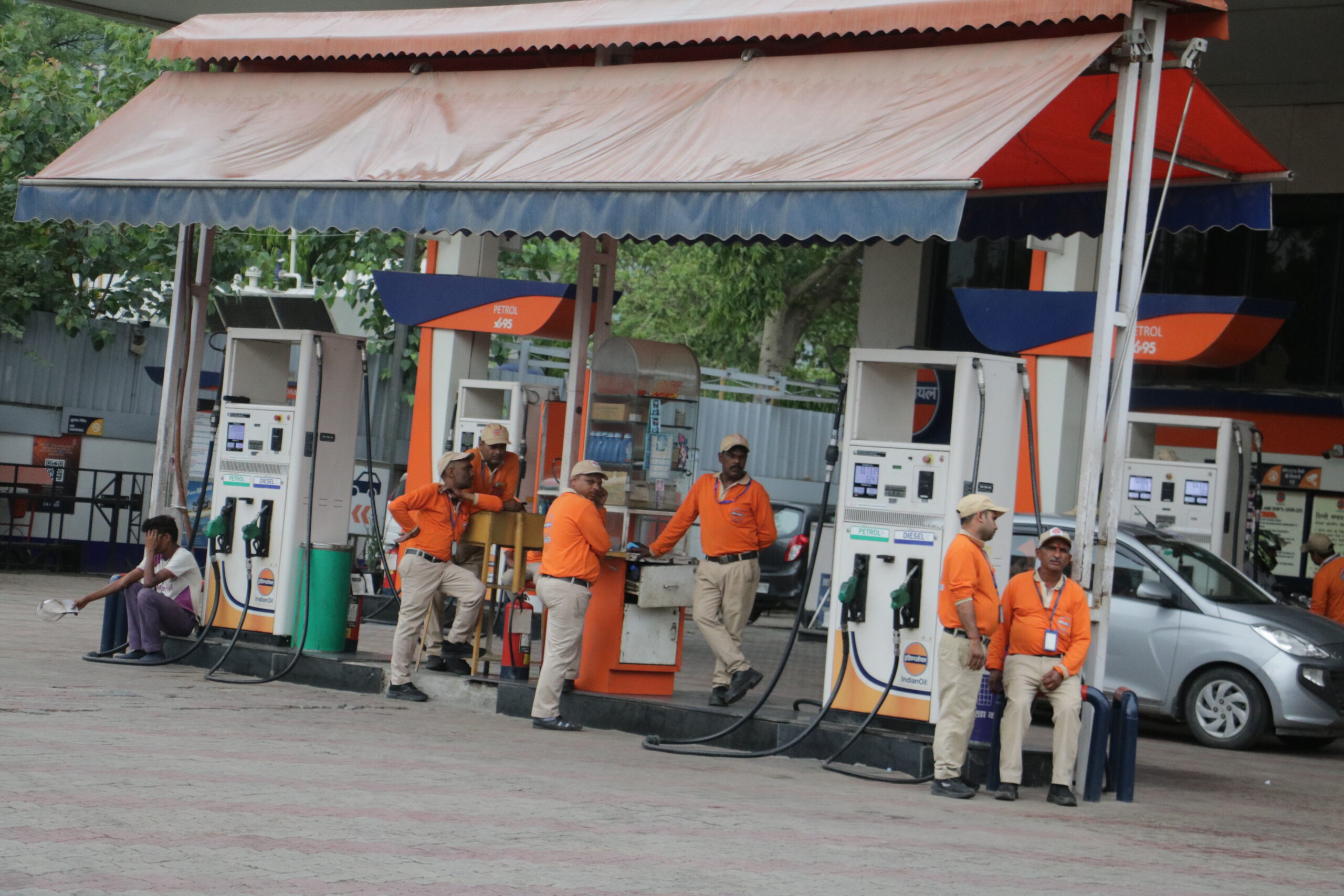
350.org and its partners have called on Asian governments to impose windfall taxes on profits of oil and gas companies and accelerate the transition to renewable energy to contain rising energy costs (Photo: Sunil Yadav)
As the Iran conflict enters its second month, climate advocacy group climate campaign group 350.org and its partners have called on Asian governments to impose windfall taxes on profits of oil and gas companies and accelerate the transition to renewable energy to contain rising energy costs.
In a press statement, 350.org says that the call comes amid sharp increases in global fuel prices, with consumers and businesses in Asia losing an estimated USD 111 billion in the first month of the conflict due to oil and gas spikes.
Also Read: 350.org slams Trump for USD 1bn payout to TotalEnergies for US offshore wind exit
The statement adds that major fossil fuel companies, including Chevron, Shell and Exxon Mobil, are expected to record significant gains during the same period.
Campaigners have urged governments to introduce windfall taxes on excess profits and use the revenue to support households and vulnerable sectors. Proposed measures include targeted bill support, direct cash transfers, subsidised electricity tariffs for low-income households, and free public transport.
Some countries have already taken steps in this direction. Lawmakers in the Philippines have proposed a windfall tax on oil companies, while India has reinstated a tax on oil exports. Following the Russia-Ukraine War, the United Kingdom imposed a windfall tax on energy producers, raising around GBP 12 billion in 2024 to support its Energy Price Guarantee scheme, says the statement.
The organisation says that alongside taxation measures, campaigners have stressed the need to accelerate deployment of decentralised renewable energy systems. These include solar mini-grids, rooftop solar installations, clean cooking technologies and electric public transport, which can be implemented faster and reduce dependence on imported fuels.
Also Read: 350.org urges World Bank & IMF to deliver climate justice
It adds that the rising liquefied natural gas prices have added to the urgency. In Asia, LNG prices have increased by 143 pc since the conflict began, according to the Institute for Energy Economics and Financial Analysis. The group estimates that 1 gigawatt of solar capacity could save countries about USD 3 billion in LNG import costs.

Sisilia Nurmala Dewi
Campaigners have called for emergency energy funds and development financing to be redirected towards renewable energy projects, with a focus on improving access, reducing long-term costs and limiting exposure to global fuel price volatility.
“The Indonesian people pay for the hidden costs of fossil fuels, not just through our energy bills, but through taxes that go towards subsidies and climate damages. President Prabowo’s directive to build 100GW of solar power to build energy independence is a step in the right direction. But the energy transition must not be a burden to low and middle-income communities it must be paid for by coal, oil and gas companies through windfall taxes,” says Sisilia Nurmala Dewi, Country Manager, Indonesia.

Amanullah Porag
“We are witnessing the real cost of fossil fuel dependence. A conflict thousands of kilometres away is rapidly undermining economic stability in Bangladesh. Our people should not have to pay for a crisis they did not cause. Governments must act now to tax fossil fuel windfall profits, protect consumers from price shocks, and invest in decentralised renewable energy at scale. Energy security for Bangladesh will not come from imported fuels, but from building systems we can control,” says Amanullah Porag, Coordinator, Bangladesh.

Fread de Mesa
“Despite its short-term framing, the Philippine government’s state of national energy emergency declaration contains language that echoes what climate activists have been raising for years. By calling for reduced dependence on petroleum and the scaling of renewables, the government is implicitly acknowledging that clean energy must be central to our long-term resilience. Renewables from community-led solar to distributed wind and efficiency measures offer not just climate benefits but energy independence, price stability, and greater protection for everyday Filipinos from the ripple effects of global crises. This moment is an opportunity to pivot from reactive crisis response to a proactive, structural transformation of our energy system,” says Fread de Mesa, National Coordinator, the Philippines.

Omkar Subedi
“Today’s energy crisis deepens inequities that stem from decades of dependence on coal, oil, and gas. The answer is not more of the same. It is high time we focus on renewable energy solutions that put communities at their core and prioritize people over profits. Nepal must invest in homegrown renewable energy solutions that are affordable and locally owned. When communities control their energy resources, we secure not just our energy needs but also social and climate justice that ensures no one is left behind,” says Omkar Subedi, Campaign Officer, Digo Bikas Institute in Nepal.

Masayoshi Iyoda
“Japan should accelerate renewable energy deployment and improve energy efficiency, instead of continuing to rely on unstable fossil fuels and dangerous nuclear energy. Consumers have been at the mercy of imported fossil energy for far too long. The window of opportunity to permanently insulate Japan from oil and gas price shocks and keep its climate commitment is wide open. The Takaichi administration should take this opportunity, or risk falling behind further on its promises of energy independence and lower energy costs,” says Masayoshi Iyoda, Campaigner, Japan.
